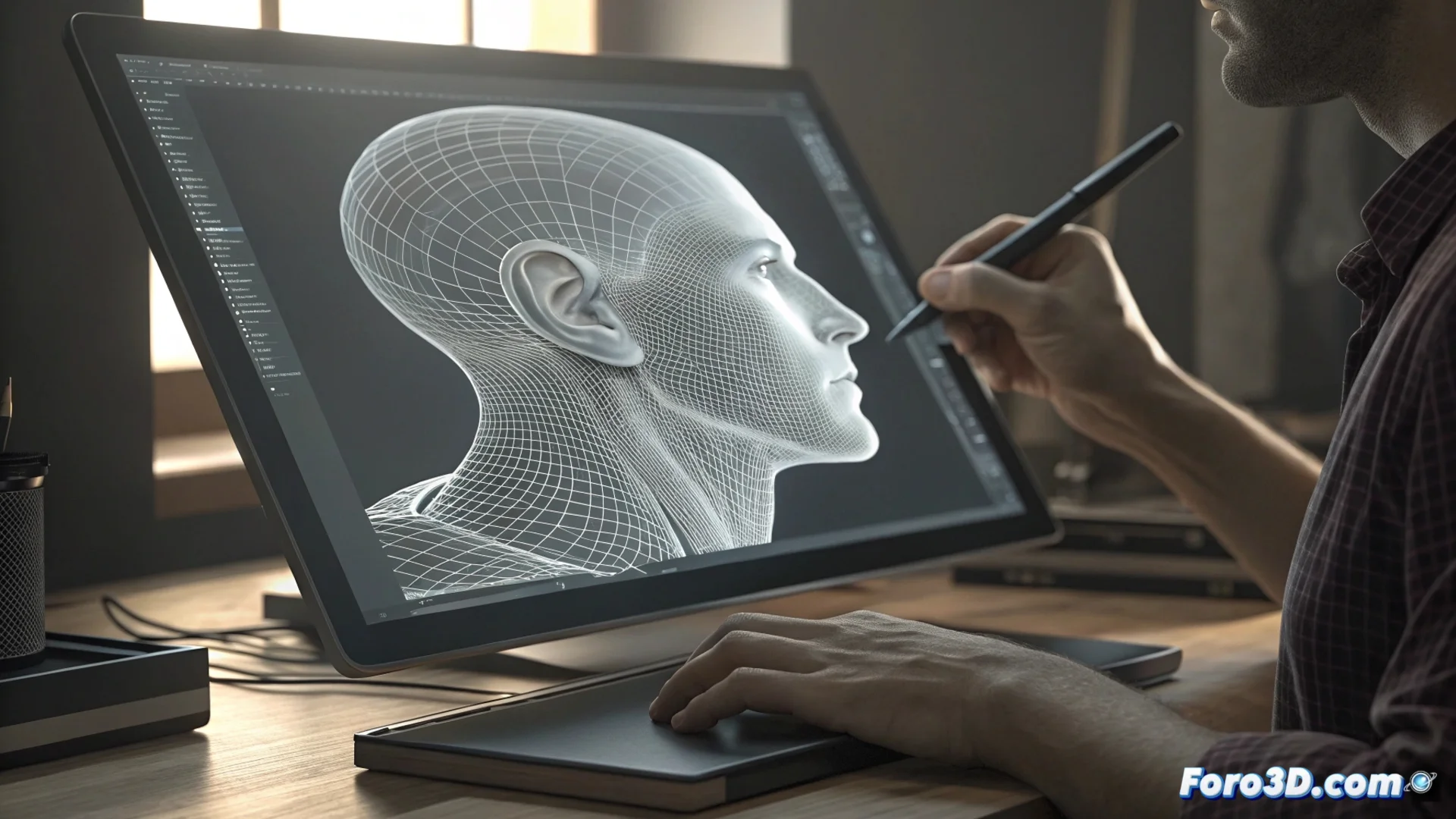
Silo Implements Focus Modeling to Isolate Polygons
The 3D modeling program Silo stands out for integrating a working approach called Focus Modeling. This methodology is designed so that the artist focuses their attention solely on the area of the mesh they are modifying, temporarily isolating polygons to manipulate the geometry with greater agility and precision. 🎯
The interface dynamically adapts to the active area
When activating focus mode on a section of the mesh, the program's environment responds by hiding or attenuating the rest of the unselected geometry. This not only makes it easier to visualize the vertices and edges being worked on, but also makes the sculpting or transformation tools respond more efficiently. The user can break down a complex volume into manageable parts, without the full model interfering during manipulation.
Key advantages of isolating polygons:- Eliminates visual distractions by attenuating unselected geometry.
- Simplifies the selection process in high-density meshes.
- Optimizes the performance of sculpting and transformation tools.
Some artists comment that, after using this method, it's hard for them to go back to programs where selecting a single polygon in a dense mesh feels more like looking for a needle in a digital haystack.
A workflow that accelerates iteration and detail
This way of working promotes a fast iterative process. The artist can refine a specific area, exit focus mode to evaluate the whole, and isolate another area fluidly. It is especially useful for tasks like adjusting local topology, defining facial features, or fine-tuning folds in clothing, as the tools only affect the visible and active polygons.
Ideal tasks for focus modeling:- Adjusting and refining the topology of specific areas.
- Defining facial features with a high level of detail.
- Creating realistic folds and wrinkles in clothing.
Impact on artistic productivity
Silo's Focus Modeling system offers more direct control and a more agile software response. By allowing the breakdown of complex models, artists can work with greater precision without being overwhelmed by the global geometry. This methodology represents a significant change in how dense mesh modeling is approached, prioritizing clarity and efficiency in every step. 🚀