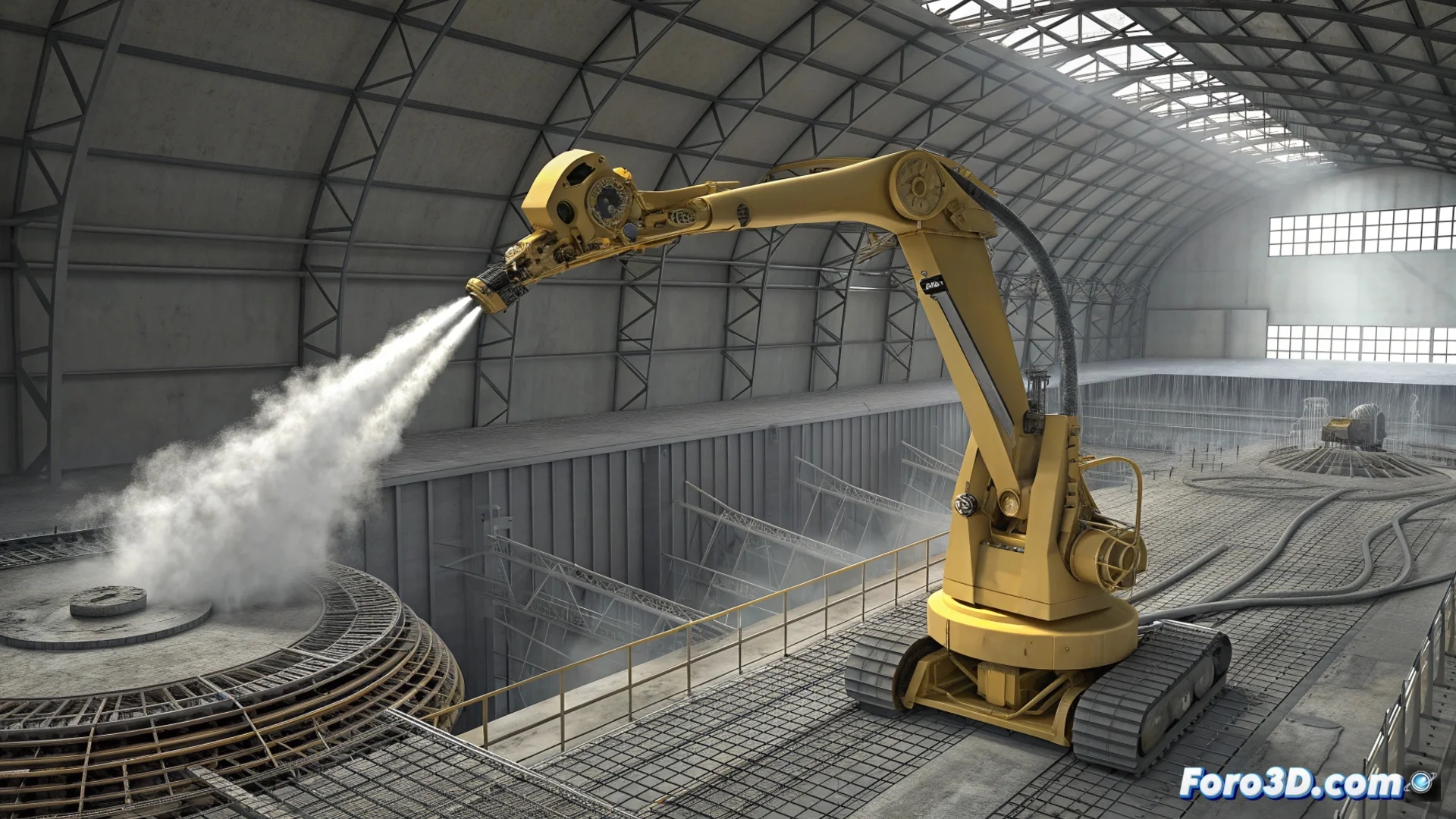
Shimizu Corporation develops a 3D printing system for concrete
The Japanese company Shimizu Corporation is addressing its nation's demographic and labor challenges with an advanced technological solution. To mitigate the impact of an aging population and a shortage of skilled workers, the firm has directed its resources toward a novel additive manufacturing technique. This method, which is based on spraying material, has been designed to produce large-scale concrete components with curved geometries and internal reinforcement. 🏗️
A dual process: spraying and reinforcing simultaneously
Shimizu's technology does not only focus on depositing concrete. The procedure integrates two synchronized work units. One robotic arm is responsible for spraying and layering mortar to shape the piece, while a second arm automatically and simultaneously places the steel reinforcement inside the growing structure. This approach enables the fabrication of complex, high-strength elements in a single uninterrupted operation, shortening timelines and reducing the need for labor-intensive work.
Key features of the system:- Uses two coordinated robotic arms for a continuous workflow.
- Sprays mortar and places steel reinforcement simultaneously.
- Allows creating large-scale pieces with curved and non-standard shapes.
Automation aims to transform how certain architectural elements are built, making the process more efficient and adaptable.
Objectives and potential applications
By implementing this system, Shimizu intends to revolutionize the production of structural components. The ability to manufacture curved and pre-reinforced pieces directly on-site or in a workshop can accelerate projects and unlock new design opportunities. The company envisions its use in infrastructure such as tunnels, bridges or building parts that require special geometries.
Visualized areas of application:- Components for tunnels and underpasses.
- Structural elements for bridges and viaducts.
- Building parts with complex architectural designs.
The future of robotic construction
This innovation represents a significant step toward a more automated construction. Although tomorrow's construction robot will not suffer from fatigue, it will require maintenance and precise software updates to avoid failures when executing tasks. Shimizu's approach demonstrates how technology can offer concrete solutions to pressing social and economic problems, laying the foundations for a more agile construction industry less dependent on traditional labor. 🤖