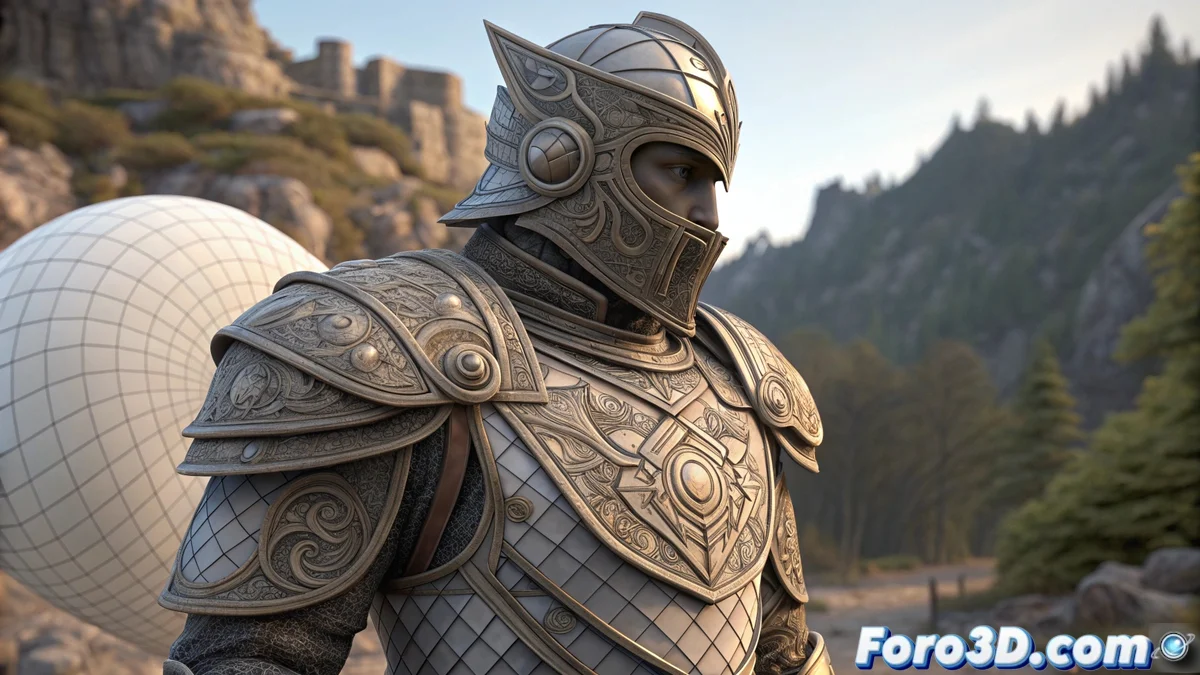
Shell Vertex Baking to Optimize Complex Models in Video Games
In video game development, managing highly detailed 3D models can consume a lot of resources. An effective technique to address this is shell vertex baking. This method takes a model with high polygon density, such as an intricate armor, and generates an extremely simplified version, known as a shell or envelope. The key process is to bake the normal information from the original model directly into the vertices of this shell. Thus, the game engine works with a lightweight mesh, but when rendering the image, the data stored in the vertices recreates the illusion of surface complexity. 🎮
Workflow to Implement Shell Vertex Baking
To apply this technique, a specific workflow is followed. First, the high-resolution model is required, and its corresponding low-resolution shell must be produced. Then, specialized baking software such as Substance Painter, Marmoset Toolbag, or Blender is used to project the normal maps. The fundamental operation consists of the software calculating how light incidents from the surface of the simple shell towards the detailed geometry. It captures this interaction in a vector map that is stored not in a texture, but in the shell's vertices themselves. Finally, a shader in the engine, often a vertex shader, reads this vector data and modifies the normal of each pixel during rendering, generating shadows and lights that suggest relief.
Essential Steps of the Process:- Prepare the detailed model and its low-poly counterpart (the shell).
- Use a baking tool to transfer normal data to the shell's vertices.
- Set up a custom shader in the game engine that interprets the baked data in the vertices.
The real art lies in creating a shell so simple that the engine loves it, but so smart that the player never notices the trick.
Ideal Applications and Technical Considerations
This solution is particularly useful for objects with small and repetitive geometric detail. It is excellent for representing dragon scales, mechanical panels, reliefs on armors, or irregular rocky surfaces. It works optimally on models that do not deform excessively, as the low-resolution shell is usually rigid. Its implementation allows drastically reducing the number of polygons the GPU must process per frame, which is crucial for maintaining high frame rates.
Limitations to Consider:- The visual effect may degrade if the player views the model from very grazing or extreme angles.
- If the shell is too simple and does not capture the overall volume of the original model, the illusion breaks.
- It consumes more vertex memory than traditional normal baking into textures, as the information is stored per vertex.
- It is not suitable for characters or objects animated with large mesh deformations.
Evaluating When to Use This Technique
Deciding to use shell vertex baking depends on the project context. It is a powerful tool within the set of optimization techniques. It should be chosen for static assets or those with rigid movement where surface detail is a priority. The key to success lies in finding a balance: the shell must have enough polygons to define the basic silhouette and volume, but be lightweight enough to offer significant performance gains. By mastering this balance, the player's perception is deceived, showing complexity where there is computational simplicity. 🛠️