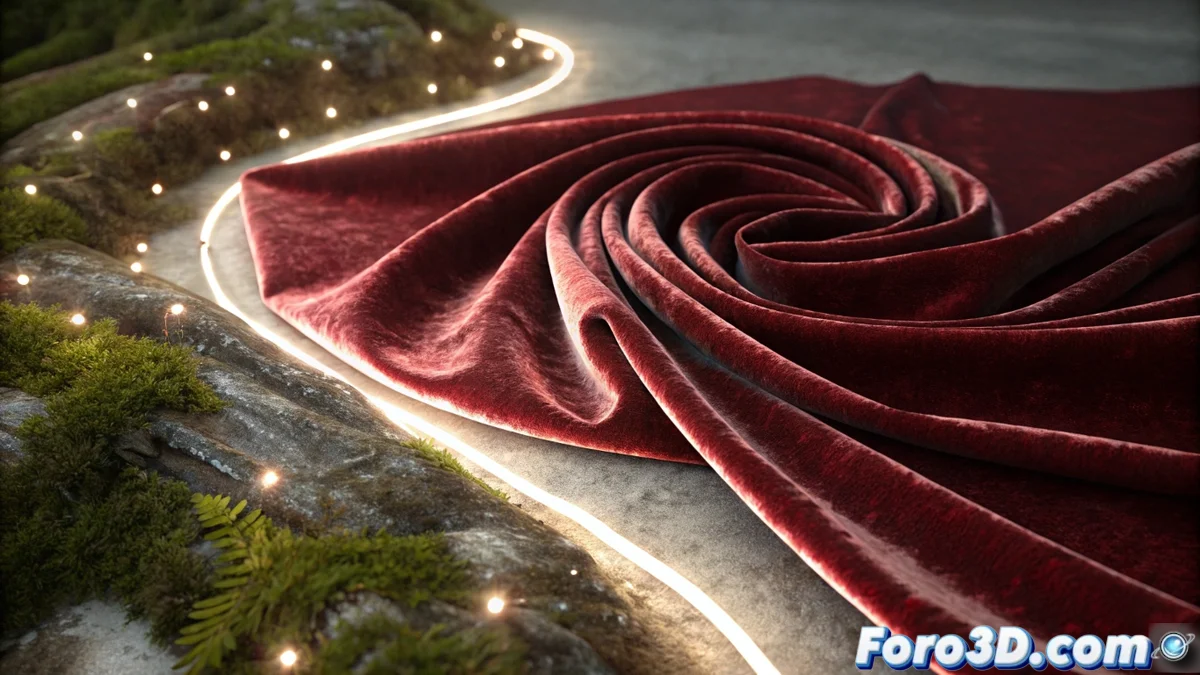
Sheen Layering in PBR: The Velvet Sheen Layer
In the realm of high-fidelity Physically Based Rendering (PBR), there is a specialized technique that goes beyond conventional reflectance models. It is Sheen Layering, an additional component designed to capture the complex light interaction with microscopically disordered surfaces or dense fields of tiny fibers. This layer does not contribute the primary color of the material, but generates a visual effect of soft scattering, creating that characteristic silky and diffuse sheen that is especially prominent when viewing surfaces at a glancing angle. It is the secret behind the tactile realism in many organic and textile materials. 🧵
The Inner Workings of the Sheen Layer
This layer operates as an independent shader module that integrates and adds its contribution to the final rendering result. It uses its own parameters, such as a color map (often in light tones or with a slight tint) and an intensity control. Its calculation is view-angle dependent, meaning its strength increases dramatically at object contours and areas away from the viewer, generating a subtle halo or perimeter luminosity effect. The key to effective use lies in precise control of its weight within the material; its purpose is to enhance and add verisimilitude, not to dominate the visual appearance and create an unaesthetic saturation.
Key Features of Its Implementation:- Angular Calculation: Its intensity is evaluated based on the view vector, being maximum at grazing angles of incidence.
- Dedicated Resources: It typically uses its own texture maps for color and intensity, separate from the base color and roughness maps.
- Non-Linear Summation: Its contribution is combined, typically additively, with the diffuse (Lambert) and specular (GGX) reflectance components, enriching the BRDF model.
"The Sheen layer does not attempt to simulate the primary color, but the light trapped and chaotically bouncing in a forest of micro-fibers. It is the difference between a flat fabric and one that invites you to touch."
Essential Materials and Application Contexts
The main utility of this technique is the authentic representation of materials whose surface structure is composed of countless micro-fibers or exhibits high porosity and disorder. It is practically indispensable for simulating textiles like velvet, fleece, carded wool, or felt, where light penetrates slightly and scatters between the fibers. It is also essential for realistically recreating moss, a layer of fine dust, certain matte-finish plastics, or the eroded and worn edges of objects. Omitting this layer in these materials results in an excessively flat and artificial appearance under side or rim lighting, completely losing the sense of depth and tactile quality that defines them. 🌿
Concrete Usage Examples:- Luxury Textiles: Velvet, duchess satin, high-pile carpets, where the sheen changes with the observation angle.
- Organic Surfaces: Moss, wet grass, the skin of certain fruits like peach (peach fuzz).
- Wear and Dirt Effects: Dust accumulated on a surface, fuzzy edges of an old plastic object.
- Special Synthetic Materials: Certain diffuse plastics or coatings that mimic tactile sensations.
The Importance of Artistic Judgment and Moderation
As with any powerful tool in computer graphics, the greatest risk is excessive and indiscriminate use. Applying an intense Sheen layer to materials like concrete, polished metal, or glass can turn a realism-seeking scene into a dreamlike and unconvincing panorama, where everything seems covered in luminous fuzz. Moderation and artistic judgment are fundamental. This technique is a realism enhancer for specific materials, not a magic filter to apply globally. Its implementation must be conscious and selective, reserved for those cases where the surface's micro-geometry physically justifies that soft light scattering behavior. Mastering its use is another step toward creating renders with impeccable depth and materiality. ✅