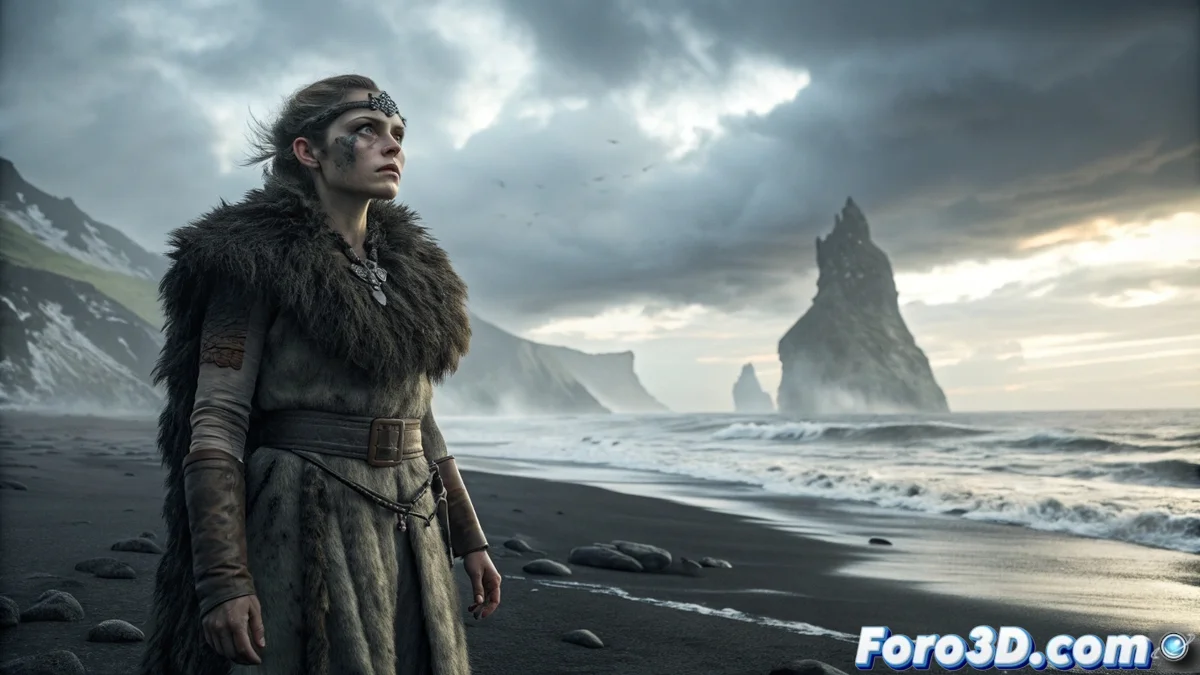
Senua's Saga: Hellblade II Unleashes the Power of Unreal Engine 5
The upcoming title from Ninja Theory, Senua's Saga: Hellblade II, stands as a visual testbed for Unreal Engine 5. This latest-generation graphics engine allows the team to develop a visual section with overwhelming detail, pushing the boundaries of photorealism in video games to a new level. 🎮
The Technical Foundations of Photorealism
To build its world, Hellblade II relies on two fundamental pillars of UE5: Nanite and Lumen. Nanite processes micro-polygon geometry, enabling environments with massive geometric complexity without drastically penalizing performance. For its part, Lumen handles global illumination and reflections in real time, making light and shadows react dynamically and credibly to every element in the scene.
Key Features of Unreal Engine 5 in the Game:- Nanite: Manages assets with billions of polygons, allowing rocks, grass, and structures with unprecedented detail.
- Lumen: Generates real-time global illumination, creating oppressive and natural atmospheres that change instantly.
- World Partition: Efficiently manages the vast Icelandic landscapes, loading only what's necessary.
The combination of Nanite and Lumen not only makes the game look incredible but redefines how light and geometry interact in real time.
From the Real World to Digital: High-Fidelity Capture
Realism doesn't just come from the engine, but from the source. Ninja Theory employs a meticulous 3D scanning process for characters, capturing every detail of the actors, including their subtlest facial expressions. For environments, they resort to photogrammetry, taking thousands of photographs of real locations in Iceland that are then digitally reconstructed as ultra-detailed 3D assets.
Methodologies for Creating Realistic Assets:- 3D Character Scanning: Transfers the appearance and performance of human performers to digital models with millimeter precision.
- Landscape Photogrammetry: Converts Icelandic geography into digital scenarios with authentic textures and geometry.
- Binaural Audio: Implements 3D sound to direct the voices and whispers that Senua hears straight to the player, enhancing immersion.
The Balance Between Detail and Performance
The main technical challenge is not just achieving this level of detail, but making the game run smoothly. While players won't need cutting-edge hardware, a powerful graphics card will be key to experiencing the full visual fidelity. Hellblade II demonstrates how Unreal Engine 5 optimizes complex processes to deliver a visually spectacular and technically solid experience, setting a benchmark for the future of graphics in the industry. 🚀