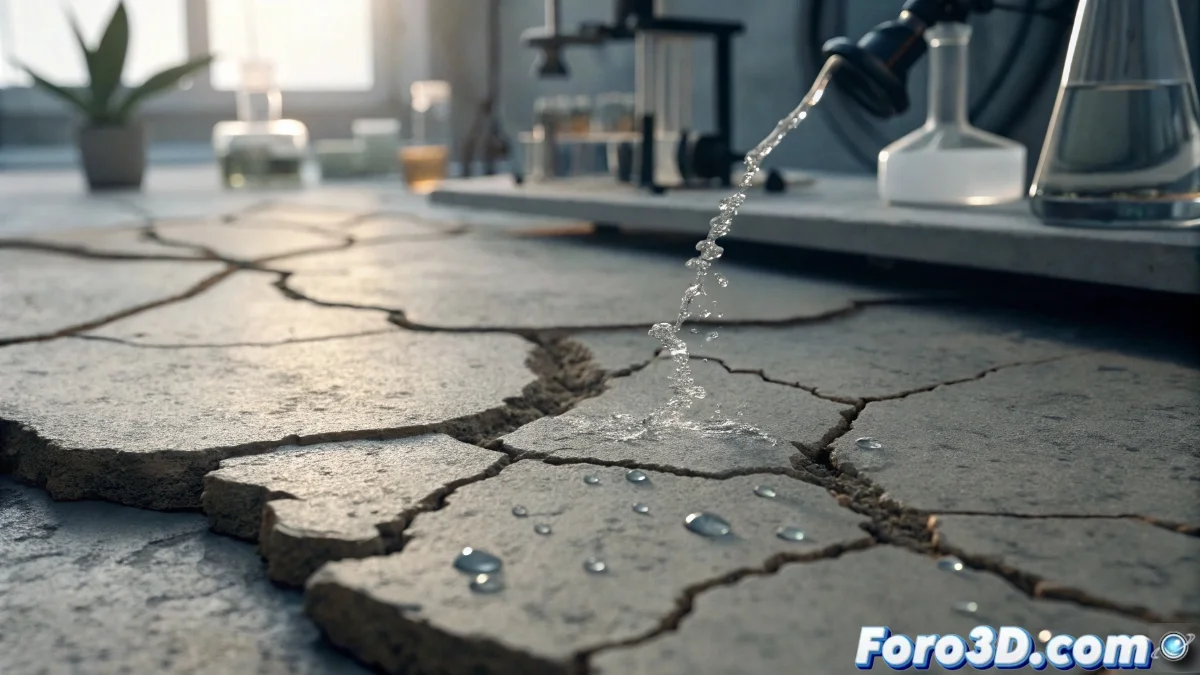
Self-Healing Concrete with Calcite-Producing Bacteria
Modern construction is undergoing a radical transformation thanks to materials with biological self-repair capabilities. This innovative concrete integrates specialized microorganisms that automatically restore structural damage 🦠.
Microbial Activation Mechanism
The system relies on biodegradable capsules that house bacterial spores in a latent state, distributed homogeneously within the cement mixture. When cracks form and water begins to infiltrate, these capsules break, releasing the repair microorganisms.
Key metabolic process:- Bacillus genus bacteria consume stored nutrients
- They initiate their metabolism producing calcium carbonate as a byproduct
- Calcite precipitates gradually, completely sealing the openings
Nature teaches us that the best solutions are often the most elegant: now concrete applies biological self-repair where we once only saw cracks.
Structural and Economic Advantages
This technology represents a significant advance for infrastructures that are difficult to access and maintain. Bridges, tunnels, and dams greatly benefit from this continuous self-healing capability 🏗️.
Main applications:- Drastic reduction in maintenance costs for critical structures
- Prevention of reinforcement corrosion by blocking water and chloride entry
- Extension of the service life of constructions in extreme conditions
Future of Smart Concrete
Current research focuses on optimizing bacterial survival in various climates and expanding the repair range for wider cracks. The potential for application in seismic zones and aggressive environments promises to revolutionize the durability of our constructions 🌍.