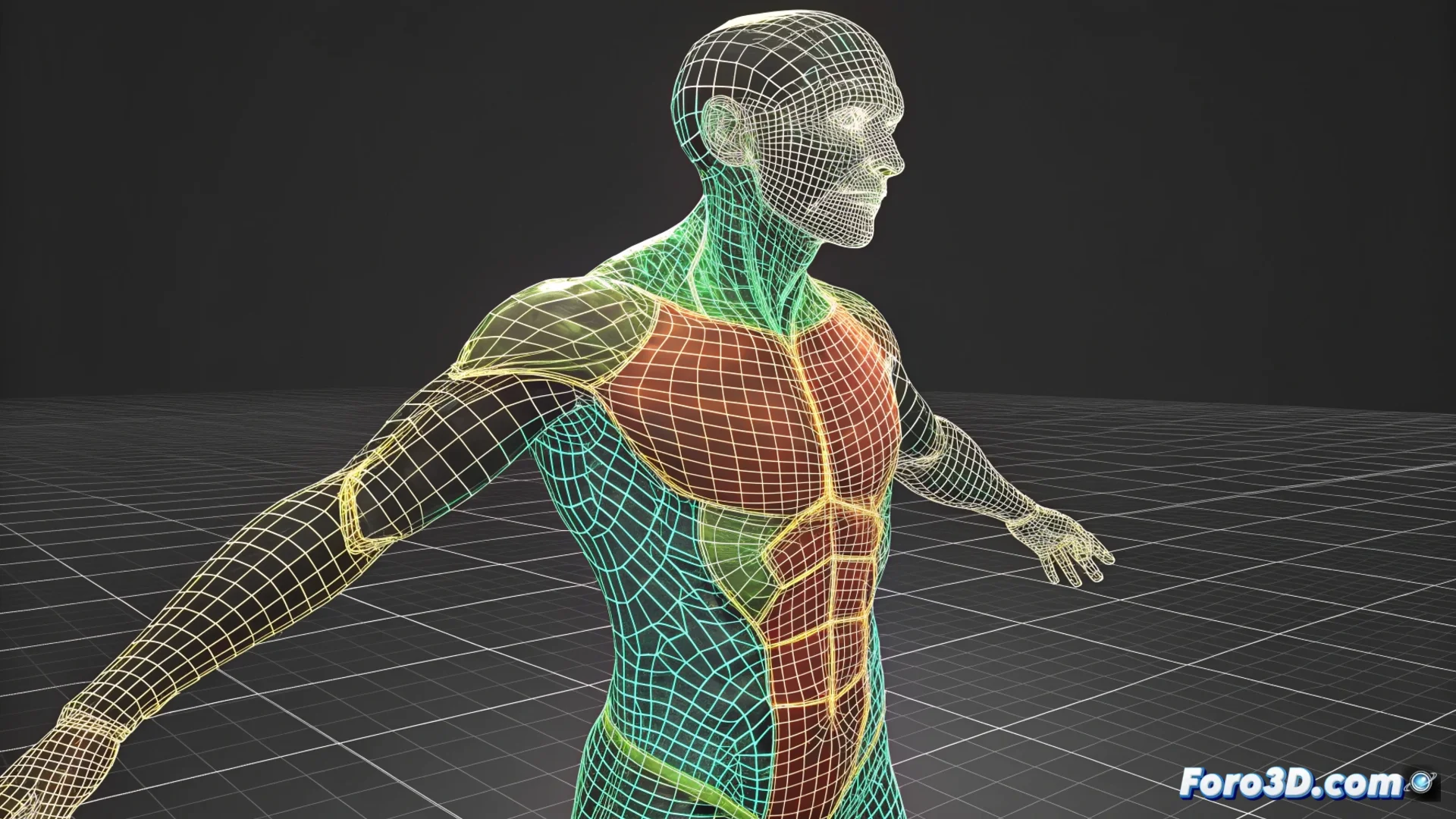
Segment 3D Meshes with the Watershed Algorithm
In the field of 3D graphics, there is a powerful technique that borrows a concept from geography to organize digital geometry. Known as watershed or water divide line, this method interprets a 3D surface as a landscape, where its geometric attributes define the elevation. 🗺️
How does the topographic metaphor work?
The core of the process consists of analyzing an attribute map calculated over the mesh. While curvature is usually the main metric, distance from a specific point or density values can also be used. Areas with low values, analogous to valleys, are marked as receiving basins. The algorithm then simulates a flood starting from these minima; the boundaries between segments emerge naturally where the "waters" from adjacent basins collide, creating a clean and automatic division of the geometry.
Key advantages of applying watershed:- Automate complex subdivisions: Identifies anatomical regions or logical components without initial manual intervention.
- Consistency in symmetric models: Applies the same segmentation logic to repeated parts, ensuring uniformity.
- Accelerate subsequent workflows: The pre-divided mesh serves as an ideal base for subsequent stages.
Watershed segmentation transforms a continuous model into a set of distinguishable parts, establishing boundaries where the geometry suggests a natural change.
Practical applications in a production pipeline
This ability to automatically divide a model finds its utility in tasks that usually consume a lot of time. For example, when unwrapping UVs, each defined segment can be directly converted into a UV island, drastically reducing the work of manually cutting and unfolding the mesh. In rigging and animation, painting weights for bones becomes more intuitive and faster when areas of influence are already delimited by coherent regions, such as fingers, legs, or panels of a mechanical model.
Considerations and limitations:- May generate too many regions: On surfaces with a lot of detail or noise, the algorithm can create an excessively fine segmentation.
- Requires parameter adjustment: The choice of attribute (mean curvature, Gaussian) and its filtering are crucial for obtaining a useful result.
- Manual merging afterward: Sometimes, the artist needs to consolidate small segments, which may be perceived as counteracting the automation.
Evaluating its utility in real projects
Implementing the watershed algorithm represents a valuable tool for optimizing repetitive processes. Its strength lies in interpreting geometry objectively and reproducibly. However, its success depends on properly preparing the input data and understanding that it does not always completely replace artistic judgment. When configured correctly, it achieves an ideal balance between automation and control, freeing up time for more complex creative tasks. ⚙️