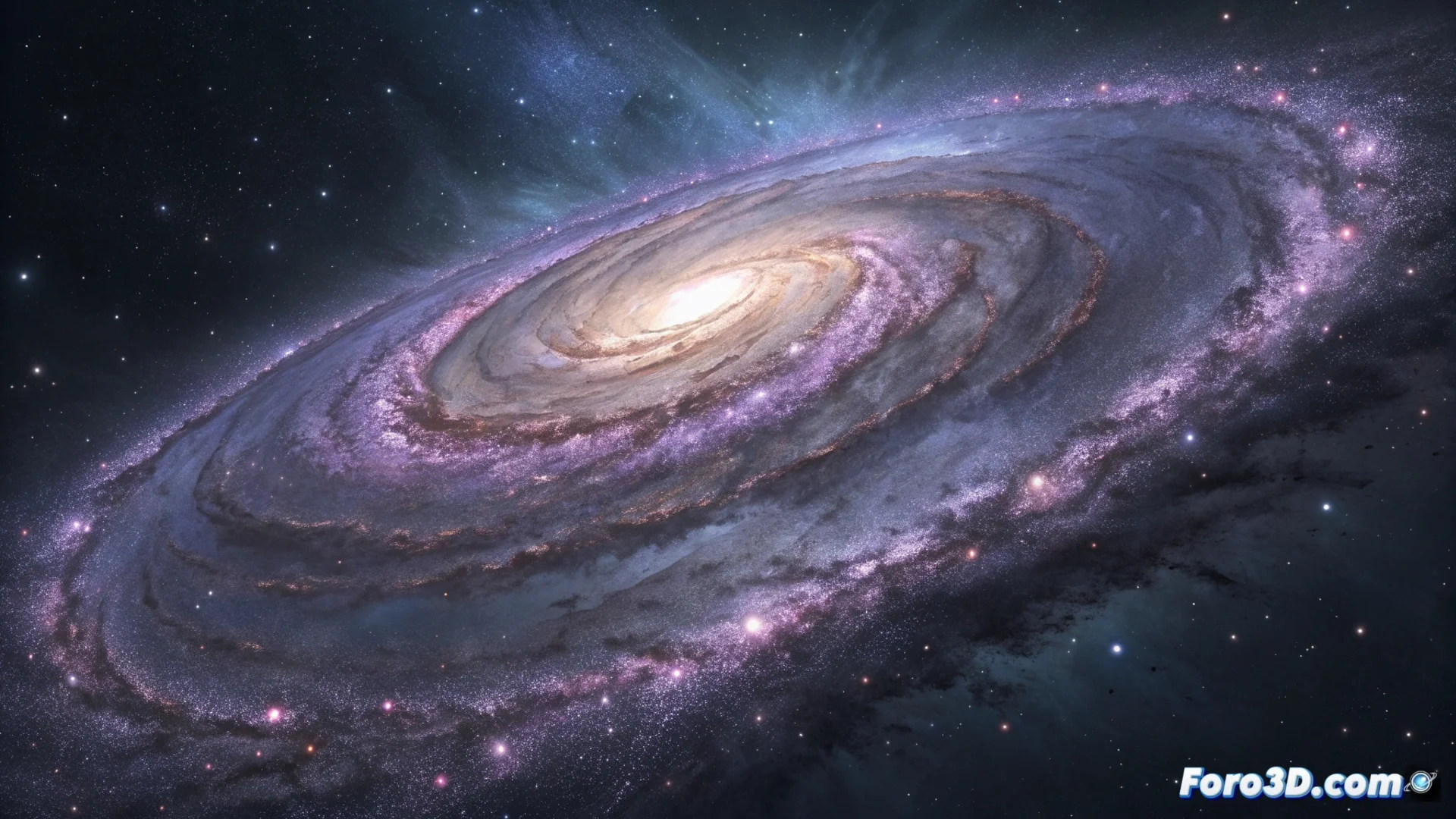
Scientists Suggest Dark Matter Nuggets Explain Ultraviolet Glow
A team of researchers proposes a novel explanation for a persistent mystery in our galaxy: the origin of a diffuse far-ultraviolet light glow detected by space telescopes throughout the Milky Way. Instead of attributing it to ordinary stars, the hypothesis points to hypothetical and compact dark matter objects, called nuggets or clumps. These could emit photons when interacting, a process not fully accounted for in current astrophysical models. 🔭
Dense Clumps as Sources of Invisible Radiation
These dark matter nuggets are conceptualized as macroscopic objects with extreme density. The theory suggests that, upon colliding with each other or gradually disintegrating in the interstellar medium, they would release energy. This energy release would manifest precisely as the diffuse ultraviolet radiation measured by astronomers. The proposal is bold because it links two of cosmology's greatest enigmas: the fundamental nature of dark matter and the origin of a specific luminous signal in our galactic neighborhood. Confirming this would completely transform how we perceive the distribution and behavior of the invisible matter that makes up most of the universe.
Key characteristics of the proposed nuggets:- Macroscopic and compact objects, not individual subatomic particles.
- Composition of exotic dark matter particles.
- Ability to emit ultraviolet photons when annihilating or interacting.
The nuggets hypothesis connects two great mysteries: what dark matter is and why we see this specific pattern of light in our galaxy.
A Theory Competing with Established Explanations
This idea does not arrive in an empty field. The dark clumps hypothesis directly competes with other more conventional astrophysical explanations. Among these alternatives are emissions from populations of very low-mass stars or various physical processes occurring in the tenuous interstellar gas. The challenge for science now is to derive concrete and verifiable predictions from the nuggets theory that can be tested against new observations.
Next steps to validate or refute the theory:- Analyze more precisely the map of diffuse ultraviolet light distribution in the galaxy.
- Search for spatial correlations between the luminous signal and the expected distribution of dark matter clumps.
- Design specific experiments or observations that can detect unique signatures of these objects.
The Path to a New Understanding of the Cosmos
This case perfectly exemplifies how observational enigmas drive the scientific community to formulate bold and disruptive theoretical ideas. If future data support the nuggets idea, not only would the mystery of this ultraviolet glow be resolved, but it would open a completely new window to study dark matter more directly. In the meantime, the term has taken on a new meaning in astrophysical circles, demonstrating that science often thrives on unexpected concepts. 🪐