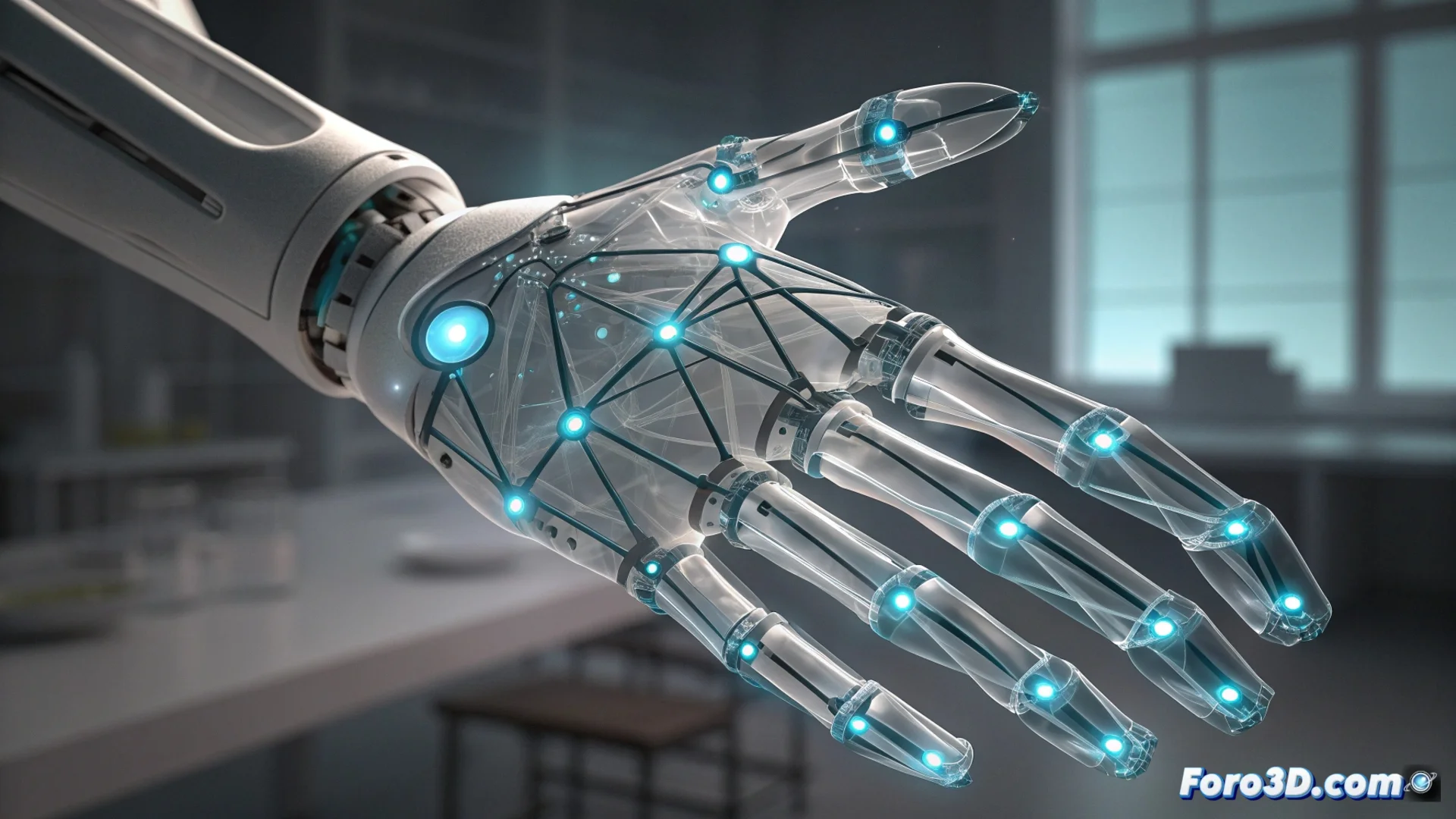
Scientists Develop Artificial Skin That Perceives Pain for Robots
The boundary between machines and living beings is blurring with a new advance in sensory robotics. A team of researchers has designed a prototype of neuromorphic artificial skin that gives robots the ability to perceive contact, pressure, and even a primitive form of pain. This system imitates how biological neurons transmit signals, opening doors to more organic and safe interaction. 🤖✨
An Artificial Nervous System for Machines
The technology is based on sensors that generate pressure data and encode it into electrical impulses. These impulses are processed in a computational architecture that partially emulates a nervous system. Instead of just registering a numerical value, the system interprets the stimulus intensity in a way more similar to a living organism, allowing the robot to react adaptively to the environment.
Key features of the prototype:- Neuromorphic encoding: Transforms pressure into electrical signals that mimic neuronal action potentials.
- Process tactile information: The architecture integrates data from multiple sensors to create a unified perception of contact.
- React in real time: The robot can adjust its movements instantly based on what its "skin" perceives.
This artificial skin not only feels, but interprets. The programmable pain threshold is equivalent to a withdrawal reflex for a robot, a crucial step for safe coexistence.
The Programmable Pain Threshold: Safety First
One of the most relevant innovations is the incorporation of a programmable pain threshold. When the applied or received force exceeds a predefined limit, the system activates a protective response. The robot can reduce its grip force or stop a movement completely. This function is essential to prevent a robot from damaging delicate objects or, more importantly, causing injuries to people during collaborative tasks.
Main applications of this technology:- Assistance for people: Service robots that help elderly people or those with reduced mobility, automatically regulating their force when interacting.
- Hospital care: Machines that can handle patients or medical instruments with precision and delicacy supervised by their own tactile perception.
- Collaborative industrial environments: Where humans and robots share workspace, sensory skin prevents accidents from involuntary contact.
The Future of Robotic Perception
Currently, the prototype focuses on perceiving pressure and contact. For a robot to truly complain if someone steps on its cable, the system needs to evolve. The next logical step is to integrate additional sensors that allow detecting variables such as temperature, texture, or vibration, creating a complete multisensory perception. This development brings robotics closer to a future where machines not only execute orders, but interact with the world in a conscious and safe way. Robotic "pain," for now, translates into smoother and more considerate movements, laying the foundation for more intuitive collaboration. 🔬⚙️