Scientists Apply a Quantum Trick to Optimize Artificial Intelligence
The quest to make artificial intelligence less costly and more understandable has found an unexpected source of inspiration: the subatomic world. A team of researchers is transferring principles from quantum physics to the design of neural networks, achieving systems that process data radically more efficiently and whose internal workings are easier to decipher. This approach promises to alleviate two major problems of modern AI: its insatiable hunger for computational power and its black box nature. 🔬
Tensor Networks: The Bridge Between Quantum Physics and Machine Learning
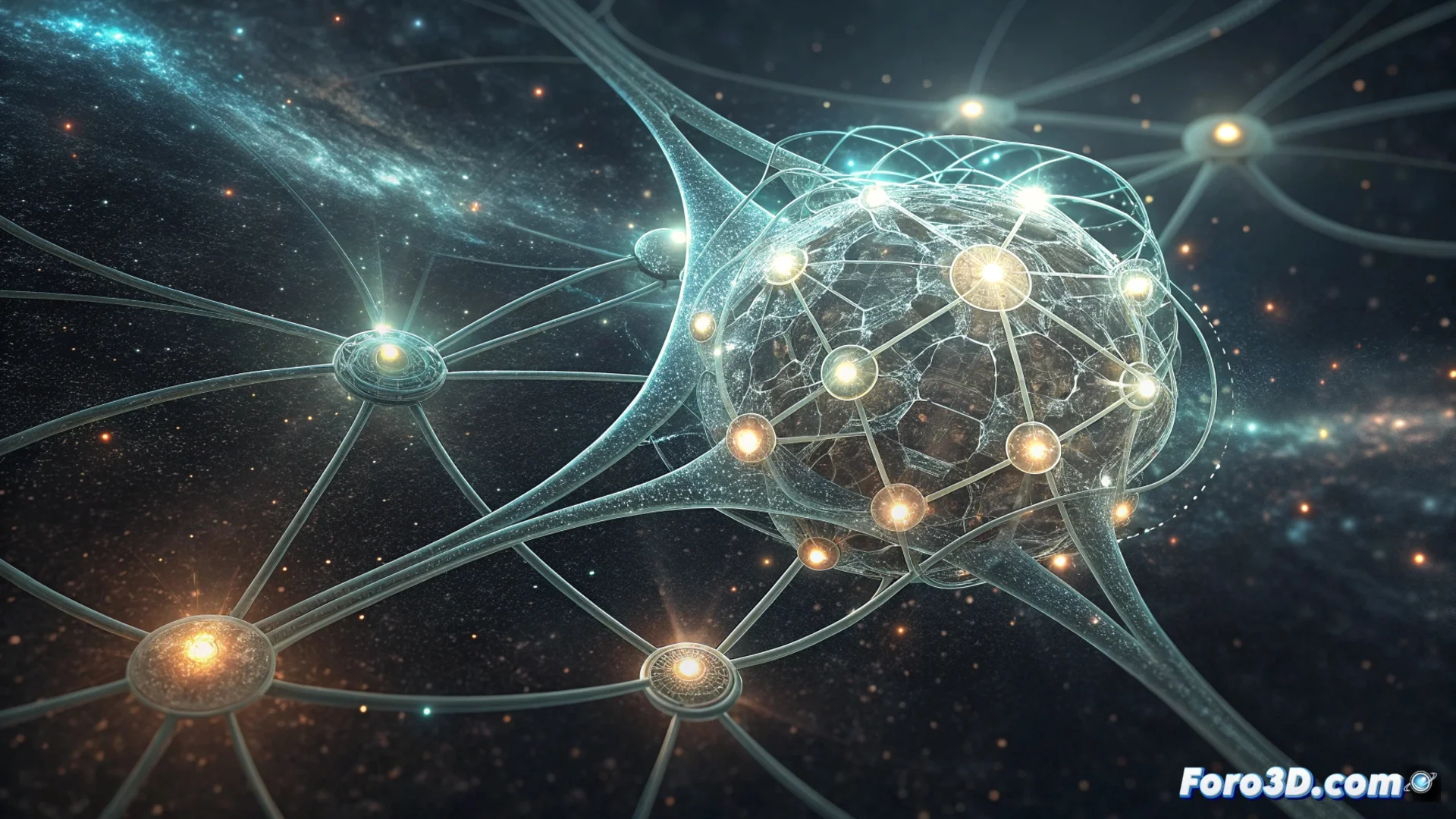
The key technique lies in using tensor networks, mathematical structures born to describe quantum systems with multiple entangled particles. Scientists adapt this principle to organize and compress the millions of parameters that form a neural network. Instead of a dense tangle of connections, the information is structured in a way that reflects the order and correlations inherent in quantum states. This smart data packaging produces remarkably lighter models.
Key advantages of this approach:- Lower memory footprint: Compressed models require storing far fewer parameters, freeing up hardware resources.
- Faster execution: Being lighter, these systems can process and generate predictions faster and with lower energy consumption.
- Preserved accuracy: Despite the compression, the models maintain, and may even improve, their accuracy on complex tasks.
Drawing inspiration from quantum physics allows us to rewrite the rules of how we structure information within an AI, moving from chaos to comprehensible order.
Towards Interpretable Artificial Intelligence
Beyond efficiency, the greatest achievement of this quantum trick could be the advance towards algorithmic transparency. The ordered structure of tensor networks makes the flow and transformation of data within the model easier to track. This allows experts to analyze how the network arrives at a specific conclusion, unraveling the logic behind its predictions. Thus, we move from an opaque model (black box) to one where its reasoning can be intuited (gray box).
Fields that benefit from transparency:- Medical diagnosis: Where it is vital to understand why a model suggests a pathology to clinically validate its finding.
- Autonomous vehicles: To audit and trust real-time driving decisions.
- Finance and justice: Areas where automated decisions must be explainable and free of hidden biases.
A Lighter and More Understandable Future for AI
This convergence between quantum physics and artificial intelligence points to a promising path. It is not about waiting for quantum computers, but about using their mathematical concepts today to optimize classical machines. The result is systems that are not only cheaper to operate and faster, but also ones in which we can place trust based on understanding. The physics that explains the smallest particles in the universe could be the key to taming and making useful some of humanity's most complex digital creations. ⚛️