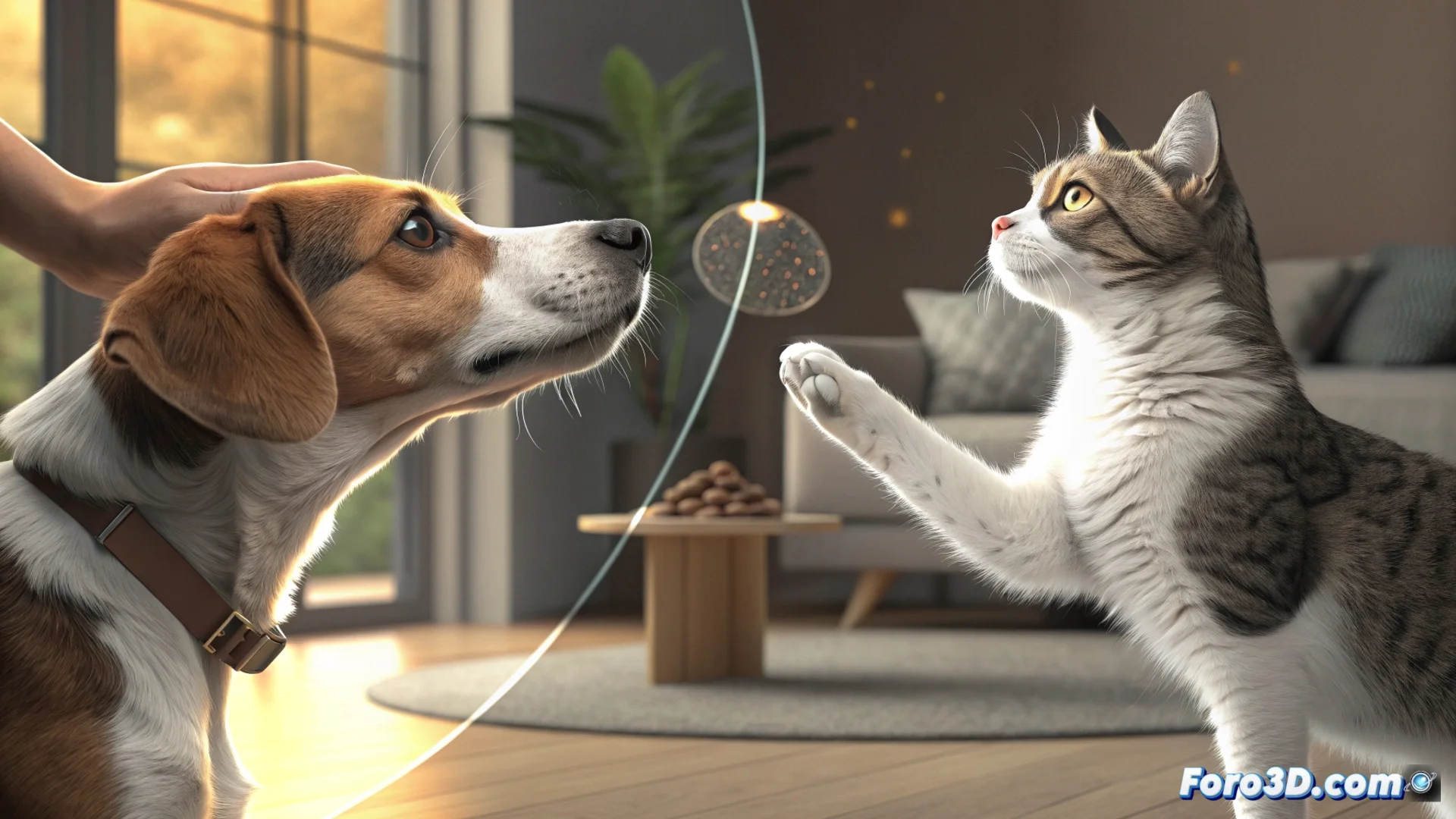
Science Explores How Dogs and Cats Perceive the World
Recent research delves into the mechanisms of cognition and sensory perception of our pets. The 2025 findings transform how we understand how these animals process their environment, from what they see and smell to how they interpret our actions. This knowledge is key to improving the relationship and care we provide them 🐾.
The Canine Brain: More Than a Good Sense of Smell
Studies confirm that dogs possess a sophisticated ability to read human body language and tone of voice. They not only associate words with objects, but their understanding operates at a level similar to that of a young child. Their olfactory system, extraordinarily powerful, allows them to detect chemical changes associated with diseases or emotional states, opening new avenues for their use in assistance.
Key Cognitive Skills in Dogs:- Interpret human gestures and visual signals with high precision.
- Associate specific verbal commands with concrete actions or objects.
- Detect odors related to medical conditions such as certain cancers or drops in blood sugar.
Canine cognition is not about understanding a complex language, but about decoding a world of contextual and olfactory signals.
The Feline Mind: Independence and Sensory Acuity
Contrary to the belief in their aloofness, cats process information from their environment with remarkable independence. Their senses are finely tuned: excellent vision in low light and hearing capable of capturing ultrasonic frequencies. They recognize their owners and their name, but their response is selective, governed by their own judgment. Their exploratory and hunting behavior is based on deep instincts and an understanding of basic physical principles, such as gravity and balance.
Outstanding Perceptive Abilities in Cats:- See clearly in very low light conditions, making the most of any beam of light.
- Hear high-frequency sounds imperceptible to humans, such as those of small rodents.
- Evaluate complex environments and calculate jumps with precision, applying an intuitive understanding of physics.
Two Perceptive Worlds Under the Same Roof
The final comparison is telling: while a dog can learn to fetch an object through cooperation, a cat will first evaluate the usefulness of the task for its own purposes. Both demonstrate forms of intelligence adapted to their evolutionary history and relationship with humans. Understanding these fundamental differences in how they perceive is the first step toward a more respectful and enriching coexistence for all 🐶🐱.