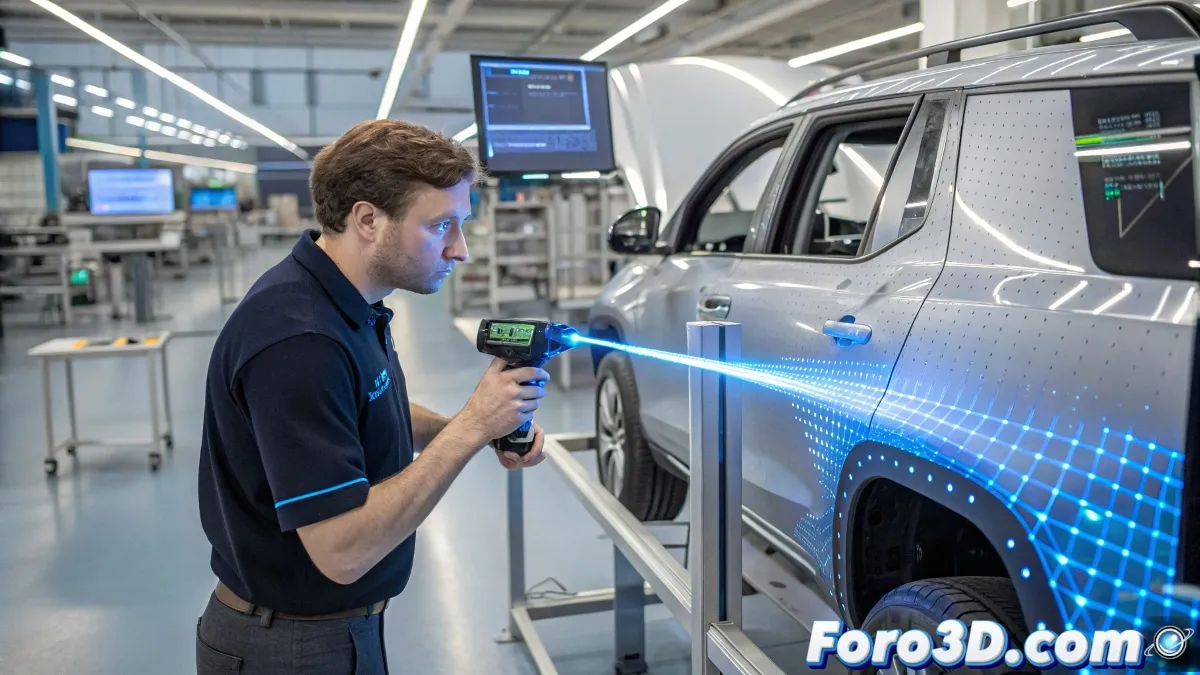
The New Era of Three-Dimensional Digitization
The evolution of 3D capture systems has reached a significant milestone with the elimination of physical markers. This technological advancement enables more agile and precise processes, especially in environments where accuracy is fundamental. Various industries are adopting these solutions to optimize their workflows and improve their results.
Innovation in the Scanning Process
Conventional three-dimensional digitization systems used to require the manual placement of physical references. The modern approach implements advanced computer vision algorithms that autonomously identify patterns and geometries. This methodology not only accelerates the process but also increases the reliability of the obtained data.
"Optical tracking technology represents a qualitative leap in capturing complex geometries without manual intervention"
Notable Technical Features
- Multiscale: Adaptable from millimeter-sized parts to large-format structures
- Versatility: Compatible with reflective surfaces and dark materials
- Robustness: Industrial design resistant to demanding working conditions
- Integration: Output compatible with leading design and engineering software
Impact on Industrial Processes
The implementation of this technology is transforming areas such as quality control and prototype development. Manufacturing sectors report significant reductions in production times thanks to the instant capture of geometries. Additionally, the ability to perform on-site dimensional inspections is revolutionizing predictive maintenance processes.
Cross-Cutting Applications
Beyond the industrial realm, these solutions find application in fields such as cultural heritage preservation or the development of customized medical prostheses. The ability to accurately capture organic and irregular shapes opens new possibilities in disciplines that previously relied on manual methods.
- Reverse engineering of components
- Documentation of cultural assets
- Development of customized medical solutions
- Creation of assets for digital production
Development Perspectives
The continuous evolution of these systems points toward greater integration with artificial intelligence platforms. It is anticipated that in the coming years, three-dimensional capture will be an increasingly automated process, with advanced capabilities for interpretation and real-time data processing.