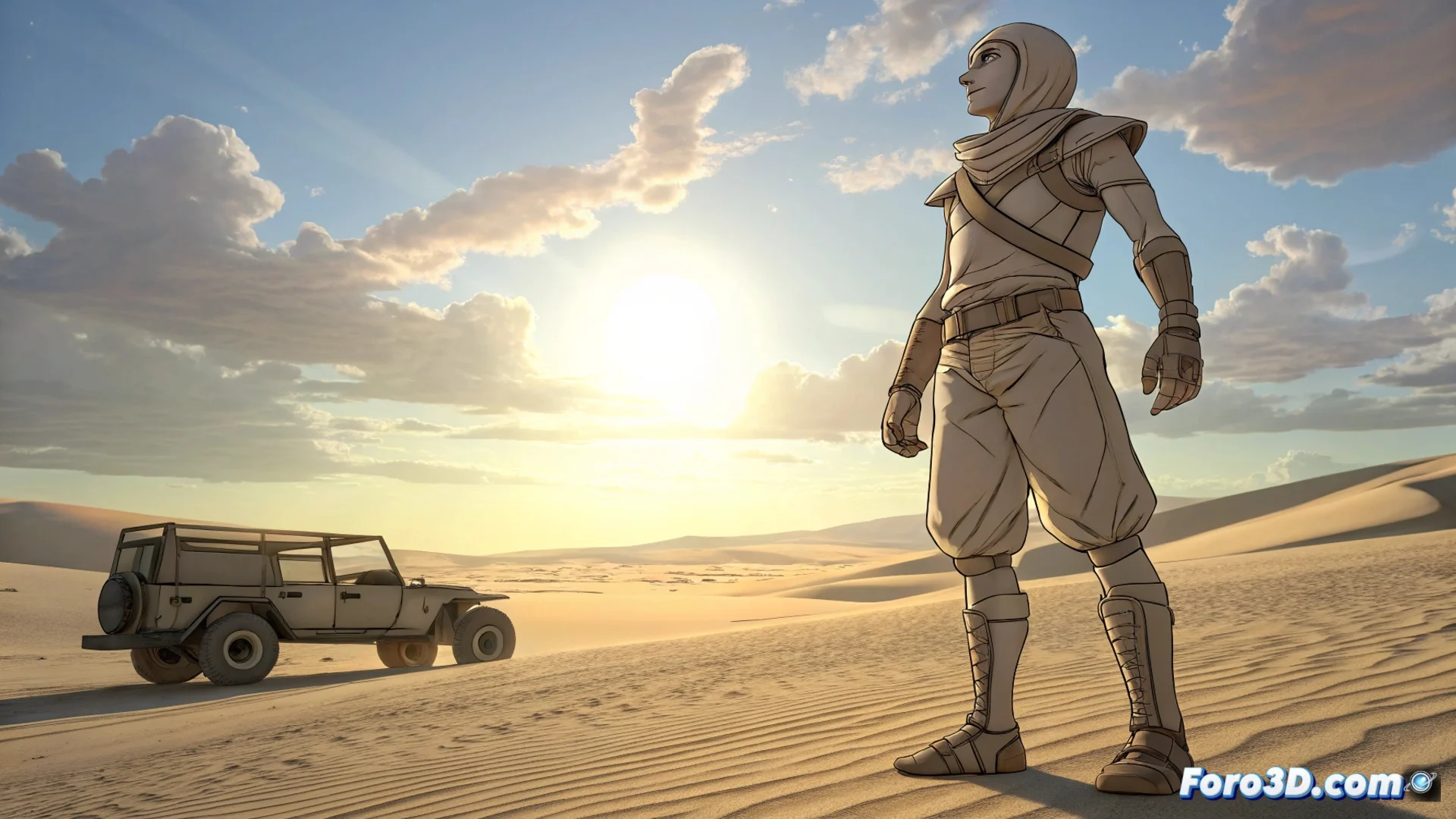
Sand Land Replicates Akira Toriyama's Style with Unreal Engine
The video game Sand Land builds its world using Unreal Engine, specifically an adapted version of the 4. Its main goal is to bring the unique visual look of the original manga to a three-dimensional space. The engine processes advanced cel-shading methods that apply to character and vehicle models, creating defined edges that recall ink strokes and employing solid color palettes. This makes the game retain the appearance of a comic or animated series during exploration. 🎮
Cel-Shading Builds the Visual Identity
The shading system is fundamental to achieving this effect. It's not just about adding a black outline, but working with stylized lighting and shadows to highlight shapes. Developers adjust the shaders so that surfaces display uniform color, without the typical gradients of realistic graphics, thus imitating the manual coloring of a manga panel. The environments, although expansive 3D deserts, also receive this treatment to maintain stylistic coherence with the characters and not disrupt immersion in Toriyama's universe.
Key Elements of the Technical Process:- Adapt shaders to produce flat and uniform colors, eliminating realistic gradients.
- Use stylized lighting that accentuates volumes and shapes without seeking photorealism.
- Generate defined outlines on characters and vehicles that simulate the artist's ink stroke.
Achieving a 3D world that looks like a two-dimensional manga page is a considerable technical challenge.
Expansive Environments Perfect the Experience
The desert world is designed to be extensive and stylized, prioritizing fidelity to the source material over hyperrealism. The engine's technology helps render these large areas with stable performance, allowing vehicle travel across the map without noticeable interruptions. The arid atmosphere and landscape details, such as rock formations or ruins, are modeled and textured to integrate into the overall artistic style, creating a believable space within the established visual logic.
Aspects of Environment Design:- Prioritize artistic fidelity to the original manga in modeling vast deserts.
- Optimize rendering to maintain smooth performance in extensive maps.
- Texture and model landscape details (rocks, ruins) to fit into the global cel-shading style.
A Technical Challenge with Its Own Identity
This adaptation demonstrates how a common graphics engine like Unreal Engine can be used to achieve a very specific and recognizable visual identity. The challenge is not only in applying cel-shading, but in doing so coherently across all game elements, from a character to the desert horizon, ensuring the player always perceives they are inside an Akira Toriyama work. The result is a technical and artistic bridge between the 2D of the manga and the interactive possibilities of 3D. ✨