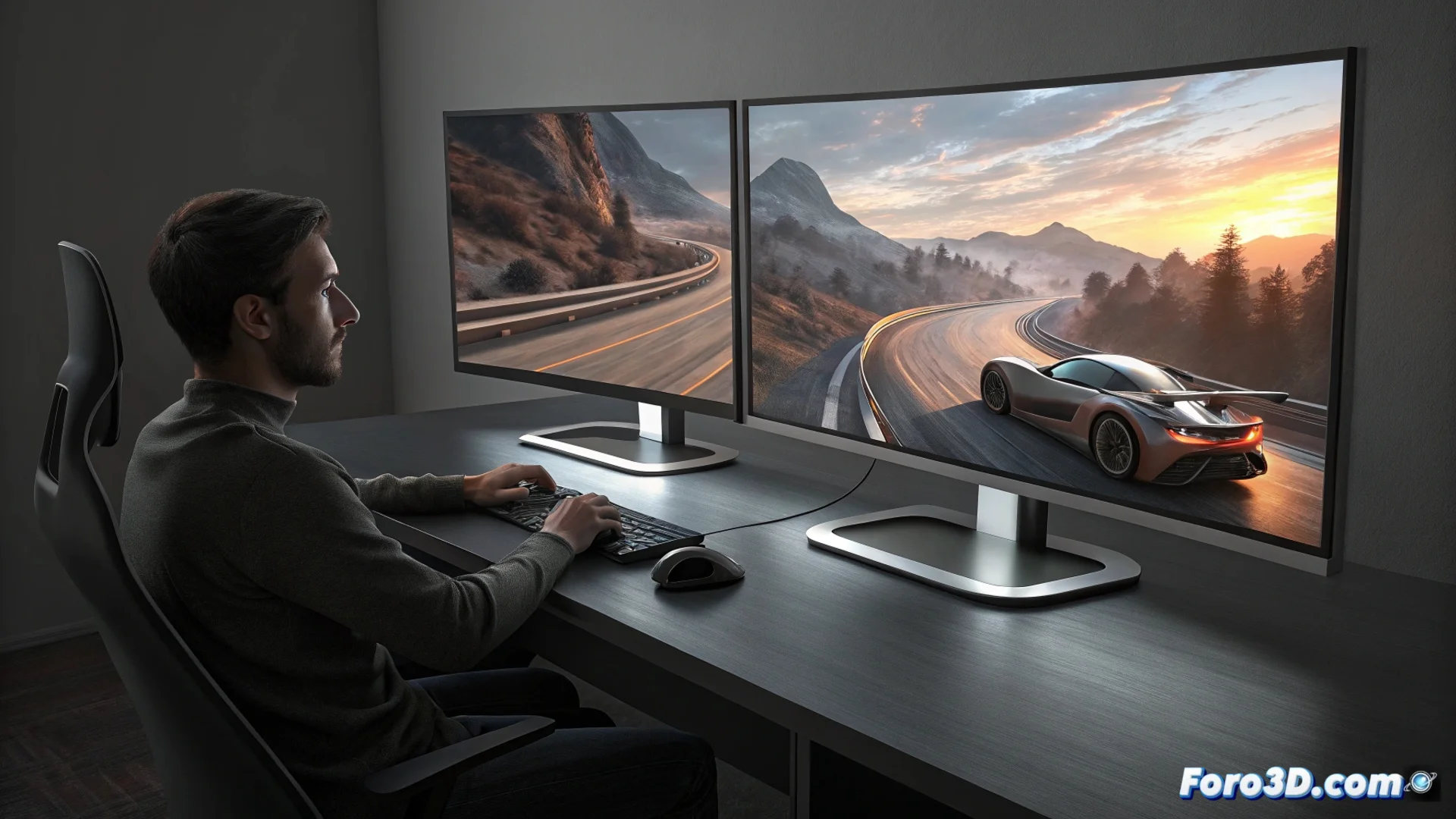
Samsung presents two Odyssey monitors with innovative technologies
The South Korean company Samsung has unveiled its upcoming releases for the gaming and professional segment: the Odyssey G6 and the Odyssey G9. With a market arrival scheduled for 2026, these devices promise to redefine the limits of visual fluidity and immersion. 🚀
Odyssey G6: The monitor with the highest refresh rate in the world
The Odyssey G6 positions itself as the monitor with the highest refresh rate announced to date, reaching 1040 Hz. This unprecedented figure means that the screen updates the image more than a thousand times per second, which almost completely eliminates motion blur and minimizes latency between the player's action and its reflection on screen.
Key features of the Odyssey G6:- OLED panel for instant response times and pure blacks.
- Proprietary signal processing technology called SmartThings.
- Aimed at users who demand maximum fluidity in competitive video games.
By the time these monitors hit the market, we might already need a graphics card the size of the Odyssey G9 itself.
Odyssey G9: 6K resolution and a new visual dimension
While the G6 bets on speed, the Odyssey G9 does so on extreme definition and depth. This model incorporates a 6K resolution, which doubles the number of pixels of a standard 4K monitor, offering an exceptional level of detail for content creation or gaming.
Innovation in 3D without accessories:- Integrated autostereoscopy technology that generates a 3D effect without the need for special glasses.
- Eye-tracking system that adjusts the 3D perspective based on the user's position.
- Aimed at professionals working with 3D models and enthusiasts seeking total immersion.
The future of high-performance displays
These Samsung announcements represent a significant leap in the sector. The race to offer the highest figures in refresh rate and resolution continues, also posing the challenge of having sufficiently powerful hardware to exploit these capabilities. The prospect of these technological advances already makes us think about the requirements of future graphics cards. 💻