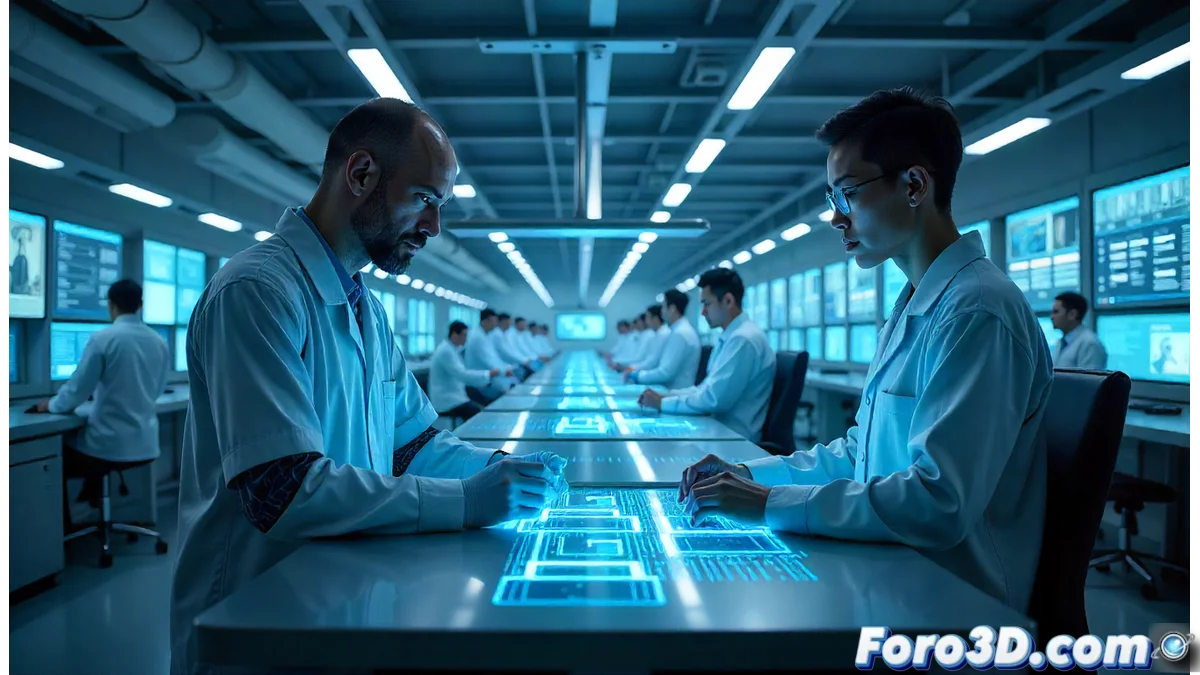
Samsung and NVIDIA Create AI Megafactory with 50,000 GPUs in South Korea
Two technology giants join forces in a revolutionary project 🚀. Samsung Electronics and NVIDIA have established a strategic alliance to build a massive artificial intelligence manufacturing facility in South Korean territory, equipped with an impressive park of more than 50,000 state-of-the-art GPU units. This megafactory will integrate advanced AI systems into every phase of the semiconductor production process, radically transforming the industry.
Revolution in Chip Manufacturing through Integrated AI
The facility will implement artificial intelligence from the initial design stages to final quality controls. Platforms like NVIDIA Omniverse will enable the creation of virtual production environments to simulate complex processes before physical implementation. cuLitho technology will significantly accelerate computational lithography, while CUDA-X will optimize GPU performance for intensive computing tasks. This comprehensive approach will drastically reduce development times and improve the overall energy efficiency of the process. 💡
Main Innovations in Semiconductor Design:- Creation of more complex and efficient circuits with reduced error margins through predictive AI
- Simulation of virtual production environments that allow accelerated design iterations
- Real-time adjustments based on performance data to ensure compliance with standards
The integration of AI into semiconductor manufacturing represents the greatest advance in decades, enabling previously impossible precisions and unprecedented efficiencies.
Intelligent Automation and Advanced Quality Control
Through CUDA-X, the factory will maximize the potential of GPUs to train specialized AI models capable of predicting potential failures in the production line. Automated quality control systems will analyze ultra-high-resolution images of manufactured chips, identifying microscopic-scale defects that would escape human detection. This approach not only increases successful production rates but also minimizes material waste, making the process more economically and environmentally sustainable. 🌱
Key Operational Advantages:- Optimization of GPU performance in intensive computing for training predictive models
- Automated detection of microscopic defects through advanced image analysis
- Significant reduction in material waste and improvement in process sustainability
The Future of Semiconductor Manufacturing
This collaboration marks a historic turning point in the semiconductor industry. The ability to perform precise simulations and implement intelligent automation in all production stages will not only accelerate innovation but also establish new standards of quality and efficiency. The resulting chips will incorporate levels of intelligence and complexity that will transform electronic devices across all industries, from computing to automotive and beyond. The future of semiconductor manufacturing is already here, and it's running at full power. ⚡