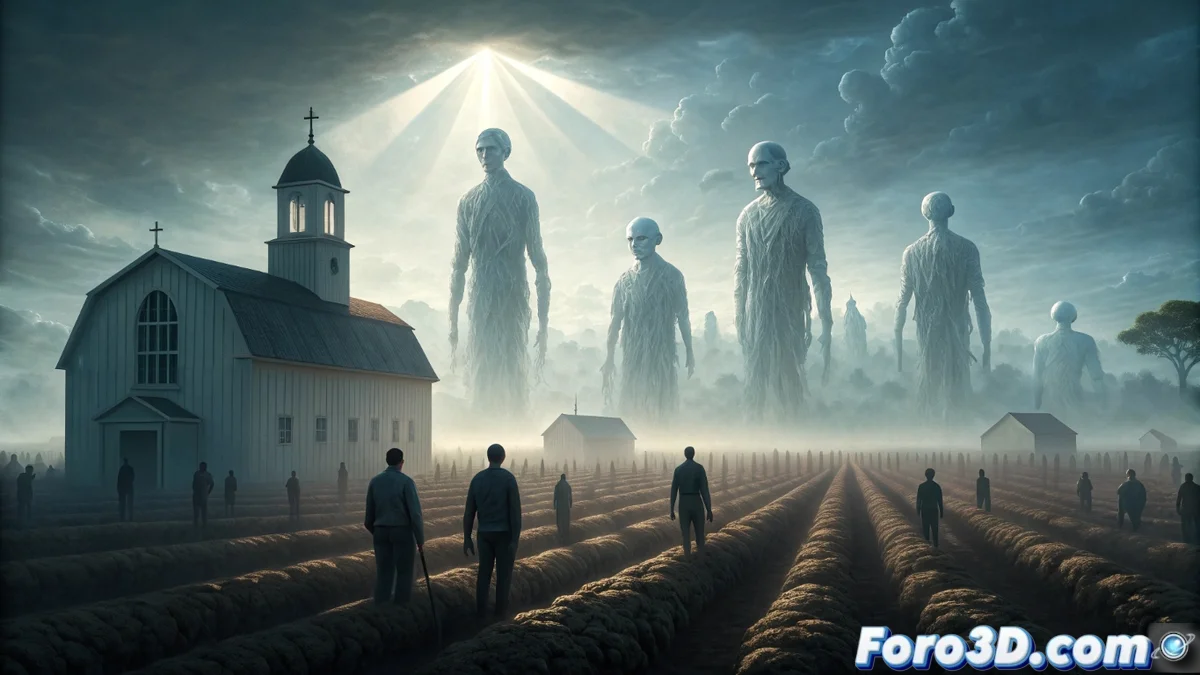
Salvador Freixedo's Human Farm: a theory about the control of humanity
In his work The Human Farm, the former Jesuit priest Salvador Freixedo presents a radical hypothesis that directly confronts our perception of reality. His central proposal suggests that humanity does not exercise free will, but rather functions as a kind of livestock or crop, managed by superior entities that operate from non-physical planes of existence. 🧠
The central premise: humans as an energy resource
Freixedo argues that these entities are not extraterrestrials in the conventional sense of visitors from other planets. Instead, he describes them as beings from other dimensions whose main objective is to extract the energy generated by human emotions. According to this theory, intense and low-vibration emotions, such as fear, anguish, and pain, constitute their main food source. The system would be designed to maintain a constant flow of this energy.
Key mechanisms of the control system:- Exploiting emotions: The entities prioritize generating and harvesting intense negative emotional states in humans.
- Operating from other dimensions: Their non-physical nature allows them to act without being directly detected, from a different plane of existence.
- Avoiding human awareness: The entire system depends on humanity not perceiving its true condition as a cultivated resource.
The book analyzes religious, political, and ufological phenomena under this unifying premise.
The tools of manipulation: religion and politics
To sustain this complex system of exploitation, the entities would need large-scale control mechanisms. Freixedo identifies organized religions and political systems as their most effective instruments. Through these pillars of society, inflexible dogmas, war conflicts, social divisions, and fanaticisms are fostered, all of which guarantee massive and continuous production of the emotional energy they require.
Human structures used for control:- Institutional religions: They create dogmas, guilt, fear of divine punishment, and holy wars, generating large amounts of conflictive energy.
- Political systems and wars: Conflicts between nations and ideological struggles produce waves of panic, hatred, and suffering on a massive scale.
- Social divisions: Confrontations between classes, races, or ideologies keep the population in a constant state of tension and conflict.
Legacy and impact on alternative thought
Originally published in the 1970s, The Human Farm established itself as a fundamental text within ufology and non-conventional thought in Spanish. Freixedo, leveraging his theological training, devotes part of his analysis to criticizing how certain interpretations of the divine can perfectly serve this system of domination. Beyond whether his specific theory is accepted or not, the book invites the reader to question the nature of reality and the role assigned to us. The next time a collective panic outbreak or irrational fanaticism is perceived, Freixedo's work prompts one to wonder what forces might be benefiting from it. 🤔