Recently, a group of scientists has used 3D printing technology to gain new insights into the hunting mechanics of extinct saber-toothed predators. The research, published in the journal Current Biology, focused on analyzing over 200 carnivore teeth to understand how these prehistoric hunters used their distinctive saber teeth.
The Research: Recreating Saber Teeth with 3D Printing
To conduct the study, the scientists created stainless steel replicas of teeth from various carnivores using 3D printing. These replicas were subjected to penetration tests using gelatin blocks that simulated prey flesh. The choice of printed metal was key, as it avoided tooth flexing during experiments, allowing precise measurements of the force needed to penetrate the target material.
Key Findings from the Study
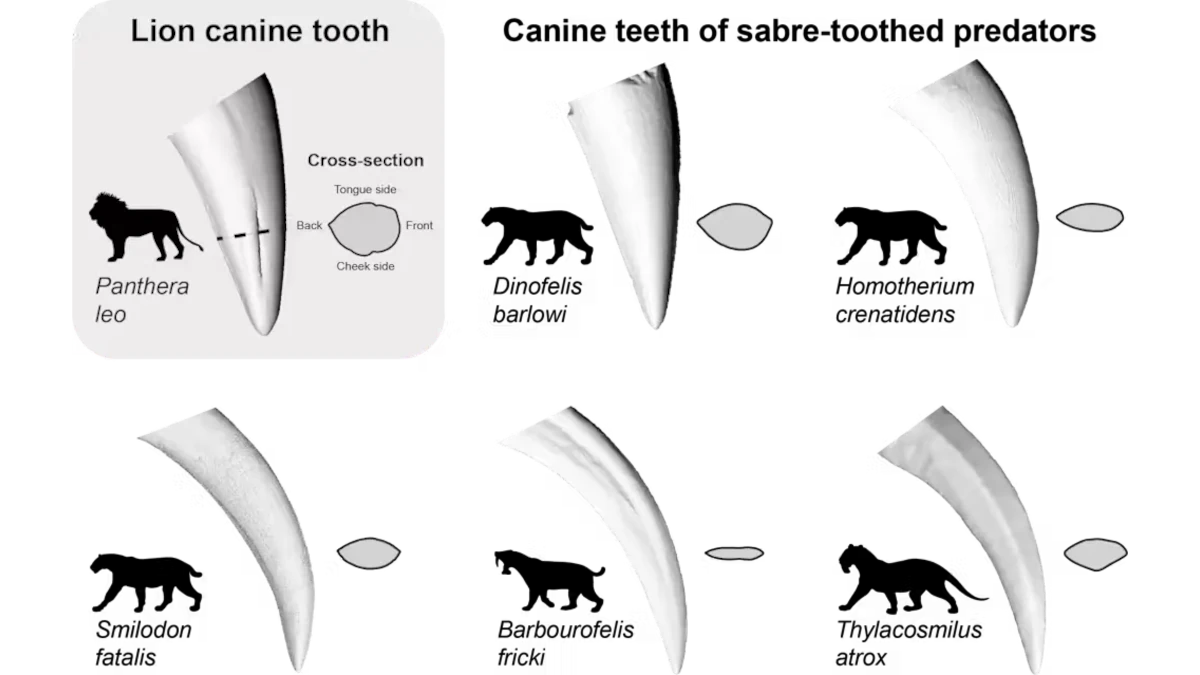
- The teeth of saber-toothed predators, such as Smilodon, were optimized to pierce prey efficiently with minimal force.
- However, these specialized teeth were more susceptible to breaking under high pressure compared to the more robust teeth of other prehistoric predators, such as Dinofelis.
- The study challenges the notion that saber-toothed predators fell into only two distinct categories, instead demonstrating a continuous range of dental forms.
Implications of the Research: Beyond Paleontology
The research findings not only have implications for paleontology, but also open new possibilities for modern engineering. The principles of balance between sharpness and durability observed in saber-toothed predators can be applied to the design of precision tools, such as surgical instruments or industrial cutting equipment.
"The study demonstrates how saber tooth specialization helped these predators hunt effectively, but it may also have contributed to their extinction when ecosystems changed." - Research team.
The Influence of 3D Printing Technology
3D printing has been crucial for better understanding the morphology of these extinct teeth. Thanks to the ability to create detailed replicas and perform precise tests, researchers have gained a clearer view of how saber teeth evolved to optimize hunting. Additionally, this technology can help scientists study other extinct species or even reconstruct parts of their anatomy for future research.
Conclusion: An Evolutionary Legacy and Modern Applications
The study on saber-toothed predators not only answers questions about their functioning but also demonstrates how 3D printing technology and engineering can help unveil evolution's secrets. The discoveries provide a new perspective on how these prehistoric hunters adapted to their environment and how their traits, which once gave them an advantage, may also have led to their extinction. Furthermore, these advances can influence the design of modern tools, opening new frontiers in engineering and biology.