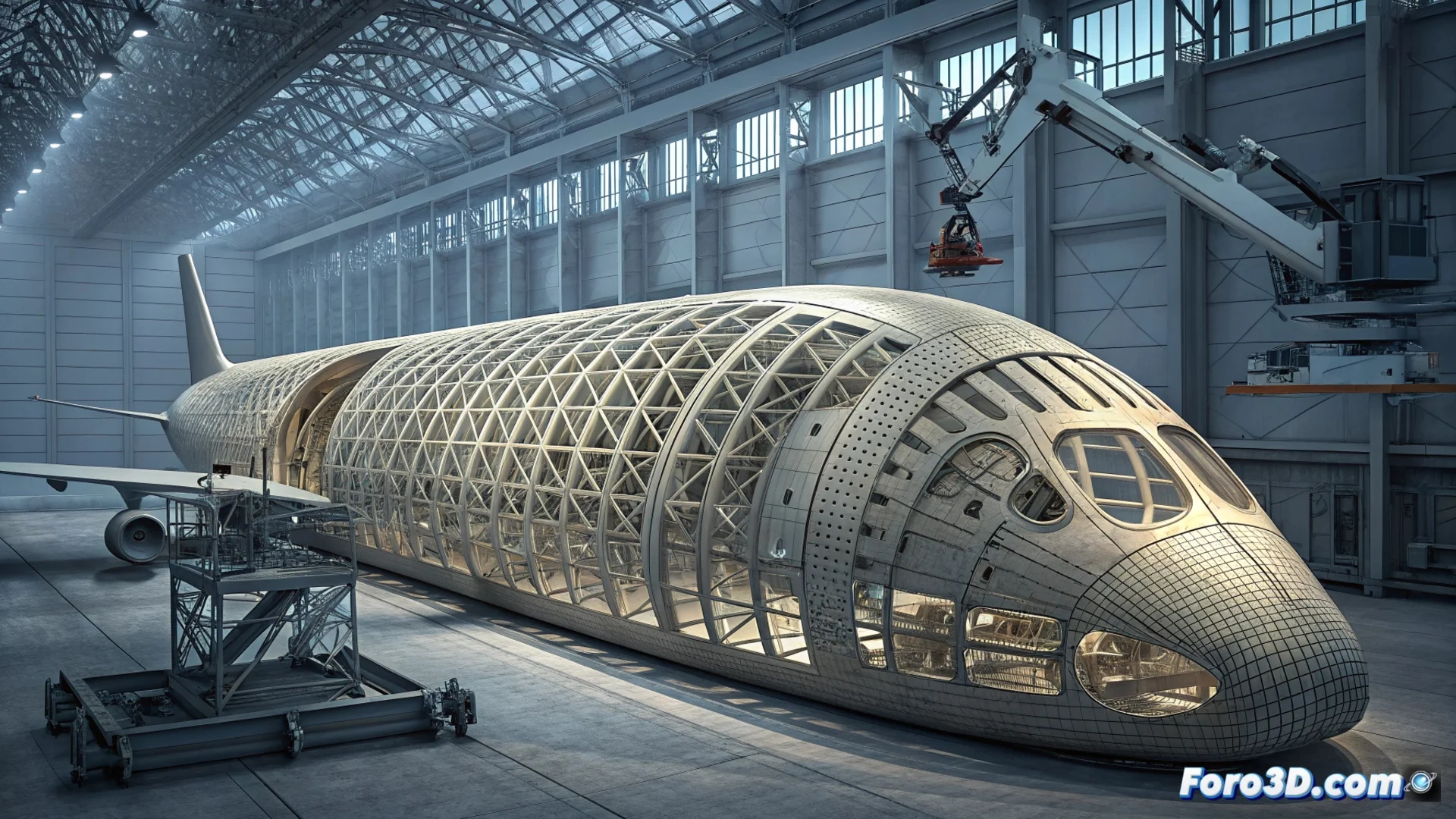
Saab and Divergent Print a Five-Meter Airplane Fuselage with 3D Technology
The aerospace industry takes a significant step forward with the presentation of a five-meter structural fuselage manufactured entirely using metal 3D printing techniques. This component, the result of the collaboration between Saab and Divergent Technologies, demonstrates that it is already viable to produce large-scale aeronautical parts with additive manufacturing, promising to streamline processes and open new design possibilities 🛩️.
The core of the advancement: the Divergent Adaptive Production System (DAPS)
The methodology that makes this milestone possible is the Divergent Adaptive Production System (DAPS). This system integrates artificial intelligence to generate optimized designs that it then manufactures directly with industrial 3D printers. This approach not only creates lighter and stronger parts but also reconfigures the traditional supply chain. By consolidating huge structures into a single piece or fewer components, it eliminates numerous assembly steps and the need for expensive, specific tooling.
Key advantages of the DAPS approach:- Generate designs with AI: Artificial intelligence calculates the optimal shape to meet mechanical requirements, resulting in complex and intricate geometries that would be impossible to manufacture with conventional methods.
- Simplify the supply chain: Reducing the number of individual parts and assembly steps decreases logistics, inventory, and dependence on multiple suppliers.
- Manufacture with greater agility: The process adapts quickly to design changes, allowing iteration and testing of new configurations without the time and cost penalties of fixed molds or tooling.
This collaboration seeks to validate the technology for integration into Saab's future aviation programs, marking a path toward more sustainable and efficient manufacturing.
Tangible impact on aeronautical engineering
The technical benefits are direct and quantifiable. The most critical is the drastic weight reduction in the final structure, a primary factor in aviation for saving fuel and increasing performance. At the same time, development time is radically compressed: what previously took months from concept to physical prototype can now be achieved in a matter of weeks.
Consequences of this acceleration:- Test designs faster: Engineers can evaluate and modify concepts with a much faster feedback cycle.
- Respond to specific requirements: Manufacturing better adapts to the particular needs of each program or aircraft model, without the prohibitively high initial costs of traditional production.
- Reduce development risk: Being able to manufacture and test large-scale functional prototypes agilely allows identifying and resolving issues in earlier stages.
From idea to structural reality
This 3D-printed fuselage symbolizes the maturity of a technology evolving from rapid prototyping to direct manufacturing of final components. It demonstrates that additive manufacturing is ready to transform how aircraft are built, shifting from a paradigm of assembling thousands of parts to one of integrating complex monolithic structures. The future of aerospace manufacturing seems to be written, layer by layer, with laser-melted metal 🔥.