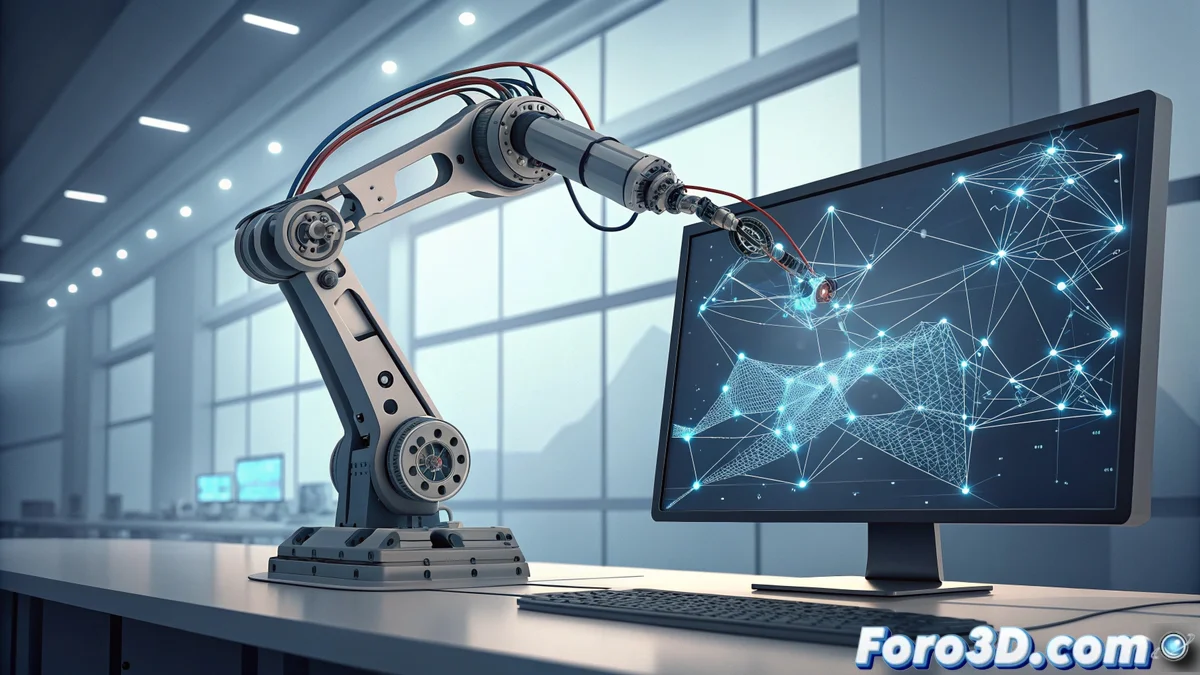
ROS: The Framework That Unifies Modern Robotics
The Robot Operating System (ROS) is a collection of open-source libraries and tools. Despite its name, it does not function as a traditional operating system. Its main purpose is to serve as an abstraction layer over the robot's physical hardware. This allows engineers to write control software that works on diverse robotic platforms without having to adapt the code for each specific model. Essentially, it organizes how the different components of a robot interact, such as its sensors and motors. 🤖
Node-Based Architecture
The core of ROS is structured around the concept of nodes. Each node is an independent process that executes a specific computational task. For example, one node may manage a laser sensor, another may process images from a camera, and a third may calculate the robot's trajectory. The key is that these nodes do not need to know where the others are running. To communicate, they exchange messages through a central system called the master (ROS Master). This decoupled design provides great modularity and flexibility, as nodes can be added, removed, or modified without needing to stop the entire system.
Key advantages of this architecture:- Parallel development: Different teams can work on separate nodes simultaneously.
- Fault tolerance: If a node fails, the entire application does not necessarily collapse.
- Flexible distribution: Nodes can run on a single computer or be distributed across several, even on the robot itself.
ROS does not provide a real operating system, but services like passing messages between processes and managing packages.
An Ecosystem That Boosts Innovation
ROS goes beyond basic tools for communicating nodes. It includes a vast collection of pre-developed and ready-to-use software packages. There are packages for simulating robots in realistic virtual environments, for visualizing complex data in 3D, or for implementing advanced navigation and object manipulation algorithms. This shared library means that researchers and developers do not start from scratch. They can build on the work of others, which significantly accelerates the process of creating functional prototypes and testing new ideas iteratively.
Essential components of the ROS ecosystem:- Simulation tools (like Gazebo) for testing algorithms without physical hardware.
- Visualizers (like RViz) for interpreting sensor data and robot states.
- Standard algorithms for mapping, localization, and motion planning.
The Path to Robotic Learning
Adopting ROS involves learning to handle its node and message paradigm, which has a learning curve. As in any complex system, unexpected behaviors can arise, such as a robot misinterpreting sensor data and making a wrong decision in its navigation. These moments are an inherent part of the developing and debugging process for autonomous robotic systems. The power of ROS lies in its ability to organize and standardize how software for robots is built, creating a common language that unifies the global robotics community. 🚀