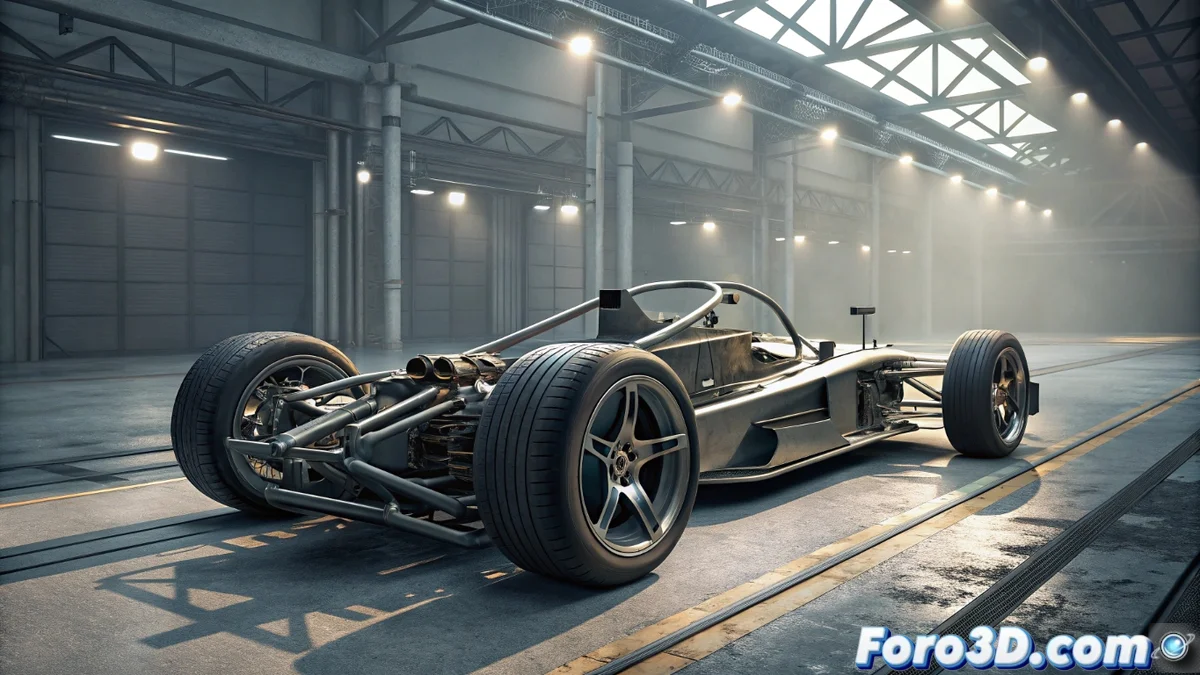
The Rodin FZERO Redefines Speed with 3D-Printed Titanium
The Rodin FZERO monoplace doesn't just aim to be fast; it seeks to set a new standard in how a circuit car is built. Its core philosophy is to remove weight without compromising rigidity, a goal achieved through additive manufacturing with titanium. This technical approach changes the game for supercars. 🏎️⚡
The Strategy: Integrate, Not Just Add
Instead of using 3D printing for secondary parts, Rodin implements it as the core of its engineering strategy. They produce critical structural elements directly in titanium, such as the suspension arms, chassis sections, and the entire exhaust system. This method allows designing complex internal geometries that are unfeasible with traditional machining, enabling material to be deposited only where it's needed to withstand loads.
Key Advantages of Manufacturing with 3D-Printed Titanium:- Component Reduction: By creating assemblies in a single piece, joints, screws, and potential weak points are eliminated.
- Greater Reliability: The monolithic structure increases precision and durability under extreme stress.
- Weight Optimization: Titanium offers an exceptional strength-to-weight ratio, ideal for withstanding high forces without adding mass.
Additive manufacturing is changing the way high-performance cars are built, where every gram counts.
Tangible Results on the Track
Integrating printed components directly into the chassis results in a more cohesive and efficient assembly. The titanium suspension arms can be lighter and yet stronger than their forged aluminum equivalents. Meanwhile, the exhaust adopts organic shapes that optimize gas flow, contributing to the engine's overall performance.
Impact on the Final Design:- Ultra-Rigid Chassis: The structure gains integrity and dynamic response.
- High-Efficiency Suspension: Reduced unsprung weight for improved grip.
- High-Flow Exhaust: Internal designs that improve gas outflow and reduce backpressure.
A Legacy Beyond the Circuit
The Rodin FZERO approach demonstrates how additive engineering transcends mere prototype production to become the preferred method for manufacturing elite cars. This vehicle, with its clearly circuit-oriented attitude—its manual probably advises against double-parking—sets a precedent on how optimize, lighten, and reinforce will be the verbs defining the future of high-performance motorsport. 🔧