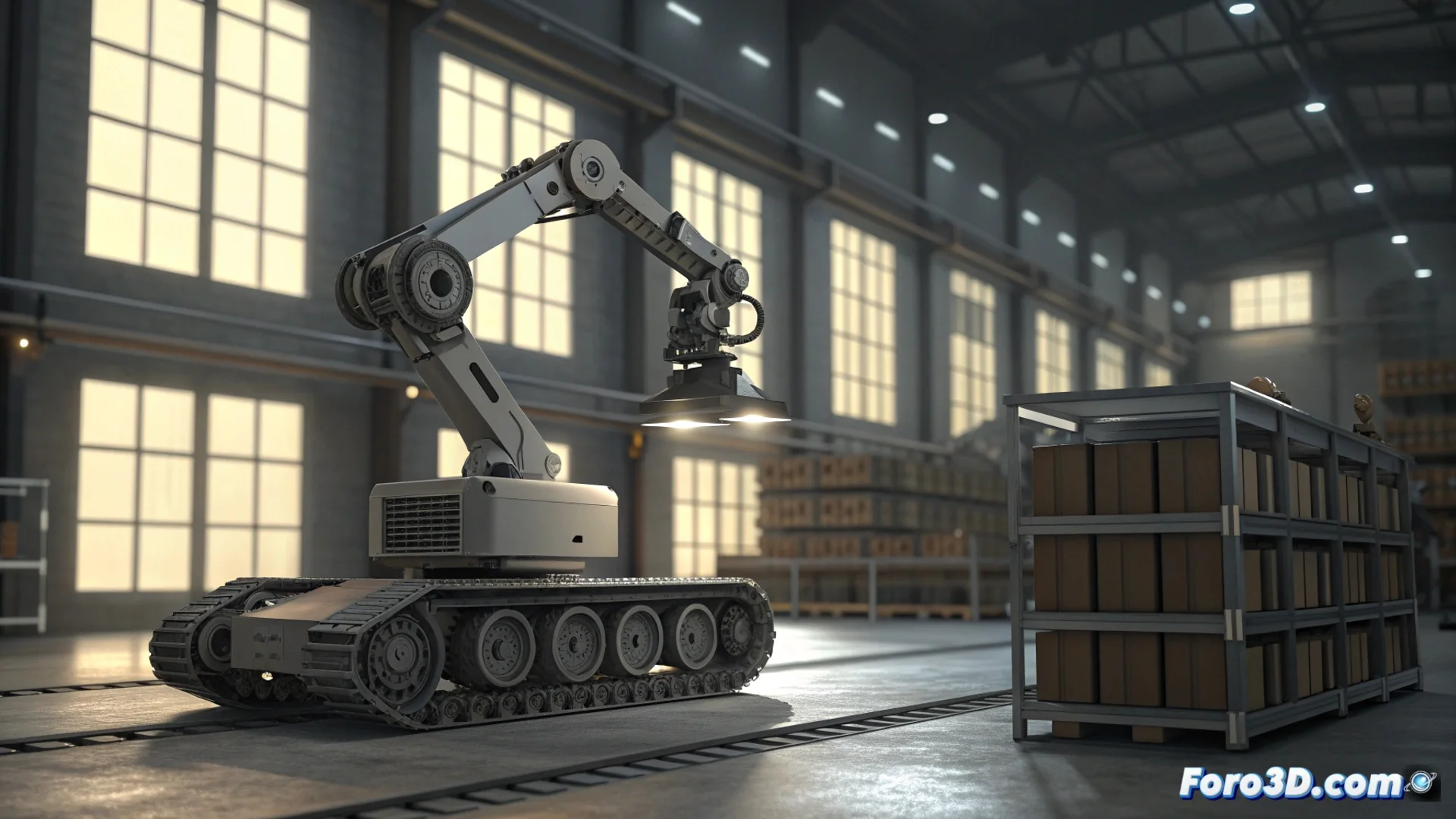
Robotnik's Mantis Robot Integrates Mobility and Manipulation
Robotnik presents the Mantis, a mobile robotic system that fuses a tracked base and an articulated arm to operate autonomously. This hybrid design allows it to move indoors and manipulate objects with high precision, aiming to revolutionize how tasks are performed in warehouses and production plants. 🤖
A Design for Moving and Operating in Confined Spaces
The robot's configuration provides omnidirectional mobility, a key feature for maneuvering in narrow aisles and congested work areas. The robotic arm, with six or seven degrees of freedom, can reach and grasp parts from complex angles. Its main function is to efficiently perform internal logistics tasks.
Main Applications of the Mantis:- Transport components between different workstations on an assembly line.
- Autonomously load and unload pallets, optimizing material flow.
- Manipulate and position tools or containers in specific locations.
“Its autonomy aims to reduce the need for operators to perform repetitive manipulation and transport tasks.”
Robust Capacity for Handling Loads
The Mantis robotic arm can lift and move weights of up to twenty kilograms. This capacity makes it ideal for handling containers, toolboxes, or medium-sized industrial parts. The tracked base provides the necessary stability for operating with these loads, even when traversing uneven floors. A set of sensors and advanced control software allows the arm to move precisely and avoid collisions, ensuring safe object manipulation and correct placement. ⚙️
Elements that Ensure Safe Manipulation:- Integrated sensors that perceive the environment in real time.
- Control software for planning trajectories and avoiding obstacles.
- Structural stability of the tracked base during operations.
Autonomy in Structured Industrial Environments
The Mantis is designed to operate autonomously in controlled environments. It uses SLAM navigation systems to create maps and locate itself precisely within a warehouse or factory. It can receive orders from a central management system to pick up and deliver materials as needed. Its arm is programmed to execute specific movement sequences, such as inserting a component into a machine or removing a finished product. This level of automation aims to free human workers from monotonous and physically demanding tasks. 🏭
Although its implementation promises efficiency, it may generate some concern among operators, who might perceive a robot with tracks and an articulated arm sneaking up the aisle. This reaction underscores the importance of designing clear and safe human-robot interaction, ensuring that the technology complements human work rather than abruptly replacing it.