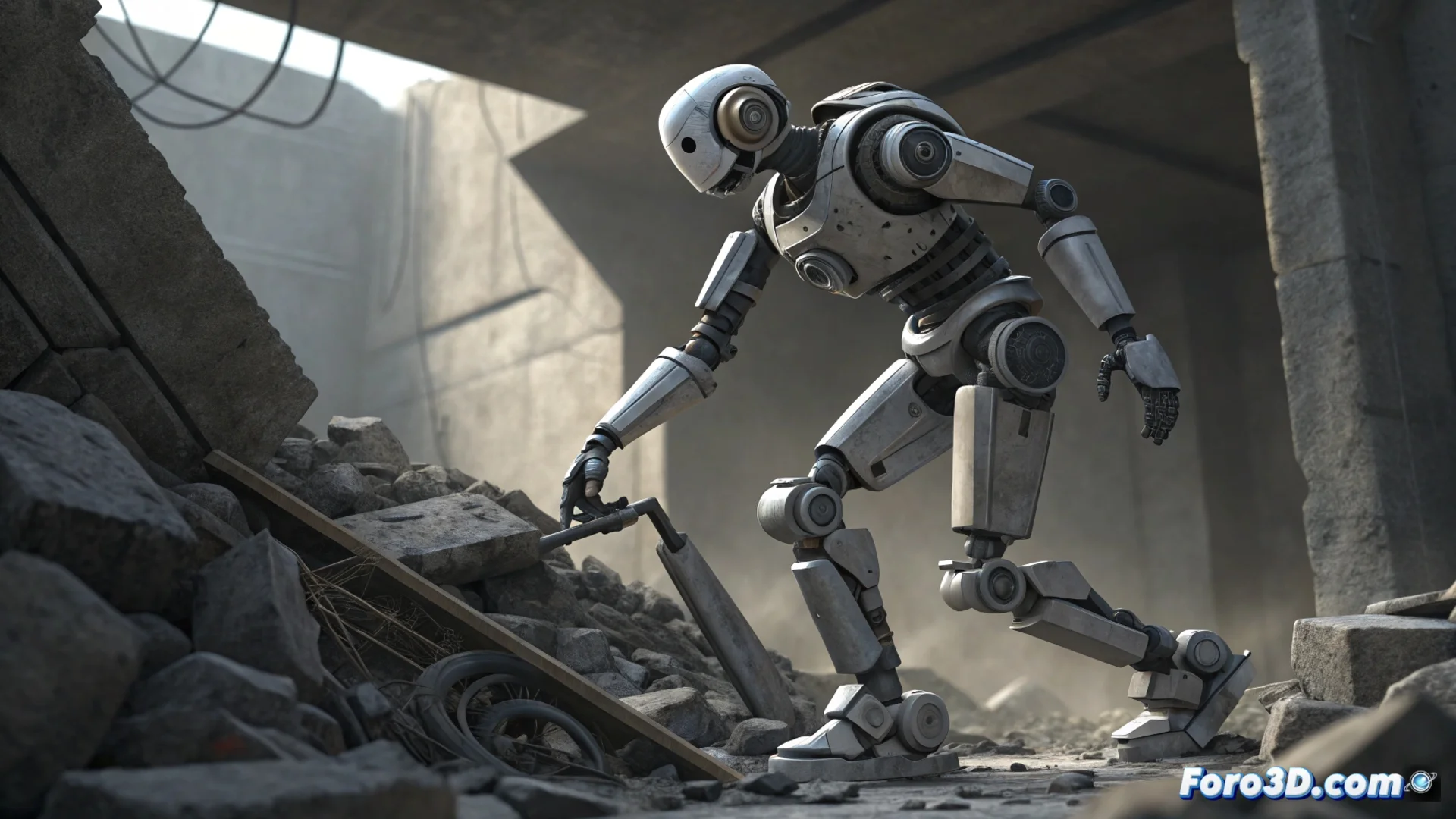
RoboSimian, the Quadruped Rescue Robot from NASA's JPL
In disaster environments, where conventional robots fail, a solution emerges with four versatile limbs. Developed by NASA's Jet Propulsion Laboratory, this ingenuity redefines mobility and manipulation in compromised spaces. 🦾
A Design that Balances Instead of Running
The philosophy of RoboSimian shifts the speed paradigm to one of absolute stability. It moves with calculated slowness to avoid compromising its balance. Each of its four limbs has seven joints, giving it an exceptional range of motion. It can flatten its body to slide under obstacles or extend to reach considerable heights.
Key Features of its Locomotion:- Quadruped configuration that functions as legs for walking and arms for grasping.
- Ability to navigate irregular terrain and debris, typical after a natural disaster.
- Adaptive postures that respond to immediate environmental challenges.
In rescues, elegance is not a priority. Effectiveness is everything.
Interacting with the Human World
Its utility is not limited to moving. It is equipped with specialized hands that can grasp and use common tools like wrenches or levers. This allows it to perform tasks in infrastructures designed for people without needing to modify them. An operator directs it through semi-autonomous control to perform complex manipulations remotely.
Manipulation Capabilities:- Operate switches, valves, and other standard mechanisms.
- Hold and use manual tools to clear or repair.
- Execute action sequences guided by a human controller.
Form Follows Function
Although its silhouette evokes an ape, its movement is methodical and precise, similar to that of a spider. This robot demonstrates that to save lives in hostile environments, the priority is a robust adaptability that surpasses the limitations of wheeled or dual-arm designs. Its true elegance lies in its uncompromising functionality. 🤖