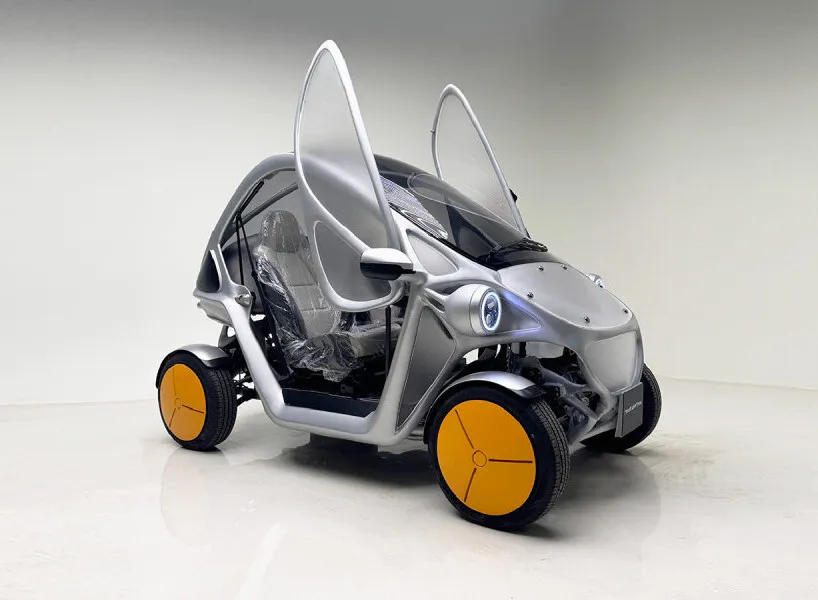
The PIX Moving team has presented the Robo-EV, an innovative electric microcar made with 3D-printed metal. This vehicle features a modular design and is capable of emotionally interacting with the driver thanks to an advanced artificial intelligence (AI) system that reads mood and voice tone, providing emotional support when needed.
A Modular and Customizable Design
The Robo-EV stands out for its modular design, allowing owners to customize their vehicle according to their needs. This microcar can be transformed into a delivery vehicle, cargo carrier, or even for public transport and car-sharing use. The open structure and use of 3D-printed metal parts not only allow for customizing the car but also ensure a futuristic aesthetic thanks to its shiny and airy surface.
An AI System for Emotional Support
In addition to its customization capabilities, the Robo-EV includes an AI system that interacts with the driver through a voice system. This personal assistant not only provides useful information but can also hold conversations to offer emotional support, depending on the driver's mood. Although details about the AI's operation have not been fully revealed, the PIX Moving team has assured that they use a large language model to enable effective emotional interaction.
Innovation in Manufacturing with 3D-Printed Metal
One of the most standout features of the Robo-EV is its manufacturing process. Being completely 3D-printed in metal, the car requires no assembly of separate parts. This not only simplifies production but also improves the vehicle's structural integrity by eliminating potential failure points. The Robo-EV's suspension is made with basalt composite materials, giving it great lightness and strength, combining robustness with efficiency.
A Fluid and Functional Design
The Robo-EV also stands out for its fluid design, inspired by modern architecture, especially visible in the vehicle's doors. These aesthetic details not only enhance the car's appearance but also optimize its functionality. The wheel arches, also made with 3D-printed metal, contribute to a cohesive design that maximizes both aesthetics and practicality.
Performance and Energy Efficiency
Regarding its performance, the Robo-EV is equipped with regenerative brakes, which recharge the batteries while the vehicle is in motion, extending its range and reducing energy consumption. Additionally, the inclusion of composite leaf springs improves vibration absorption, reducing weight and carbon emissions, making the Robo-EV a more sustainable vehicle.
A Vehicle Designed for the Future
The Robo-EV's cabin is designed to offer comfort and adaptability. With two seats for users, the dome-shaped roof can be adjusted to various heights. This design, which may seem skeletal due to its open structure, is complemented by the ability to provide a fresh and pleasant driving experience, thanks to its 3D-printed metal structure.
Tests and Future of the Robo-EV
On November 4, 2024, the PIX Moving team conducted on-road tests of the Robo-EV. Although the results have not yet been shared, the team has stated that this vehicle represents a significant step toward the future of electric cars, offering a combination of advanced technology and a design that responds to the needs of the modern driver.
"The Robo-EV is not just a car, it is a new way to interact with urban mobility, offering emotional support and a unique driving experience," stated a PIX Moving spokesperson.