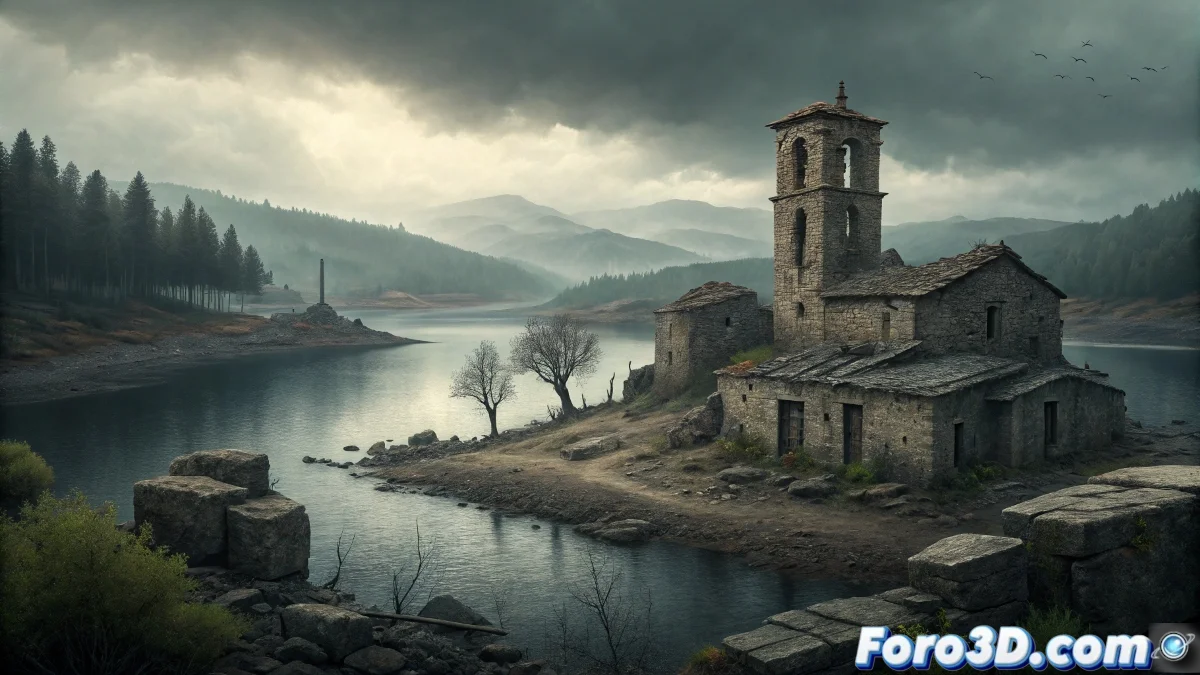
When Rhino Becomes a Tool for Three-Dimensional Historical Memory
Ribadelago Viejo rises from the waters of oblivion through the mathematical precision of Rhinoceros. Recreating this Zamoran tragedy involves not only modeling geometries, but capturing the emotional weight of a community swept away by the waters. Each NURBS curve, each surface, and each solid must convey not only the physical form of the vanished village, but the historical burden of that January night in 1959 when the Vega de Tera dam unleashed its destructive fury.
The true technical and ethical challenge lies in balancing historical rigor with respect for the victims and their descendants. The modeled ruins are not mere architectural forms, but the last silent witnesses of lives cut short. The water flooding the scene is not a decorative element, but the visual representation of the force that erased a village from the map and from collective memory. 💧
Modeling a tragedy in 3D is like building a digital monument: every polygon must honor the memory it represents
Modeling Techniques for Historical Catastrophes
The recreation of Ribadelago requires an approach that combines topographic precision with historical sensitivity. Geometric accuracy serves the emotional truth.
- NURBS Surfaces to capture the natural topography of the valley with mathematical precision
- Deformation Tools that simulate the erosive effect of torrential water
- Complex Booleans to recreate collapsed structures and structural damage
- Layer Systems that allow visualizing the village before, during, and after the tragedy
The use of construction history allows adjusting parameterizations and maintaining flexibility throughout the process, essential when working with historical documentation that may contain inaccuracies or gaps.
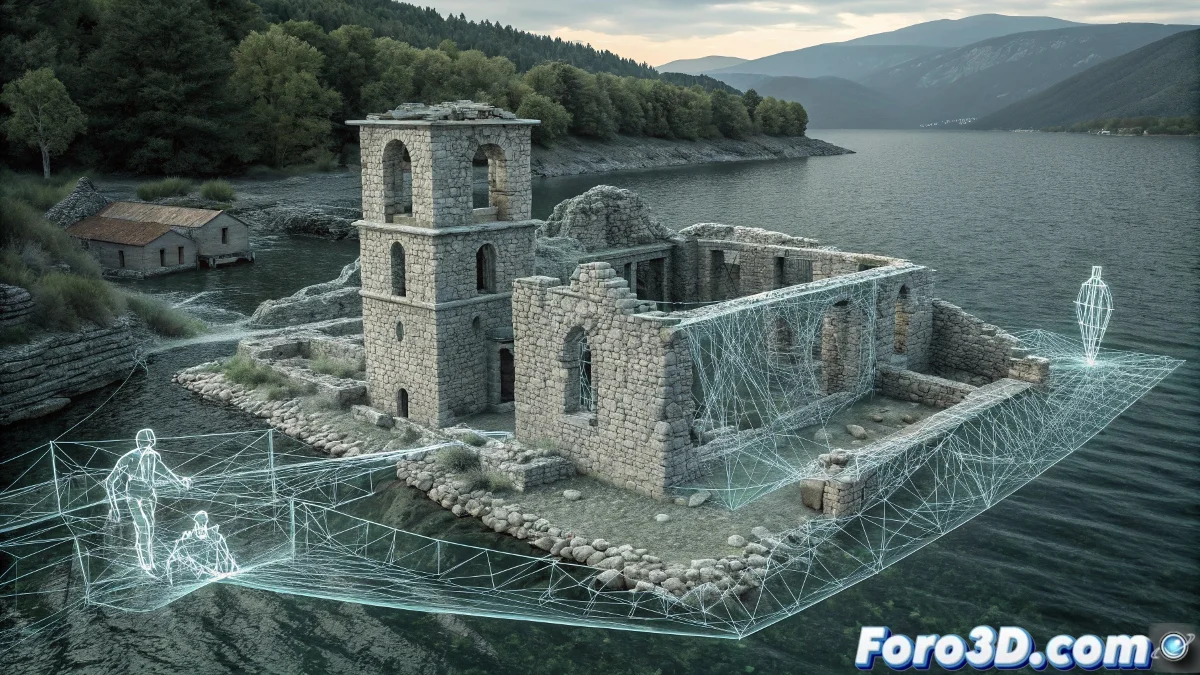
Workflow for Historical Reconstruction
The methodology in Rhino must follow a rigorous process of research and verification. Every modeling decision must be backed by documentary sources.
- Digitization of historical plans and aerial photographs from the era
- Reconstruction of the original urban layout based on testimonies and documents
- Modeling of specific damages according to technical reports of the catastrophe
- Integration of contextual elements from the surrounding natural landscape
Rhino's ability to work with submillimeter precision is crucial when recreating architectural details that may be the only remaining witnesses of vanished lives and homes.
The Result: Memory Converted into Precise Geometry
This recreation transcends the academic exercise to become an instrument for preserving collective memory. Physical Ribadelago Viejo lies under the waters, but its digital representation preserves its form and history for future generations.
The final value lies in creating a three-dimensional document that allows understanding not only the scale of the tragedy, but the life that existed before it. Rhinoceros thus becomes a bridge between the documented past and contemporary understanding. 🏘️
And if the model turns out to be as moving as the survivors' accounts, perhaps it's because in Rhino even the deepest tragedies can be expressed through perfectly defined curves and surfaces... although human pain always challenges any geometric representation 😉