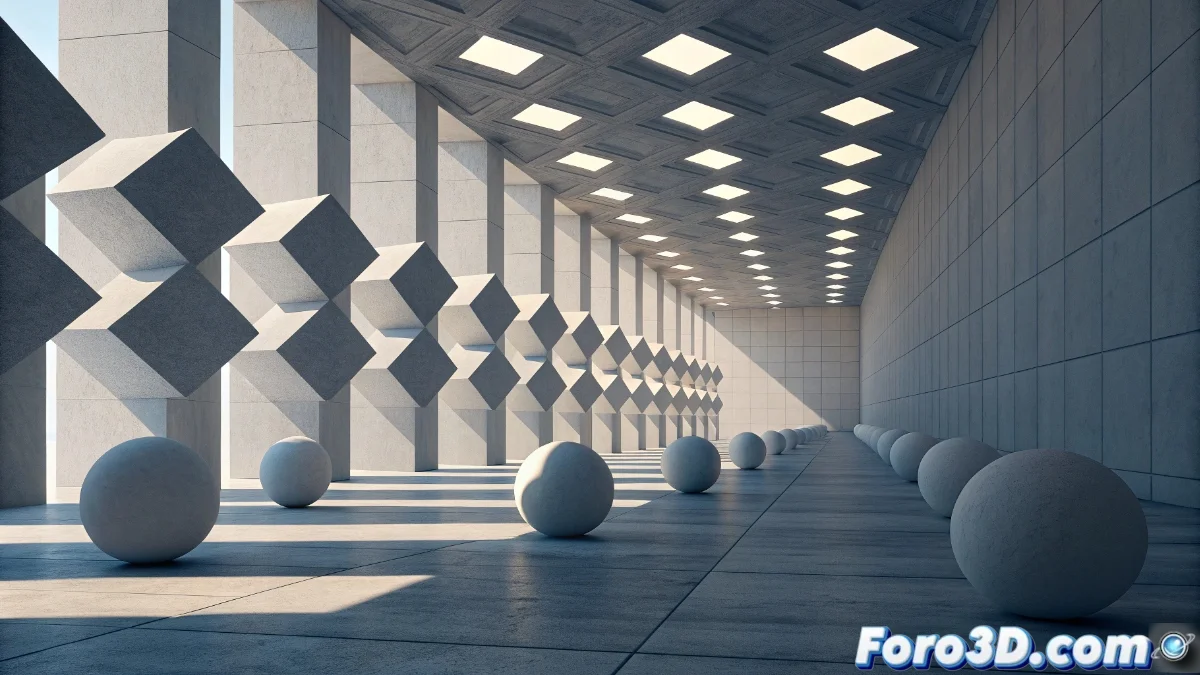
Rhythm and Composition in 3D Design: Parallels with Music
The organization of elements in three-dimensional scenes maintains a deep connection with the principles of musical composition. Just as a melody is structured through notes and silences, 3D space is articulated through volumes and voids that generate visual rhythm 🎵.
Translation of Musical Concepts to Visual Elements
The musical meter finds its equivalent in the modular repetition of architectural forms, while variations in intensity are reflected in contrasts between solids and voids. The tempo manifests through the density of objects: dense groupings convey dynamism, while open arrangements evoke tranquility 🌌.
Key elements in this transposition:- Volumes as notes: Physical masses define the main visual pulse
- Voids as silences: Free areas allow perceptual pauses
- Repetitions as motifs: Recurrent patterns create spatial coherence
Harmonic 3D design is not seen, it is felt; like good music, it resonates in our spatial perception
Practical Implementation in 3D Composition
In the creation of three-dimensional scenes, artists establish base rhythms through regular sequences of structural elements. Over this base, secondary patterns are superimposed that introduce complexity and variation. The conscious handling of visual silences prevents saturation and allows the composition to breathe 🌀.
Essential tools and techniques:- Procedural arrays: To generate adjustable modular repetitions
- Particle systems: Allow control of density and spatial distribution
- Scale hierarchies: Establish contrast and visual accents
The Sensory Duality in Digital Art
There is a fundamental creative irony: just as musicians wish to visualize their creations, 3D artists aspire for their works to convey auditory qualities. This sensory interdependence demonstrates how art always seeks to transcend the limits of its original medium, creating multisensory experiences that resonate on multiple levels of perception 🎭.