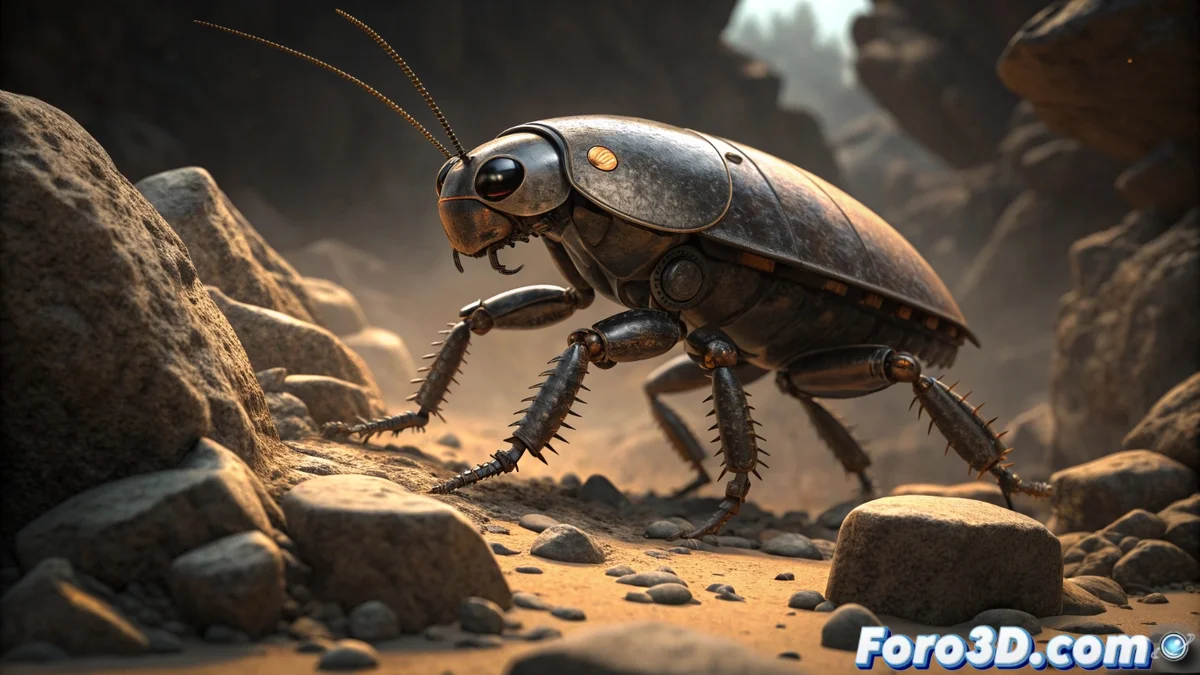
RHex: The Nature-Inspired Hexapod Robot
At the forefront of bioinspired robotics, emerges RHex, a remarkable six-legged robot resulting from the collaboration between researchers from the University of Pennsylvania and Boston Dynamics. Drawing from the efficiency and resilience of the cockroach, this mechanical marvel is designed to conquer hostile environments with an agility that redefines the limits of artificial mobility 🦿.
Architecture and Design Principles
The essence of RHex lies in its minimalist and robust design. Unlike wheeled or tracked platforms, its six semicircular legs allow it to perform dynamic movements such as running, jumping, and overcoming obstacles fluidly. This locomotion mechanism, which emulates biological patterns, provides exceptional traction and stability on unpredictable surfaces.
Key technical features:- Integrated chassis: Houses a suite of advanced sensors (IMU, cameras, lidar) that enable real-time adaptation to the terrain.
- Versatile legs: Made with composite materials, their curved shape optimizes propulsion and cushioning on irregular surfaces like sand, rocks, or debris.
- Autonomous control: Equipped with artificial intelligence algorithms that process sensory data to make navigation decisions without constant human intervention.
RHex represents a paradigm in robotic locomotion, demonstrating that well-conceived mechanical simplicity can outperform more complex designs in chaotic environments.
Practical Applications in the Real World
RHex's adaptability makes it an invaluable tool for scenarios where human access is limited or dangerous. Its role has expanded beyond the laboratory to critical applications that save lives and expand our knowledge.
Main fields of implementation:- Search and rescue (USAR): Penetrates collapsed structures after earthquakes or explosions to locate survivors, reducing risk to emergency teams.
- Scientific exploration: Accesses unexplored or extremely difficult terrains, such as caves, glaciers, or environmental disaster zones, to collect data.
- Surveillance and reconnaissance: In defense and security missions, it can perform reconnaissance tasks in urban or natural environments with great stealth and effectiveness.
Future and Ethical Considerations
Ongoing development by UPenn and Boston Dynamics focuses on improving its energy autonomy, remote control precision, and integration of modular tools. While RHex imitates an insect to achieve the seemingly impossible, its evolution raises fascinating reflections. Its growing independence and robustness leads us to imagine a future where such machines are commonplace, sparking both admiration for their utility and cautious curiosity about the limits of their deployment 🤖.