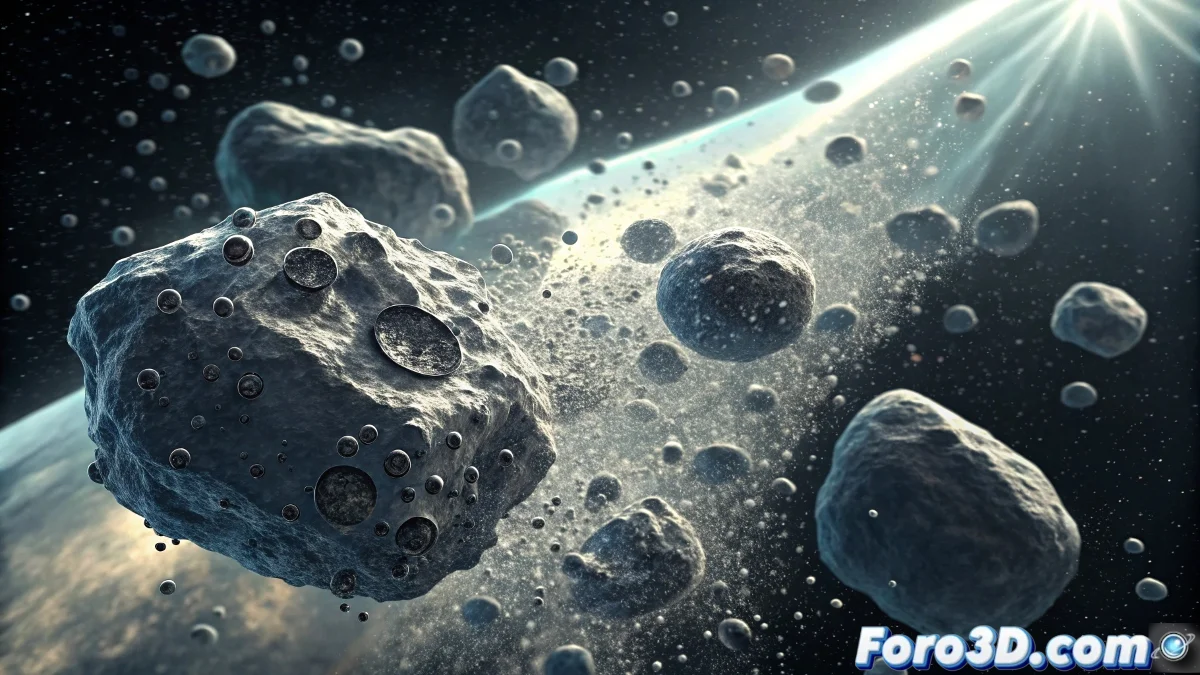
Revolutionary Discovery: Liquid Water on Asteroid Ryugu Challenges Solar System Timeline
The Hayabusa2 mission by the Japanese space agency JAXA has provided extraordinary evidence that is rewriting textbooks about the early history of our cosmic neighborhood. Detailed analysis of samples collected from asteroid Ryugu suggests that aqueous processes persisted far beyond what theoretical models predicted 🪐
Revelations from the Depths of Space
The asteroidal fragments studied using mass spectrometry and electron microscopy have revealed hydrated minerals that could only have formed in the presence of circulating liquid water. This hydrothermal alteration occurred when the solar system was already over a billion years old, a period considered too late for such active processes according to conventional theories.
Key Research Findings:- Presence of phyllosilicates and carbonates that require liquid water for their formation
- Evidence of chemical reactions between minerals and aqueous fluids at moderate temperatures
- Isotopic composition indicating an early origin but prolonged alteration
Asteroids like Ryugu functioned as active geological systems over surprisingly extensive timescales, maintaining their own internal hydrological cycles long after estimated
Implications for the Search for Extraterrestrial Life
This transformative discovery suggests that potentially habitable conditions could have persisted in numerous bodies of the solar system for significantly longer periods. The temporal window for the development of prebiotic chemistry expands considerably, opening new perspectives for astrobiology.
Main Scientific Consequences:- Revision of thermal evolution models for primitive bodies
- New horizons for the search for biosignatures in asteroidal materials
- Reevaluation of water distribution mechanisms in the solar system
A New Paradigm for Planetary Science
These results force the scientific community to fundamentally rethink the established chronology of when and how liquid water was available in the early solar system. What we considered as fixed temporal limits now appear as moving frontiers in our understanding of the cosmos 🌌