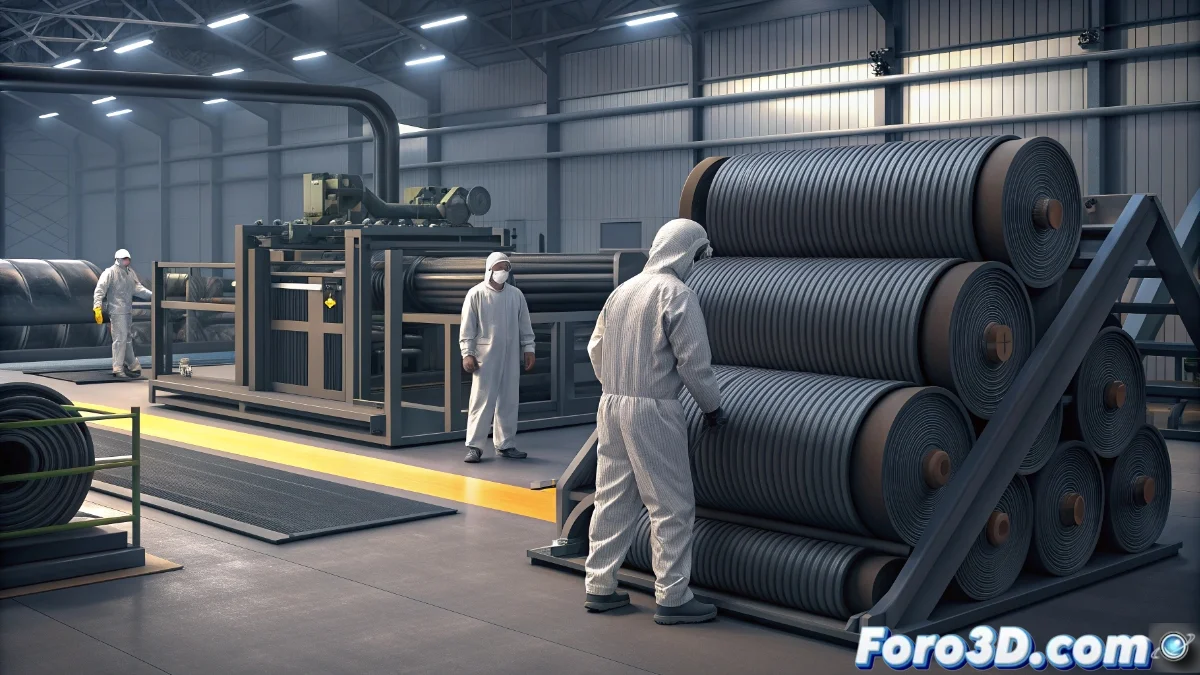
Revolution in Composite Materials: Procotex Recycled Carbon Fiber
The French company Procotex is radically transforming the composite materials sector through the development of recycled carbon fiber that fully matches the technical characteristics of virgin material, but with substantially lower production costs. This innovation responds to the growing industrial need for eco-friendly solutions that do not sacrifice performance, positioning the company as a leader in the circular economy of high-tech materials 🌱.
Advanced Recovery Technology
Procotex has deployed an exclusive patented system that allows recovering up to 95% of carbon fibers from industrial waste and end-of-life products. Through specialized thermal and mechanical methods, they preserve the essential mechanical properties of the fiber, enabling its reuse even in high-demand industries such as aeronautics and automotive. The resulting material retains the stiffness and strength inherent to the original carbon, but with a 70% reduction in environmental impact 🔬.
Key Process Features:- 95% fiber recovery from industrial waste
- Complete preservation of fundamental mechanical properties
- Application in high technical demand sectors
"Now it turns out that green is not only beautiful, but also cheaper. Maybe we should start recycling our preconceived ideas too." - Specialized Engineer
Competitive Advantages in the Current Market
Procotex's recycled fiber offers a price up to 40% cheaper compared to virgin material, a crucial factor for its mass implementation by manufacturers seeking to optimize costs without compromising quality. Additionally, the manufacturing process consumes considerably less energy than new fiber production, generating significant economic and ecological savings. These benefits are attracting the attention of clients in high value-added industries that have historically shown resistance to recycled materials due to performance concerns 💰.
Highlighted Benefits:- 40% cost reduction compared to virgin fiber
- Drastically lower energy consumption in production
- Attraction of traditionally conservative industrial sectors
Impact on the Industry of the Future
This technological innovation not only represents an advance in industrial sustainability, but also establishes a new paradigm in composite materials manufacturing. The ability to offer equivalent performance with tangible environmental and economic benefits is redefining sector standards, demonstrating that the circular economy can perfectly coexist with the most demanding technical requirements 🚀.