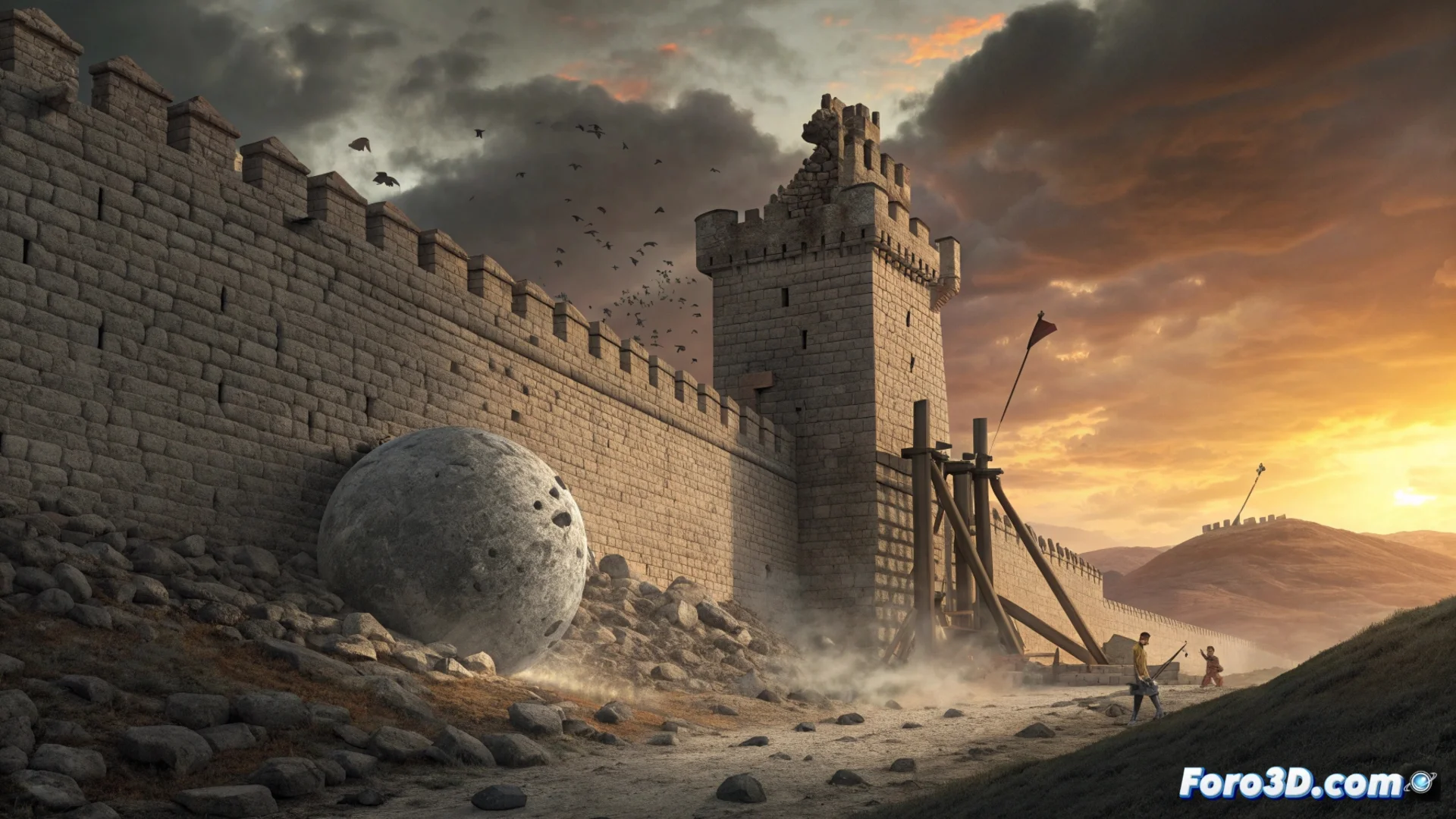
Reverse Engineering to Decipher the Collapse of a Medieval Castle
A group of researchers applies reverse engineering techniques to understand how a medieval fortress could have failed during a historical siege. The process digitally reconstructs the events, combining modern scanning and simulation technologies to validate archaeological hypotheses. 🏰
Reconstructing the Structure from the Ruins
The first step involves generating a precise 3D model of the current remains. For this, photogrammetry is used with specialized software like Agisoft Metashape. This initial model, which captures the geometry of the ruins, is then imported into Blender. In this environment, experts digitally restore the structure, returning it to its original and complete form before the attack. The ultimate goal is to produce a faithful virtual replica that serves as a base for physical simulation tests.
Modeling Phases:- Capture data with photogrammetry to create a detailed 3D mesh of the ruins.
- Refine and restore the geometry in Blender, reconstructing missing parts based on historical evidence.
- Prepare the final optimized model to be processed by simulation software.
The virtual replica is not just an image; it is a structurally consistent digital twin prepared to undergo a simulated siege.
Simulating Trebuchet Bombardment
With the model ready, the attack is simulated. Historical parameters of the siege engines are introduced, such as the maximum range of a trebuchet and the weight of its projectiles. Custom physical simulation software calculates thousands of possible trajectories, taking into account variables like the firing angle and air resistance. This analysis identifies which sections of the wall would receive the most impacts and how much kinetic energy they would absorb. The points with the highest probability of impact are determined systematically. 💥
Key Variables in the Simulation:- Siege engine parameters: projectile mass, angle, and launch force.
- Simulated environmental conditions, such as wind direction and intensity.
- Calculation of impact distribution and energy transferred to the structure.
Validating Failure Points with Structural Analysis
The areas marked by the simulation as high-impact are analyzed in more detail. Finite element analysis is used with tools like Ansys or Abaqus. These simulations evaluate how the wall's masonry responds to repetitive stress from impacts, seeking stress concentrations that could initiate a crack or cause a collapse. The results, which show the weakest sectors of the simulated structure, are then compared with the actual archaeological damage documented in the ruins. The correlation between the failure points predicted by the model and the observable damage validates the hypothesis on how the attack occurred. An interesting counterfactual: if cannons had existed at that time, this analysis would have been much shorter and the results, evidently, more explosive. ⚙️