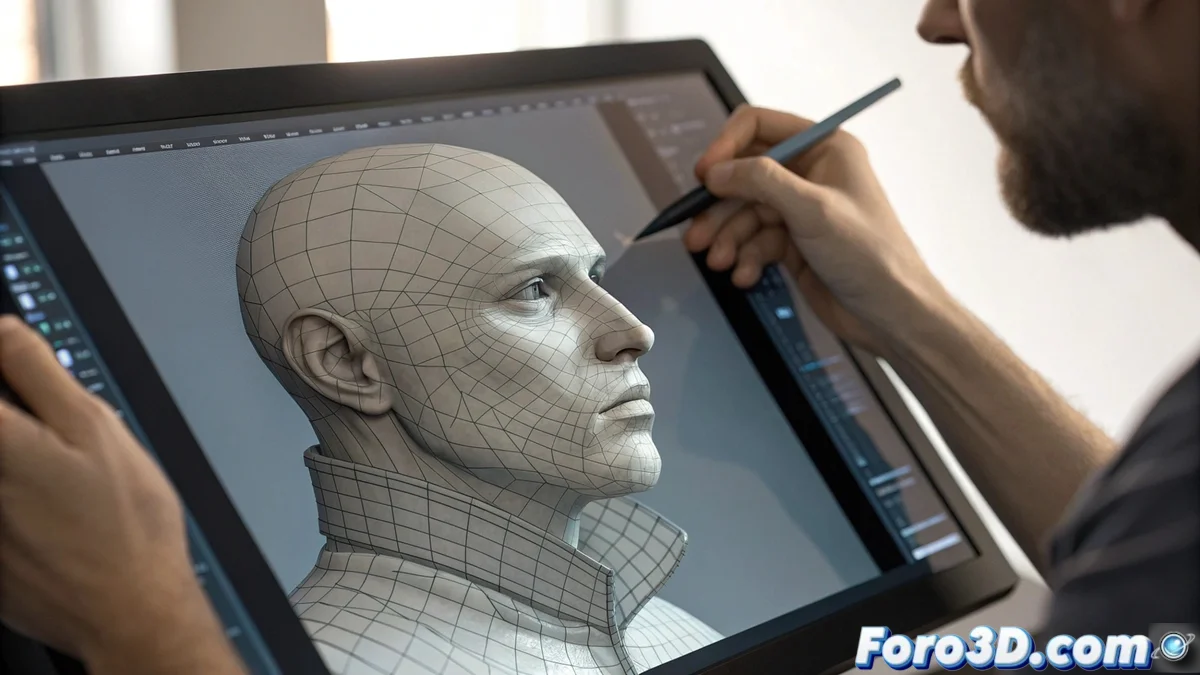
Retopology: Rebuilding Meshes for Animation
In the 3D modeling workflow, a crucial step is retopologizing. This process involves rebuilding an orderly and lightweight polygonal mesh over a high-density base, such as a digital sculpture. Without this step, it is almost impossible for a model to move realistically or accept textures properly. 🛠️
Why Edge Flow is Vital
The main goal is not just to reduce polygons, but to organize a logical edge flow. This flow must follow the natural lines of the anatomy or the object's shape. A good flow ensures that the model deforms credibly when animating, avoiding visual breaks or strange folds. Polygons are strategically arranged to support the planned movement.
Key Benefits of Good Retopology:- Allows animating characters and objects with realistic and clean deformations.
- Facilitates the process of applying textures and UV mapping, as the mesh is uniform.
- Optimizes performance by using fewer resources for a model that will move, without losing the original sculpture's shape.
Retopology transforms your digital sculpture, which may look like a block of virtual clay, into a model that can bend a knee or smile without internal issues.
How the Process is Carried Out
Artists use tools specific to software like Blender, Maya, ZBrush, or dedicated packages. The basic technique consists of manually drawing polygons one by one over the high-resolution mesh, carefully following its contours and silhouettes.
Common Approaches and Tools:- Manual Retopology: The artist defines each loop and ring of polygons, offering maximum control for complex areas like the face, hands, or clothing.
- Semi-Automatic Tools: Modules like ZRemesher in ZBrush or Retopology in Blender can speed up the process on simpler surfaces, but usually require manual adjustments.
- Guides and Snapping: Surface snapping functions and guide curve drawing are used to place new vertices precisely on the reference model.
The Art Behind the Technique
More than a technical step, retopologizing is an artistic skill. It requires understanding how anatomy moves and anticipating where more or fewer edges are needed. It is the fundamental bridge between a static sculpture and a model ready to live in an animation or video game. Mastering this process is essential for any modeler who wants their creations to move. 🎬