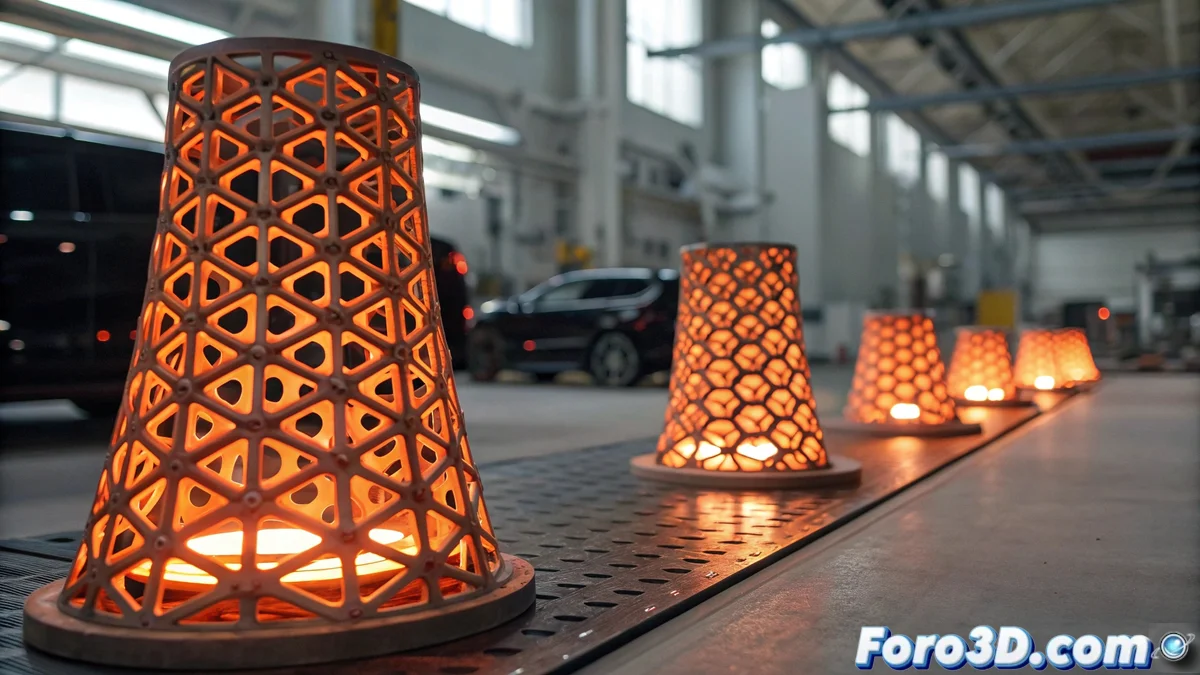
Lattice Structures in 3D Printing: Revolution in Lightweight Component Design
Additive manufacturing is undergoing a radical transformation thanks to the implementation of lattice structures that enable the creation of extraordinarily lightweight components without compromising their structural capacity. These designs inspired by natural patterns are redefining the limits of engineering in diverse sectors such as automotive, sports medicine, and technical equipment 🚀
Innovative Industrial Applications
Lattice configurations are proving their worth in applications where weight is critical. In the automotive industry, they enable the development of internal components that significantly reduce the vehicle's total mass while maintaining safety standards. Sports footwear manufacturers have discovered that these customizable structures in soles offer unprecedented levels of cushioning and ventilation.
Highlighted Implementations:- Mountaineering Equipment: Backpacks with lattice panels that intelligently distribute loads, increasing comfort during prolonged activities
- Medical Implants: Porous designs that promote bone integration and minimize immunological rejection reactions
- Aerospace Components: Ultralightweight structures that meet rigorous strength and durability requirements
The beauty of these structures lies in how they challenge our intuition: materials that seem fragile like technological Swiss cheese can withstand surprising loads, demonstrating that in engineering, less material can mean greater performance
Technical Advantages and Design Considerations
Topological optimization represents the heart of these solutions, using advanced algorithms that determine the ideal material distribution according to specific loads. This approach not only reduces filament consumption by up to 70%, but also significantly accelerates manufacturing times. Designers must master multiple parameters such as cell density, wall thicknesses, and structural geometries.
Critical Design Factors:- Cell Size: Determines the final structure's rigidity and flexibility
- Geometric Pattern: Triangles, hexagons, and organic shapes that optimize different types of loads
- Specialized Software: Generative design tools that create configurations impossible with traditional methods
Future and Development Potential
Lattice structures continue to evolve toward increasingly sophisticated applications, integrating composite materials and variable geometries that dynamically respond to different load conditions. This technology not only represents an advance in material efficiency, but also opens new frontiers in sustainable design and mass customization, demonstrating that 3D printing remains one of the most exciting fields in contemporary engineering 💡