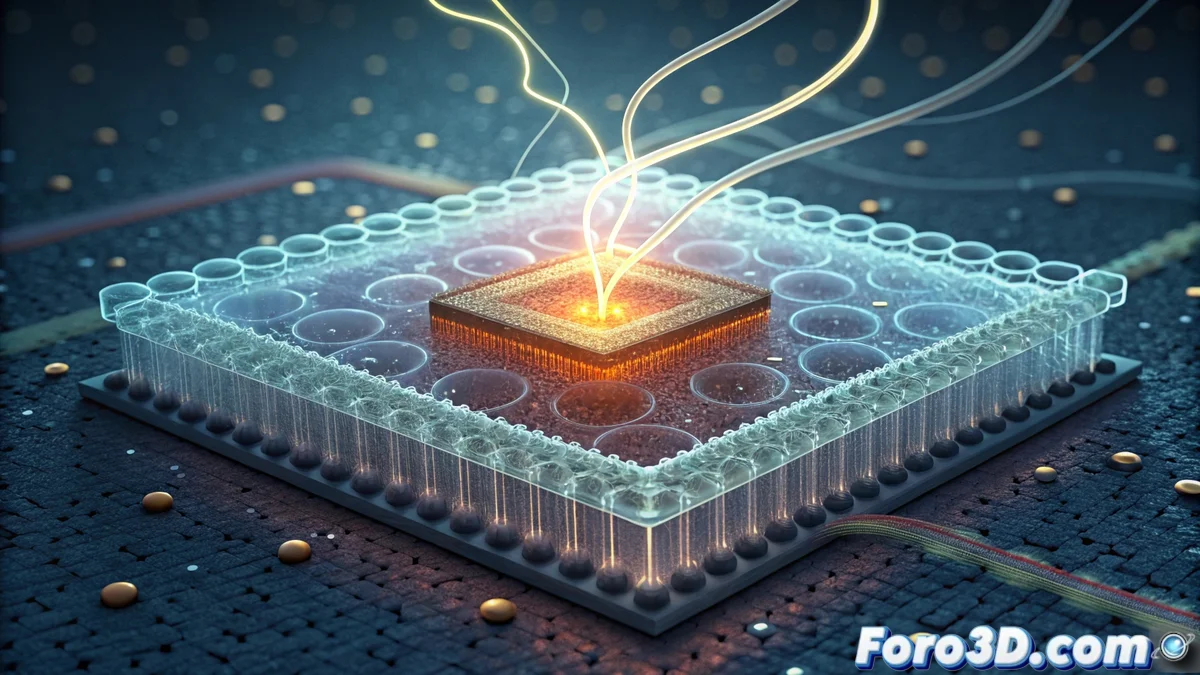
Resistive RAM or ReRAM Competes with Other Technologies
In the computer memory landscape, Resistive RAM emerges as a disruptive alternative. This technology, also called ReRAM or RRAM, belongs to the category of non-volatile memories. Its fundamental principle lies in altering the electrical resistance of a special material to store information, physically materializing a memristor. Its promises include pairing high storage capacity with minimal energy consumption. Additionally, its intrinsic architecture enables processing operations within the memory array itself, a paradigm known as in-memory computing. 🚀
The Mechanism Driving ReRAM
The basis of its operation is a reversible physical change. By supplying a precise voltage, conductive filaments are generated or destroyed at the nanoscale within the dielectric layer. This action modifies its resistance, oscillating between a high value for a logical '0' and a low one for a '1'. The state is maintained without the need for constant energy, defining its non-volatile nature. Its elemental design, commonly an intersection between two electrodes, allows for the fabrication of extremely compact cells and stacking them in multiple layers to achieve high density in 3D.
Key characteristics of its operation:- The state change is reversible and fast, based on ionic phenomena.
- The cell structure is simple, facilitating scaling and miniaturization.
- It retains data permanently when power is disconnected.
The race for the ultimate memory sometimes seems like a game of 'burn and mark', but here it literally involves forming and breaking paths at the atomic scale.
Potential and Obstacles on the Path
This technology stands out for its write speed, which surpasses conventional NAND Flash memory, and for its high tolerance to repeated write and erase cycles. Its energy efficiency makes it ideal for mobile devices and for accelerating artificial intelligence tasks, where it can natively optimize matrix calculations. However, to achieve mass production and reliability, it must overcome several technical challenges.
Main challenges to overcome:- Precisely and uniformly controlling the formation of conductive filaments in each cell.
- Ensuring a long lifespan and consistent reliability across all manufactured devices.
- Refining manufacturing processes to be cost-competitive with established technologies.
The Future of Storage and Processing
Resistive RAM is not just a potential substitute for Flash memory; it represents a shift toward architectures where storing and computing converge. Its ability to enable in-memory computing can drastically reduce data transfer, a bottleneck in modern systems. Various companies and global research centers are intensely working to resolve manufacturing and stability issues. If they succeed in overcoming these hurdles, ReRAM could redefine hardware design for high-performance computing and intelligent edge devices, making information processing more efficient. 💡