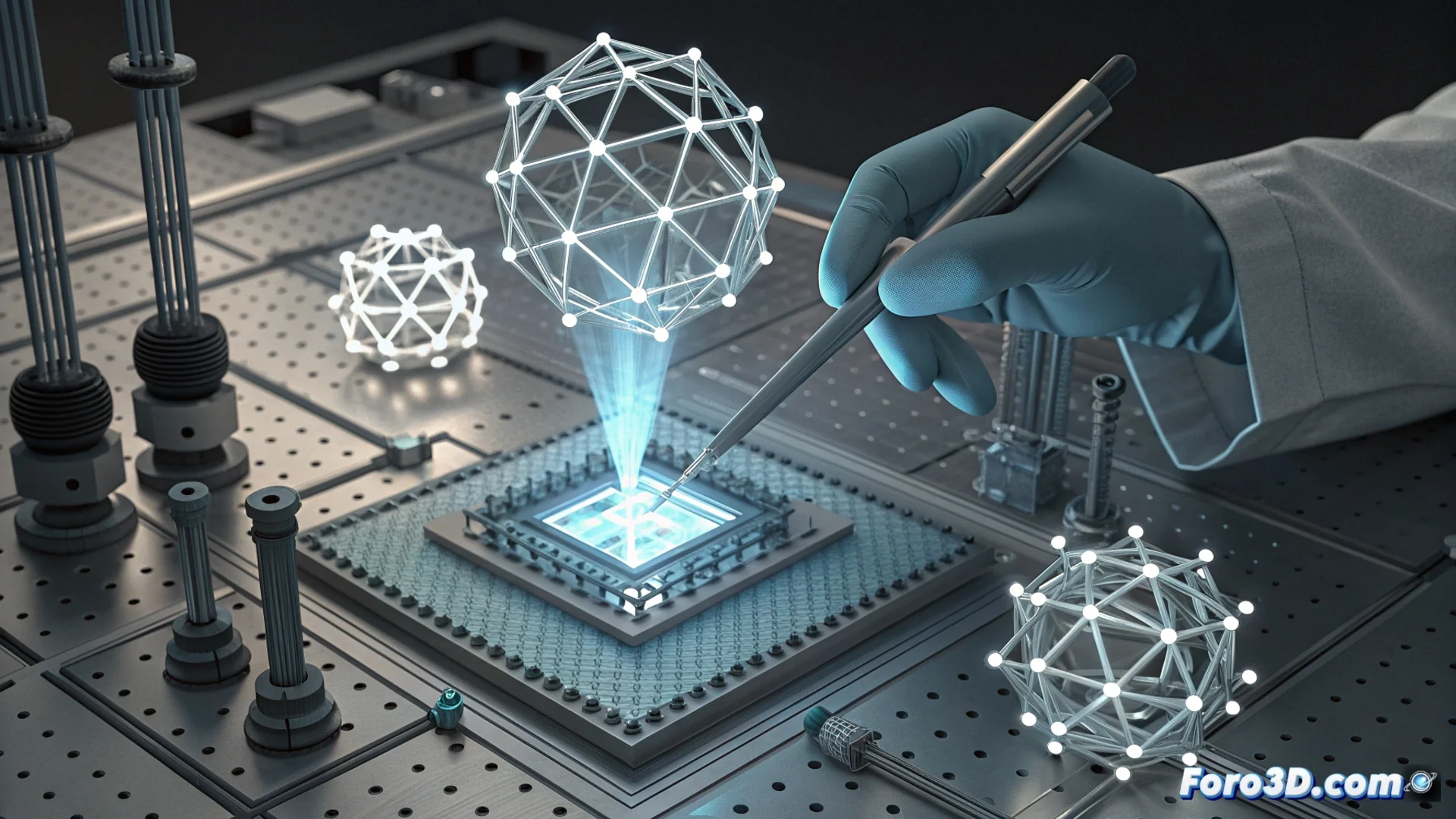
Researchers Develop Quantum Memory on Chip with Light Cages
The race to build practical quantum networks takes a leap forward with a new device. A team of researchers has successfully integrated a functional quantum memory directly onto a chip, using an ingenious system of light cages fabricated in 3D. This method allows for controlled confinement and manipulation of photons, a fundamental requirement for processing quantum information. 🚀
The Technological Foundation: Photonic Crystal Cavities
The innovation lies in fabricating photonic crystal cavities on a silicon nitride substrate. Using microscopic-scale 3D printing techniques, scientists create structures that act as perfect traps for light. Inside these cages, photons encoding quantum bits or qubits can be stored stably. Integrating this functionality into a chip platform is crucial for making the system compact and scalable.
Key Design Features:- Direct Fabrication: The microstructures are 3D printed directly onto the chip, simplifying the integration process.
- Efficient Confinement: The cages trap light with high efficiency, minimizing photon escape.
- Scalable Platform: The use of silicon nitride allows for parallel fabrication of many such devices.
This approach integrates memory functionality into a chip platform, which is key to scaling the system.
Overcoming Challenges of Previous Memories
The light cages architecture addresses common limitations in previous designs. By coupling light more directly and reducing losses, the device operates with greater speed and reliability. Experimental results confirm that it can store and read quantum states with the high performance required for real-world applications.
Demonstrated Operational Advantages:- Fast Operation: Reduces the time needed to store and retrieve quantum information.
- High Fidelity: Maintains the integrity of delicate quantum states throughout the process.
- Reduced Losses: The design minimizes signal degradation, improving overall efficiency.
A Future for Quantum Networks
This breakthrough represents an essential component for communicating quantum information over long distances. On-chip memories like this are the quantum repeaters of the future, necessary to connect nodes in a network. The next step will be to further optimize storage time and integration with other parts of a quantum computer. The photon, though it may get bored in its cage, has a brilliant role to play. 🔬