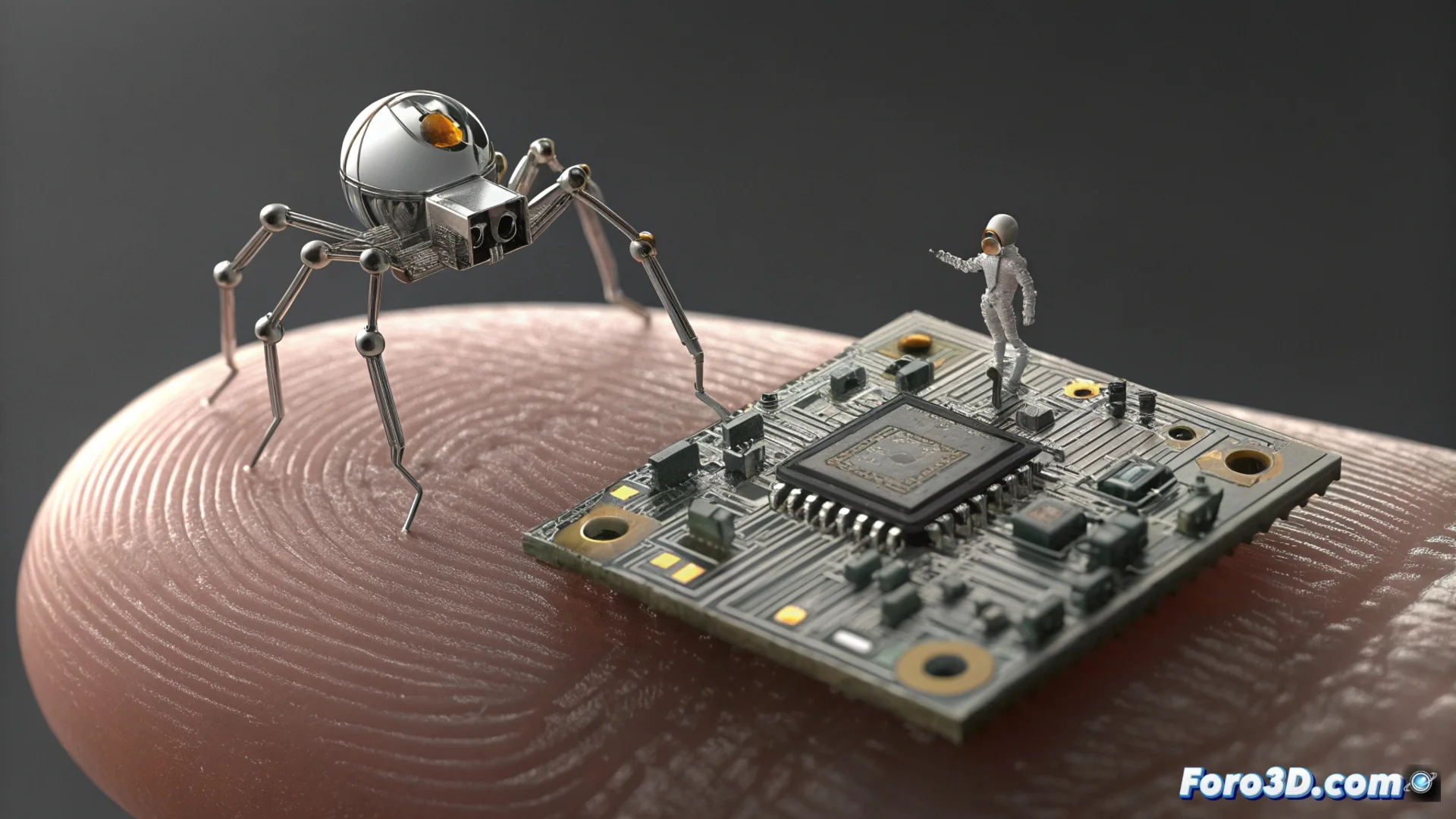
Researchers Create the World's Smallest Programmable Robot
The frontier of robotic miniaturization has just advanced. 👨🔬 A joint team from the universities of Pennsylvania and Michigan has succeeded in manufacturing a complete robotic device whose size rivals that of a simple grain of salt. The most notable feature is its ability to operate completely autonomously, without relying on cables or external batteries.
A Complete System in a Tiny Volume
This microscopic robot is not just a passive sensor. It integrates into its tiny structure the fundamental trilogy of robotics: sensing, processing, and acting. 🧠 It has circuits at scale that allow it to detect changes in its environment, such as temperature variations or the presence of certain chemical compounds. An internal microprocessor analyzes this information and decides on the appropriate response, which can translate into controlled movement or the release of a specific substance.
Key features of the device:- Total autonomy: Operates without the need for an external power source, which is crucial for internal applications.
- Integrated processing: Makes decisions based on the stimuli it detects.
- Physical action: Can perform mechanical or chemical tasks in its micro-environment.
It demonstrates that it is possible to package autonomy into an almost invisible space.
The Future Lies in Precision Medicine
The field where this breakthrough promises to revolutionize current paradigms is, without a doubt, medicine. 🏥 Its minuscule size allows us to imagine its introduction into the bloodstream or specific tissues to perform functions that were previously impossible.
Potential medical applications:- Precise drug delivery: Carry medications directly to a tumor or diseased cell, minimizing effects on the rest of the body.
- Real-time monitoring of indicators: Evaluate glucose levels, inflammation markers, or other physiological parameters from within.
- Assist in diagnostics: Access hard-to-reach areas to take samples or images, reducing the need for invasive surgeries.
A Prototype with a Long Way to Go
Although the laboratory prototype is functional and proves the concept, the researchers are cautious. 🔬 They emphasize that there is still a long process ahead to test its safety, efficacy, and reliability in complex biological systems before it can be used in patients. Nevertheless, this technological milestone lays the foundation for a new generation of microscale medical tools.