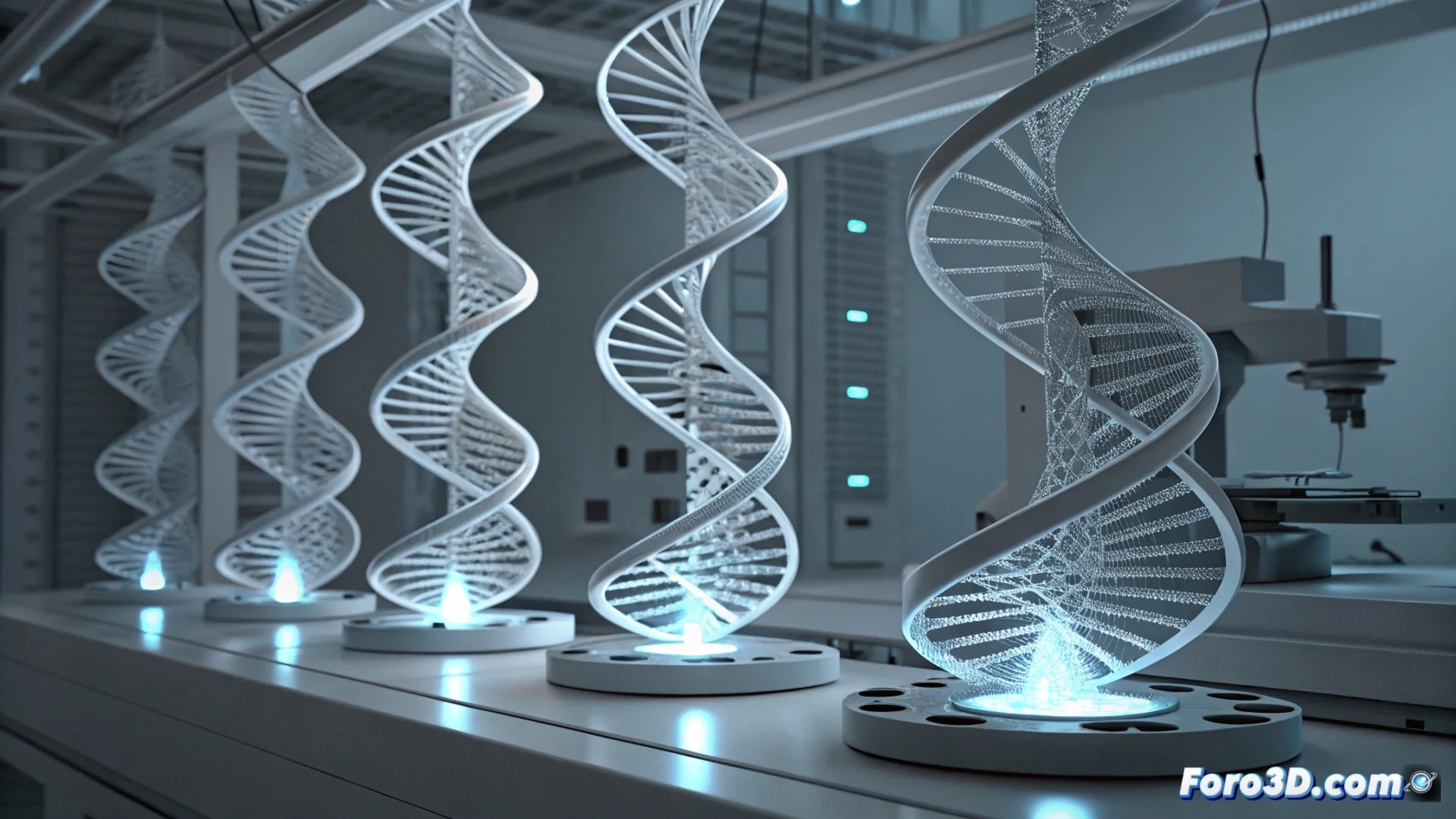
Researchers 3D Print Chiral Helices for Terahertz Optics
A team from the Lawrence Livermore National Laboratory (LLNL) has succeeded in producing complex helical structures using additive manufacturing. These chiral metamaterials can direct and modify radiation in the terahertz band, an achievement that facilitates the design of custom optical components for a challenging spectral range. 🌀
Microscopic Precision with Digital Light Projection
The core technique is digital light projection stereolithography (DLP). With this method, researchers cure a light-sensitive photopolymer layer by layer, guided by a digital design. This precise control allows achieving the exact geometry and orientation required for the microhelices to interact with terahertz waves in specific ways, a freedom that conventional manufacturing processes do not offer.
Key Advantages of Additive Manufacturing:- Allows creating complex and intricate helical geometries.
- Offers unprecedented control over the orientation and size of structures.
- Streamlines the process of producing prototypes and final devices.
3D printing enables the production of these devices faster and with more complex designs than before.
Practical Applications in Cutting-Edge Technology
These 3D-printed metamaterials are ideal for manufacturing active optical components in the terahertz range, such as polarizers, isolators, or modulators. Terahertz radiation is used in fields where other frequencies are invasive or slow, opening up a range of practical uses.
Direct Application Fields:- Medical Imaging: For safe scanning without ionizing radiation.
- Communications: Enables data transmission at extremely high speeds.
- Spectroscopic Detection: In sensors that identify materials by their spectral signature.
The Future Takes the Shape of a Helix
This advance demonstrates how high-precision 3D printing can solve problems in photonics and advanced optics. By enabling the fabrication of custom chiral structures, it paves the way for a new generation of compact and efficient devices that manipulate a very useful but difficult-to-master electromagnetic spectrum. The literal "twist" of these printed helices is revolutionizing the control of invisible waves. ⚡