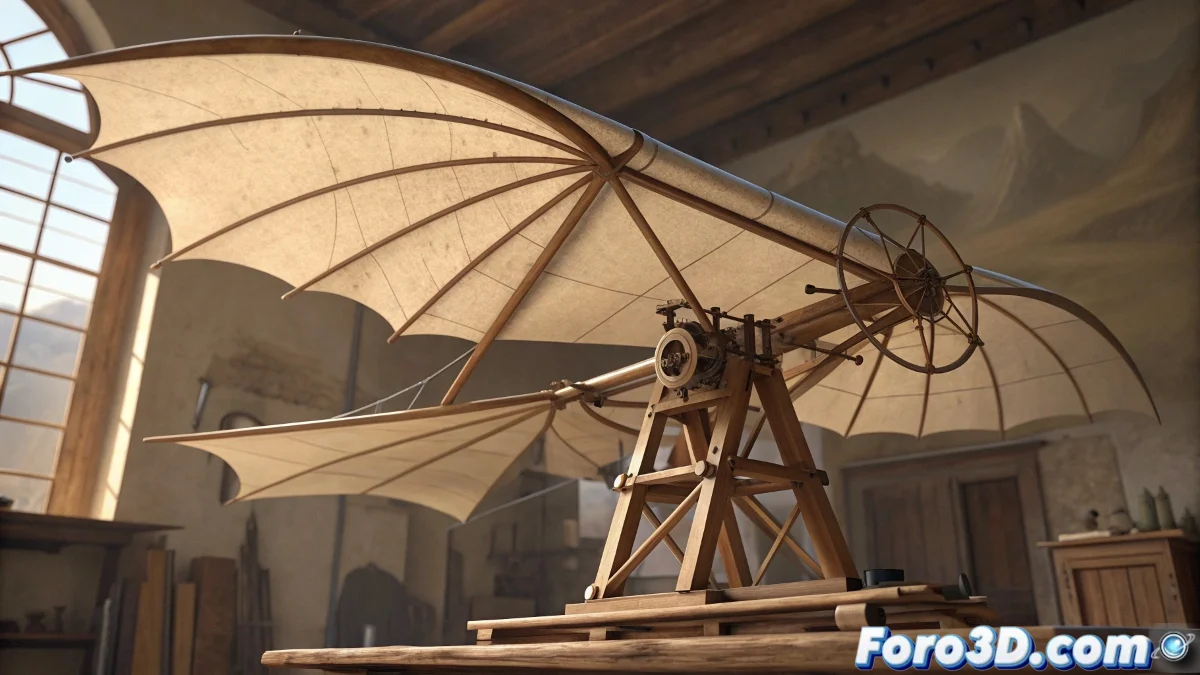
When the Renaissance genius meets modern software
Leonardo da Vinci's Aerial Screw represents one of those visionary ideas that anticipated centuries of technological development. Considered the conceptual precursor to the modern helicopter, this 15th-century design proposes a helical linen structure to compress air and generate lift. Recreating it in Blender is not just a modeling exercise, but a dialogue between the Renaissance mind and contemporary digital tools.
The artistic challenge lies in capturing not only the physical form of the invention, but also the essence of Da Vinci's thinking. His designs combine scientific observation with a particularly organic aesthetic, where each element serves a specific function. In Blender, this translates to paying attention to structural details while maintaining that sketchy quality characteristic of his codices.
Key elements of the original design
- Helical structure approximately 10 meters in diameter according to original specifications
- Wooden frame with metal reinforcements at critical joints
- Linen surface gummed to maintain the rigidity of the helical shape
- Human-powered drive mechanism via platform and bars
Workflow in Blender
The modeling begins with the creation of the base spiral using Bezier curves that define the helical path. This curve will serve as a guide for the array modifier that generates the repetitive structure of the screw. The key is to achieve the correct blade inclination to match Da Vinci's original sketches, maintaining that sensation of being both organic and mechanical.
Da Vinci's genius lies in how he transformed natural observation into practical engineering
Materials play a crucial role in visual authenticity. The wood must show the characteristic grain and knots of Renaissance carpentry, while the linen needs a texture that suggests fabric stretched over a rigid structure. Shaders in Blender can be enriched with roughness maps that capture how materials would age over time, adding that historical patina so characteristic of Leonardo's designs.
Specific modeling techniques
- Circular arrays to replicate the helical structure around the central axis
- Subdivision surface modifiers to smooth shapes while maintaining control
- Basic sculpting to add natural irregularities to the wood
- Texture painting to create construction marks and wear
The lighting must evoke the atmosphere of a Renaissance workshop, with soft light entering through high windows and creating chiaroscuros that accentuate the three-dimensional form of the screw. The intelligent use of volumetrics can suggest dust floating in the air, so characteristic of Quattrocento workspaces. The final render not only shows an object, but tells the story of an idea that anticipated the future.
Those who think Da Vinci's designs were just fantasies probably haven't tried recreating them with the precision that Blender allows 🌀