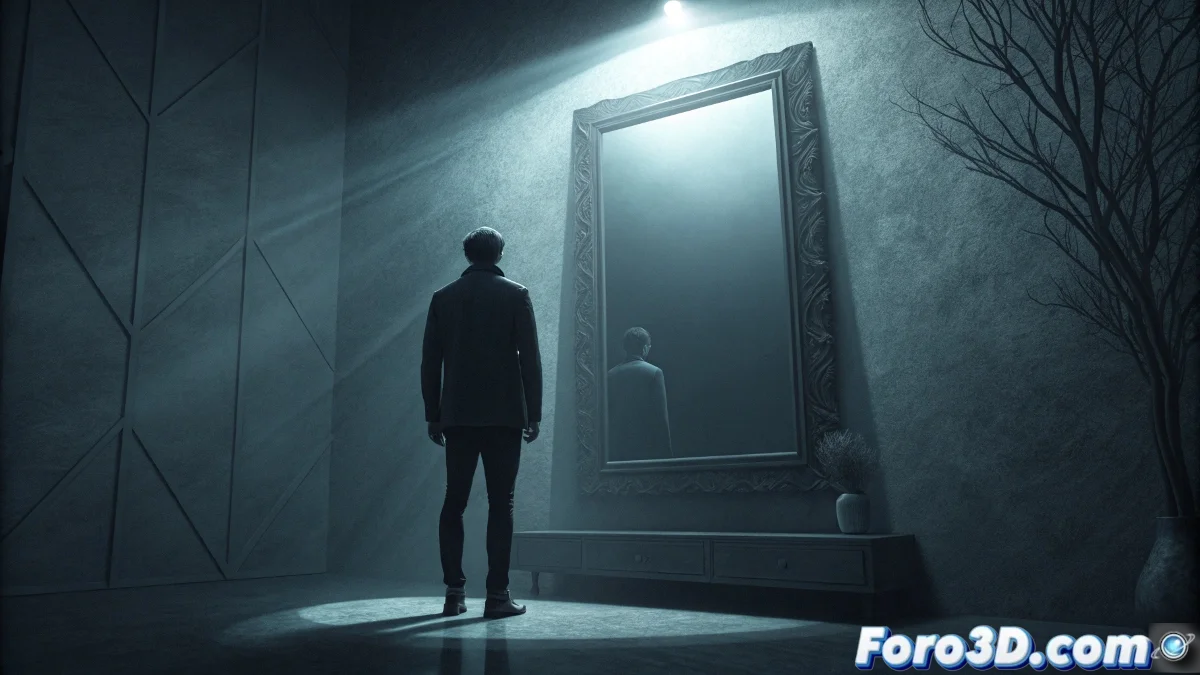
Rendering the Bottomless Mirror Man in Keyshot for Digital Psychological Horror
The legend of the Bottomless Mirror Man represents a modern manifestation of digital psychological horror, where a reflection that does not correspond to reality or simply the total absence of a reflection generates an immediate existential crisis, playing with the primal fear of loss of identity and the possibility that unknown entities have usurped our place in the reflected reality, offering the perfect scenario to master advanced reflective materials and lighting control techniques in Keyshot. 🪞
Psycho-Digital Context and Identity Horror
This internet age phenomenon transcends physical locations to inhabit the digital space, representing the contemporary fear of identity loss in a hyperconnected world. The mirror, traditionally a symbol of truth and self-recognition, becomes a portal to existential uncertainty where what is reflected no longer guarantees the real.
Characteristic manifestations of the phenomenon:- Reflection that does not synchronize with real movements
- Complete absence of reflection in a normal mirror
- Reflected figure that maintains a different expression
- Black void where the reflection should be
- Sensation of "something watching from the other side"
A reflection in the mirror that does not imitate your movements correctly or that, when stared at fixedly, simply reflects nothing - Description of the digital phenomenon
Research on Optics and Visual Perception
It is essential to study the physical properties of real mirrors, the psychology of reflection perception, facial recognition theories, and develop techniques to violate these established expectations in a visually credible and psychologically disturbing way.
Essential research areas:- Reflection optics on mirrored surfaces
- Psychology of facial and body recognition
- Material properties of glass and coatings
- Lighting for precise reflection control
- Visual effects of absence and void
Step by Step: Rendering in Keyshot
1. Initial Scene Setup
Open Keyshot 11 and set up the environment. Import the 3D model of the mirror and the human figure. Set the image size to 4K UHD and sampling to at least 256 for professional quality without noise.
2. Anomalous Mirror Material
Configure the main material: - Use Specular material with IOR of 1.52 (glass) - Adjust roughness to 0% for perfect reflection - Set opacity to 100% but control reflectivity - Develop coating layer for unique properties
3. Controlled Lighting System
Set up lighting for reflections: - Use domestic interior HDRI for context - Configure area lights for directional control - Develop three-point lighting for the human figure - Create light groups for independent control
4. Distorted Reflection Effects
Implement reflection anomalies: - Create a slightly different version of the human figure - Configure materials with slight color shifts - Develop different facial expressions - Set desynchronized movement timing
5. Reflective Void Material
Develop the "bottomless" effect: - Create black material with 100% reflectivity - Configure absorption for infinite depth - Develop "no reflection" effect with transparency - Set non-physical properties for mystery
6. Camera and Angles Setup
Optimize the visual composition: - Use angle that shows both subject and reflection - Configure depth of field for selective focus - Develop framing that emphasizes disconnection - Set cinematic aspect ratio
7. Integrated Post-Processing Effects
Apply render adjustments: - Configure color grading for unsettling atmosphere - Develop subtle chromatic aberration - Apply vignette for central focus - Set subtle grain for organic texture
8. Multi-Pass Rendering
Prepare for advanced compositing: - Render beauty pass as base - Generate reflection pass for independent control - Create material ID pass for easy selections - Develop depth pass for atmospheric effects
9. Progressive Anomalies Animation
Create phenomenon evolution: - Develop keyframes for subtle changes - Configure transition from normal to anomalous reflection - Create expanding void progression - Set timing for maximum psychological impact
10. Final Render and Optimization
Generate the professional result: - Render in 32-bit EXR for maximum range - Configure denoiser for reasonable times - Develop versions with different anomalies - Prepare metadata for post-production pipeline
Advanced Materials and Lighting Techniques
For cinematic results, master the use of layered materials for visual complexity, use light mixing for absolute control, and develop custom shaders for unique reflection effects. 💡
Recommended advanced techniques:- Layered materials for complex effects
- Light mixing for absolute lighting control
- Custom shaders for non-physical reflections
- Advanced ray tracing for optical precision
Integration with Post-Production Pipelines
When exporting for After Effects or Nuke, configure passes for maximum control in compositing, develop expressions to automate effects based on the reflection, and create reusable templates for phenomenon variations.
Rendering the Identity Crisis
Working with the Bottomless Mirror Man in Keyshot explores the visual representation of abstract psychological concepts, demonstrating that photorealistic rendering can be as effective for communicating existential horror as for representing physical reality, and that the controlled violation of established visual expectations can generate deeply unsettling emotional experiences. 🔄