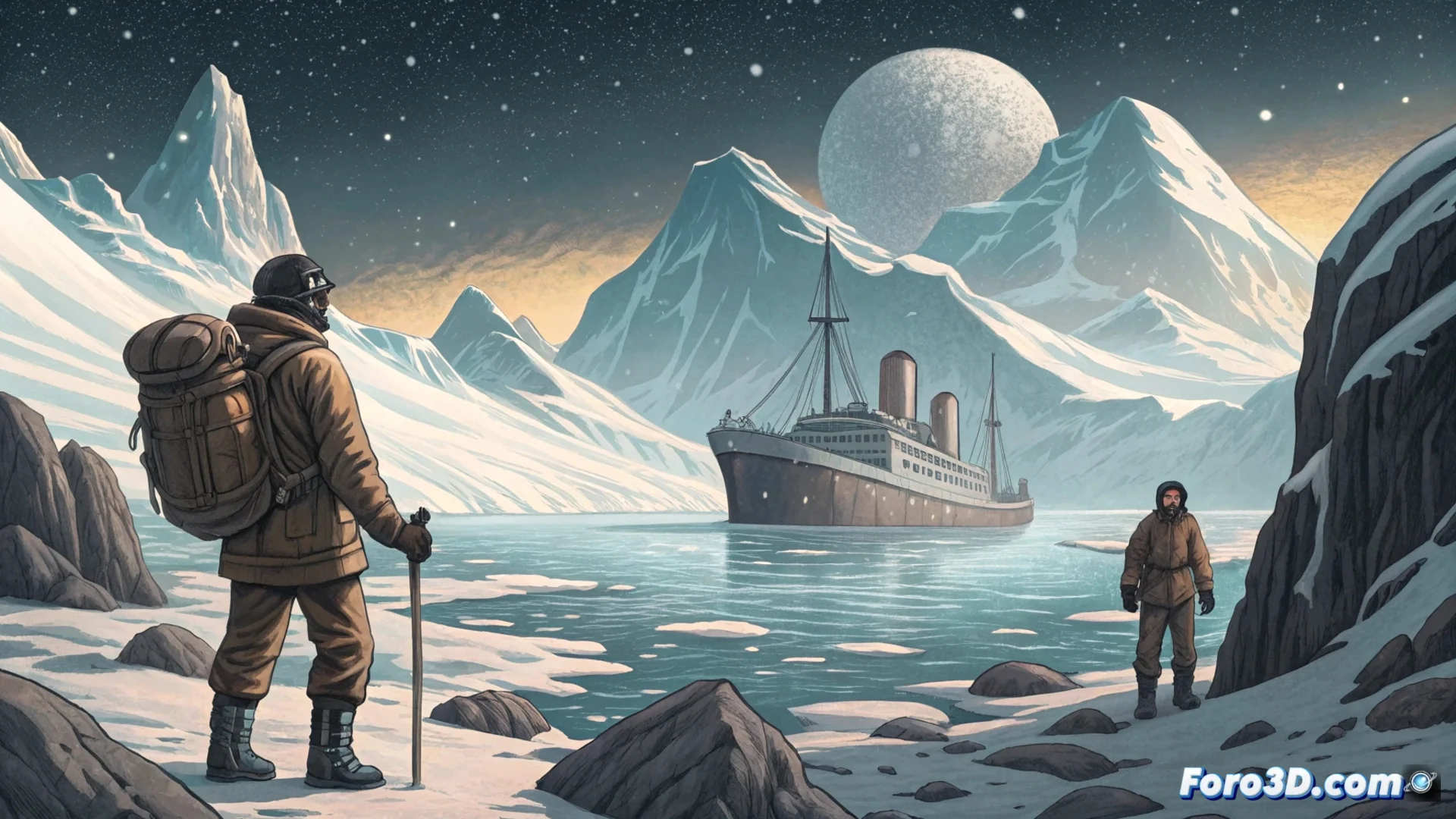
René Barjavel and His Precursor Novel on Ancient Astronauts
Long before theories about ancient astronauts became popularized, a French author had already paved the way in literature. In 1951, René Barjavel published The Day After Tomorrow, a visionary work that fuses scientific exploration with a deep reflection on human origins. 🚀
A Discovery Frozen in Time
The plot places an expedition in Antarctica, where scientists find something extraordinary: the vestiges of a technologically immense civilization and two human beings in suspended animation. This discovery serves as the starting point for a narrative that questions conventional history, anticipating by almost twenty years the proposals of authors like Erich von Däniken.
Central Plot Elements:- Primordial Civilization: The awakened beings reveal they belong to a humanity that reached advanced development 900,000 years ago.
- Tragic Self-Destruction: Their society collapsed due to an atomic war, marking a cycle of rise and fall.
- Themes Explored: Barjavel addresses eugenics, the dangers of unlimited power, and the cyclical nature of history with a poetic tone.
Barjavel had already frozen his characters and thawed the ancient astronauts theory before it was cool.
The Foundations of Modern Science Fiction
This novel not only anticipates a subgenre but introduces narrative concepts that later became pillars of science fiction. Barjavel blends the adventure of discovery with a meditation on humanity's capacity to destroy what it builds.
Pioneering Concepts in the Work:- Cryogenics and Suspended Animation: It literarily presents the idea of preserving life in extreme conditions.
- Lost and Superadvanced Civilizations: It places advanced knowledge in a remote past, not in the future.
- Intervention in Human Past: It proposes the idea that ancient events may have been influenced by technology or superior beings.
An Enduring Literary Legacy
The Day After Tomorrow is considered a foundational work within postwar French science fiction. Its narrative, which combines scientific speculation with deep philosophical reflection, demonstrates that ideas about alternative origins and warnings about technological progress have a long literary tradition. The next time modern ideas in fiction are discussed, Barjavel's name deserves a prominent place. 📖