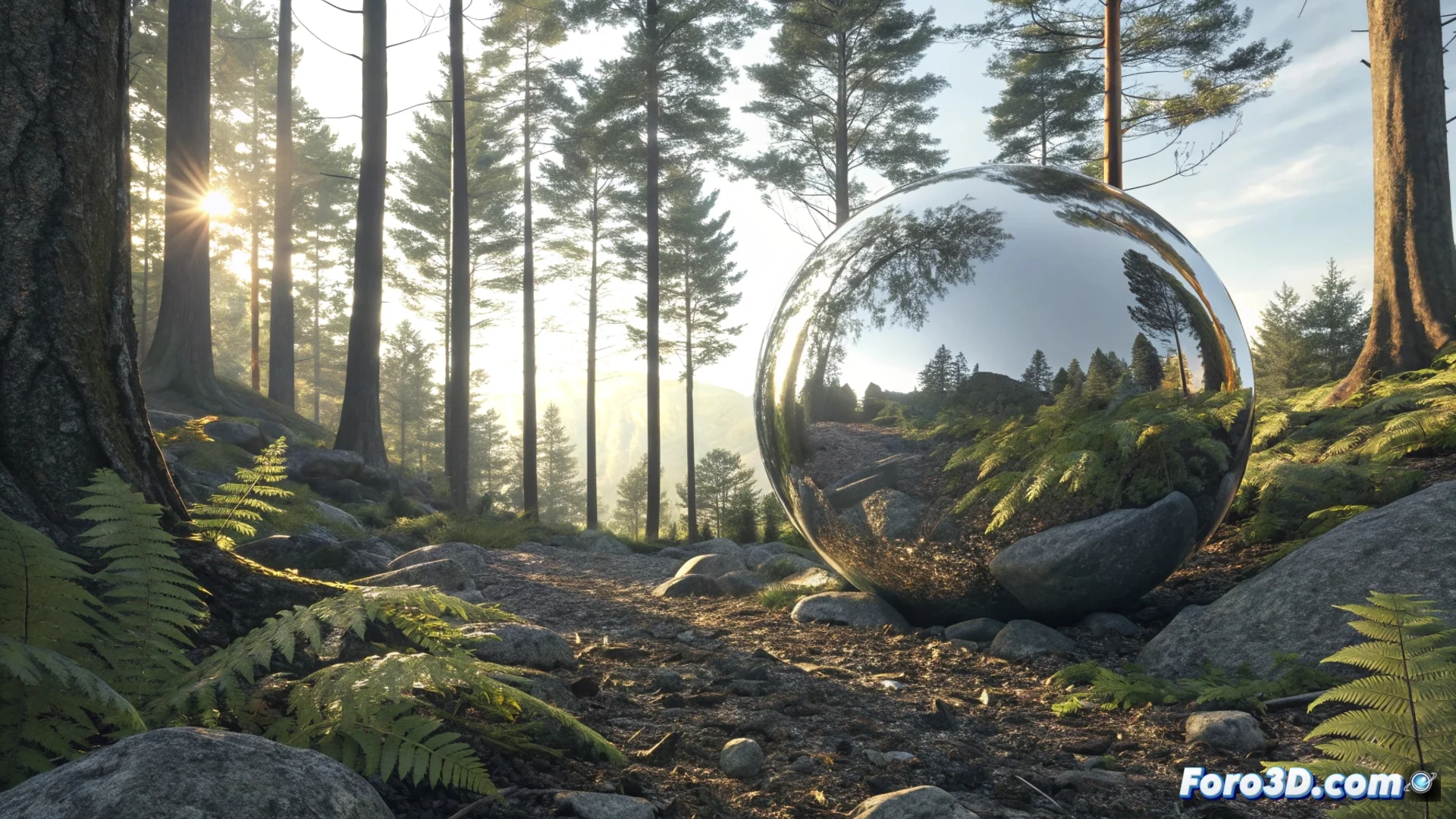
Reflections Must Integrate the Object into Its Environment
A flat reflection or a generic environment map that doesn't match the scene destroys visual immersion immediately. If an object in a sunny outdoor setting reflects a dark studio, or vice versa, the brain perceives a glaring incoherence. This not only reduces realism but also reveals neglect of the lighting and environmental context. The reflection acts as an extension of the environment; if it fails, the object appears artificial or out of place. 🧠
Avoiding the Incoherent Reflection Error
To solve this problem, you need to capture or generate an environment map that faithfully represents the lighting and elements of the scene. If the object is outdoors under a cloudy sky, its reflection must contain that information. You can use a real HDR map from the site, render a cubemap from the object's position, or, as a basic option, use a generic map that simulates analogous conditions. It is crucial that the color, intensity, and direction of the light in the reflection match those of the main scene.
Methods for Generating Coherent Reflections:- Capture real HDR maps from the specific location where the object will be placed.
- Render a cubemap from the exact point of the object in the 3D scene.
- Use high-quality generic environment maps that simulate similar environmental conditions (daytime sky, interior, etc.).
The classic sports car on a mountain road that, mysteriously, reflects the photographer's tripod and softbox lights, as if a studio were floating among the pines.
Coherence Defines the Final Visual Quality
The key lies in maintaining coherence. A precise reflection not only shows what surrounds the object but also interacts credibly with its material. Polished metal in a park will show distorted trees and sky, not studio lights. Integrating this step into the workflow is fundamental. You must plan the reflected environment with the same priority as direct lighting, ensuring both systems work in harmony so that the viewer believes in the scene.
Key Points for Planning Reflections:- Treat the reflected environment with the same importance as the main lighting.
- Ensure the object's material interacts correctly with the environment map information.
- Verify that the direction and intensity of the reflected light match the scene's light sources.
Integrate to Convince
Making an object seem to belong to its environment depends largely on the precision of its reflections. A common error is underestimating this element, resulting in that feeling that the object is "pasted" on top. By dedicating time to generating or selecting the correct environment map, and meticulously matching its lighting properties, a total visual coherence is built that sustains the illusion and significantly elevates the render's quality. ✅