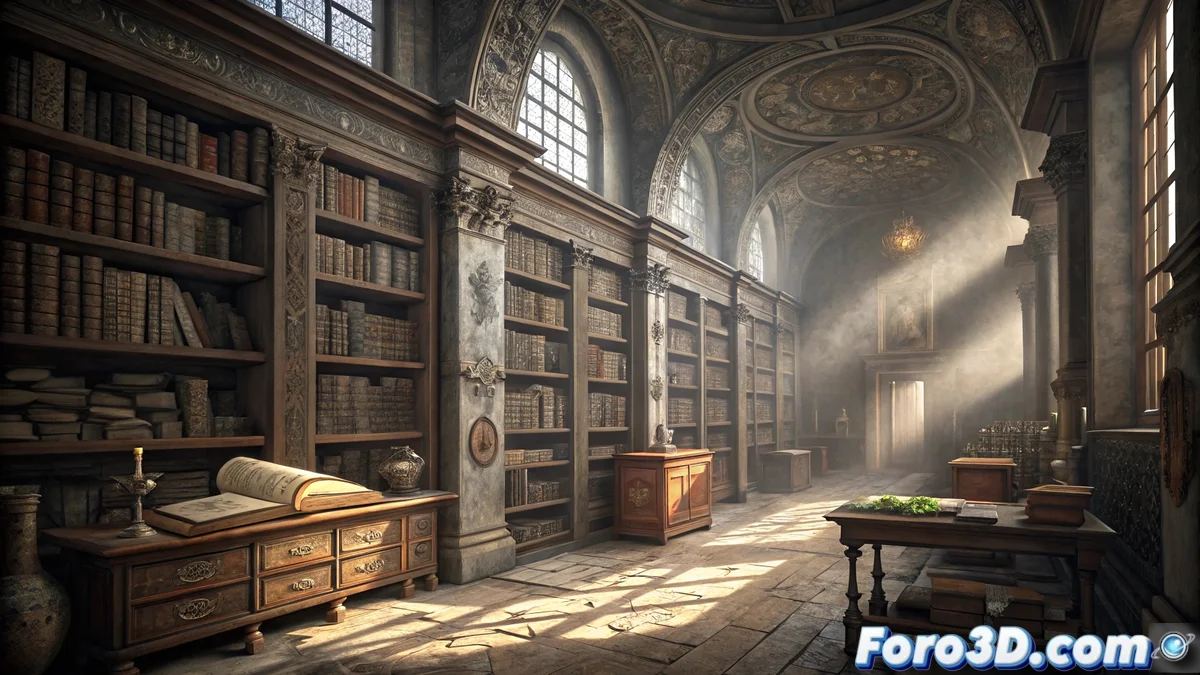
Unveiling Vatican Secrets through 3D Modeling 📜
A researcher exploring the Vatican archives has accidentally discovered a hidden room that could contain the lost library of Pope Gregory II, with parchments believed to have been destroyed centuries ago. This discovery, laden with historical mystery and architectural richness, finds in Cinema 4D the perfect medium for its digital recreation. The combination of precise modeling, aged material texturing, and dramatic lighting allows capturing both the majesty of the space and the intimacy of a long-guarded secret.
Architectural Modeling of the Hidden Room
The process begins by building the base structure with primitives—cubes for walls, cylinders for columns, and subdivided planes for floors and vaulted ceilings. Using polygonal modeling tools, architectural details such as cornices, arches, and moldings characteristic of Vatican architecture are added. For complex elements like sculpted capitals or reliefs, Displacement Maps or Cinema 4D's Sculpting module are used to carve fine details without overloading the topology. Shelves are modeled with Arrays and Cloners to efficiently replicate wooden modules. 🏛️
Texturing Historical Materials
Visual authenticity is achieved through realistic materials:
- Aged wood with variable roughness maps and wear streaks
- Limestone with subtle veining and porosity in bump maps
- Parchments with wrinkled paper textures and faded inks
- Oxidized metals on candelabras and fittings with procedural corrosion
Book bindings and labels are added using Alpha Maps imported from Photoshop.
Texturing a lost library is returning the soul that time stole from it.
Volumetric Lighting and Atmosphere
Lighting is crucial for conveying the mystery:
- Volumetric lights simulating sun rays filtering through high clerestory windows
- Point lights dim in candelabras with limited influence radius
- Area lights soft for general illumination without saturating the scene
- Light volumetric fog to add depth and mystery
The balance between light and shadow creates that atmosphere of recent discovery.
Secondary Objects and Arrangement
The room is populated with elements that tell a story:
- Parchments rolled and unrolled on study tables
- Stacked books with random variations in orientation and size
- Ancient writing instruments like quills and inkwells
- Dust particles suspended emitted from surfaces
These details transform the architectural space into visual narrative.
Render and Post-Production
It is rendered with Redshift or Cinema 4D's physical engine, using:
- Global Illumination for realistic indirect light
- Adaptive sampling to handle fine textural details
- Render passes separated for control in compositing
- Denoiser to keep render times reasonable
In post-production, color curves are adjusted toward warm tones and vignetting is added to direct attention.
If the scene is so convincing that historians ask for coordinates, you can always explain that the only key to this library is Alt + R. 😅