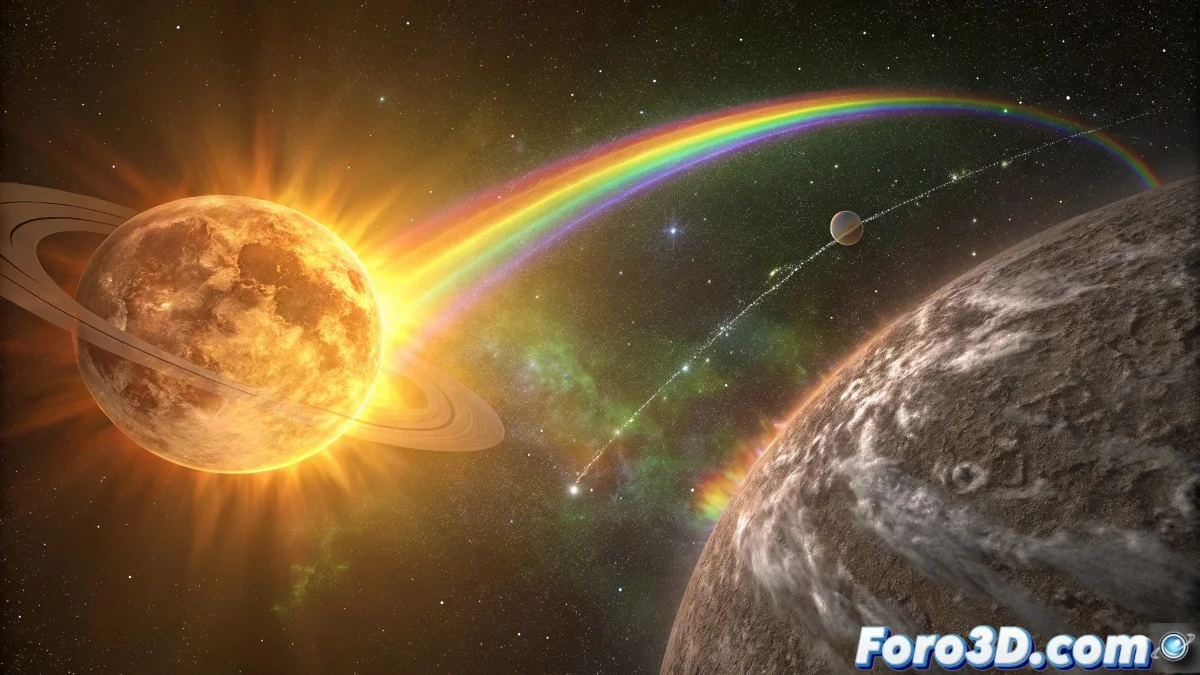
When Cosmic Light Paints Space
The recent discovery of the PUNCH mission—capturing the first solar rainbow in space—represents a milestone in understanding the interaction between sunlight and cosmic dust. 🌞🌈 In Animation Master, we can recreate this unique phenomenon, modeling how light scatters through zodiacal dust particles near the Sun, creating polarization patterns and spectral colors that reveal new secrets about our solar system. This visualization not only reproduces cosmic beauty; it illustrates fundamental physical principles.
Astronomical Project Setup
Upon starting Animation Master, the project is configured with appropriate astronomical units for the scale of the inner solar system. 🚀 The organization of the scene into logical layers—Sun, Cosmic_Dust, Light_Effects, and Cameras—ensures a manageable workflow despite the visual complexity. Activating GPU rendering accelerates the preview of particle and lighting effects, critical for this scene.
Recreating astronomical phenomena in 3D software not only produces beautiful images; it serves as an educational tool to understand physical processes that would otherwise be abstract or invisible to the human eye.
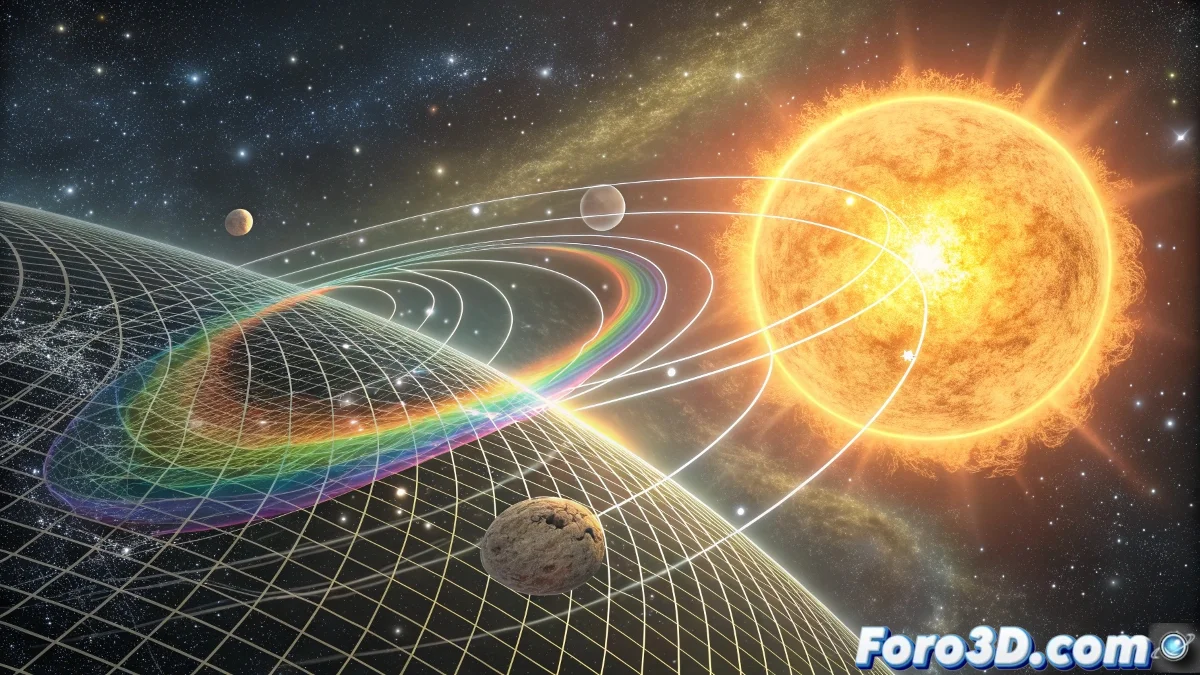
Modeling the Sun and Space Environment
The Sun is modeled as a sphere with intense emission, using materials with high luminosity and glow effect to simulate the corona. ☀️ The cosmic dust is distributed in a disk around the Sun using particle systems, with density decreasing with distance. Individual particles are textured to respond to light with appropriate scattering, crucial for the rainbow effect.
Light Scattering Simulation
- Rayleigh Scattering: Implemented in shaders to simulate how small particles preferentially scatter blue light.
- Prismatic Effect: Refractive materials with variable dispersion index are used to separate light into spectral colors.
- Polarization: Virtual optical filters are added to show how light polarizes when scattered, key in the real discovery.
Lighting and Visual Effects
Solar light is configured as an intense point source, with physically accurate parameters for color temperature (≈5778 K) and intensity. 💡 Multiple render passes—beauty, specular, volumetric—are used for independent control in compositing. Lens flare and bloom effects are added moderately for realism, referencing real WFI-2 images.
Animation and Cosmic Motion
Dust particles are animated with slow orbital motion around the Sun, creating dynamic variations in light scattering. 🪐 Cameras perform smooth movements that reveal the phenomenon from different angles, highlighting how observation geometry affects the solar rainbow's appearance—exactly as in the real discovery.
Rendering and Post-Production
Rendering is done with high sampling to capture subtle color gradients and volumetric effects. 📸 In post-production, color levels are adjusted to match the real solar spectrum and polarization bands are emphasized for educational clarity. The final output balances scientific accuracy with visual impact.
Applications Beyond Visualization
This recreation can be used in NASA educational materials, astronomy documentaries, and as a tool for scientists studying zodiacal light and solar wind. 🎓 The ability to visualize these phenomena helps communicate the importance of missions like PUNCH to non-specialized audiences, fostering public support for space exploration.
Thus, while the PUNCH mission reveals real solar rainbows, we can explore their mechanisms in virtual space… where the only thing that should scatter is the light, not the attention. Because in astronomical visualization, the only magic that matters is that of real physics. 😉