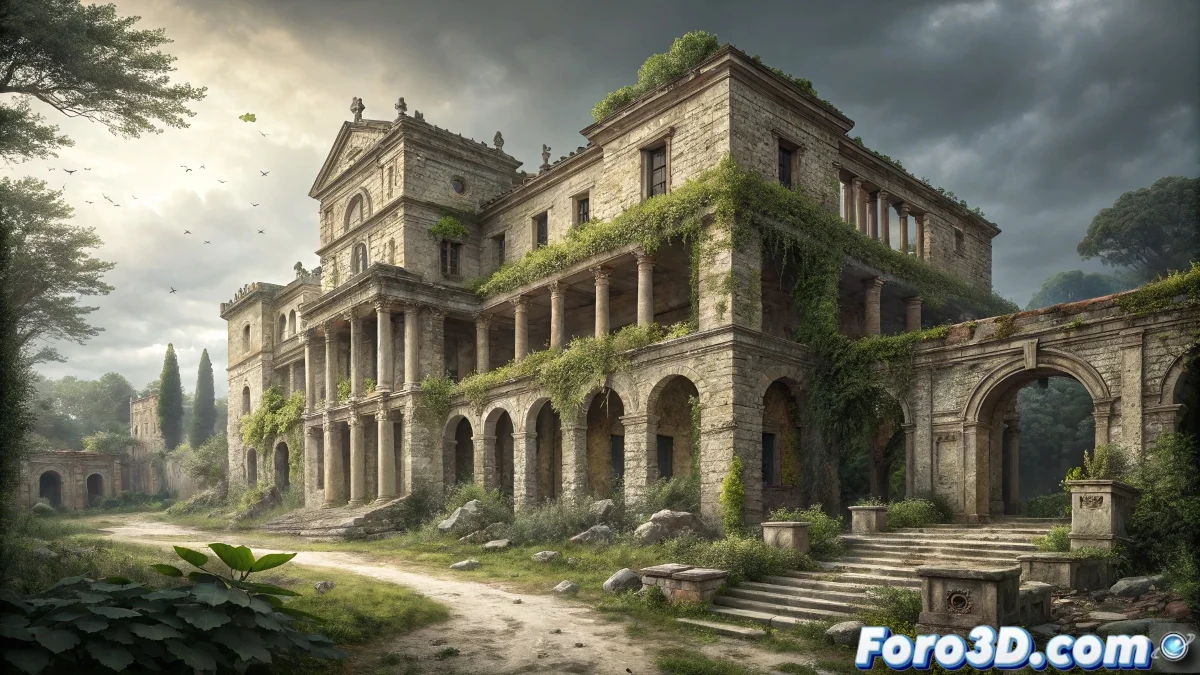
The Manchegan Versailles that rises again digitally
In the lands of Villalgordo del Júcar stand the ruins of the Palacio de los Gosálvez, a 19th-century construction that aspired to emulate the grandeur of French palaces. Popularly known as the Manchegan Versailles, its history blends aristocratic splendor with a decay that has turned it into a symbol of forgotten heritage. Today, thanks to tools like 3ds Max, we can restore some of its former shine through architectural visualization.
The digital recreation of this monument not only requires technical skills, but also artistic sensitivity to capture the melancholy that permeates its crumbling walls. From the neoclassical columns to the gardens invaded by vegetation, every element tells a story of abandonment and beauty that defies time.
Recreating this palace is connecting with the memory of a place that once represented the utmost refinement
Essential workflow in 3ds Max
- Historical documentation: gathering plans and old photographs
- Architectural modeling: from basic volumes to ornamental details
- PBR texturing: realistic materials that show the wear of time
- Atmospheric lighting: capturing the melancholic essence of the place
From abandonment to digital recreation
The process begins with a thorough investigation of the palace's original features. Historical photographs, architectural descriptions, and visits to the current site provide the necessary reference base. In 3ds Max, this information is translated into precise geometry that respects the proportions and styles of the original building, from the balustrades to the dormer windows.
Procedural vegetation becomes a fundamental ally to represent how nature has reclaimed its space among walls and staircases. Combining particle systems with intelligent instancing, we achieve that abandoned look that characterizes ruins while maintaining artistic control over every visual element.
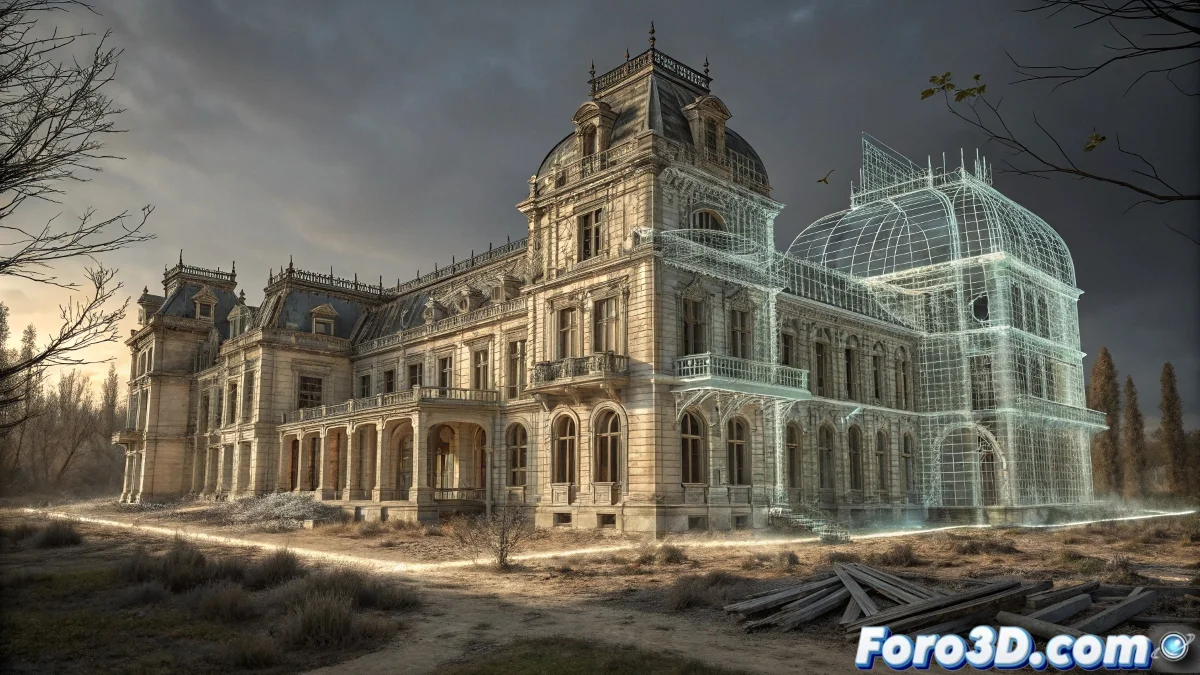
Advanced visualization techniques
- Aged marble textures with roughness and displacement maps
- Global illumination with HDRI for realistic twilight environments
- Particle systems for invasive vegetation and atmospheric effects
- Ray tracing rendering for maximum fidelity in materials and lights
The final result is not just an architectural representation, but an artistic reinterpretation that captures the soul of a place marked by the passage of time. A unique opportunity to digitally preserve what reality has allowed to fall into oblivion 🏰.
Optimization and post-production
For scenes of this complexity, efficient resource management becomes crucial. The use of proxies for repetitive elements, level of detail systems, and meticulous layer organization allow fluid work even on moderate hardware. Multi-pass rendering facilitates fine adjustments in post-production without the need to rerender the entire scene.
In the final phase, tools like Photoshop or After Effects allow subtle atmospheric adjustments, adding that veil of nostalgia that characterizes abandoned constructions. The balance between historical fidelity and artistic expression defines the success of the recreation.
The grandeur of this recreation lies in the details that tell a story of splendor and decay
And who says you can't resurrect an entire palace without moving a single brick... even if the final render takes longer than the original construction 😅