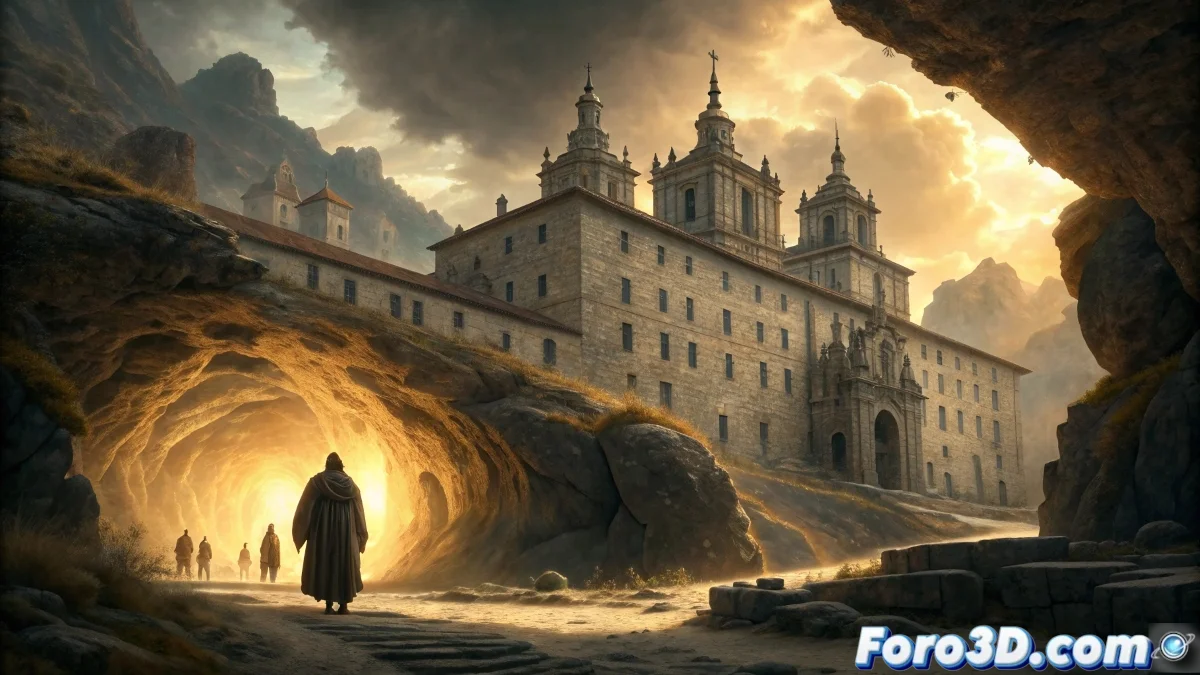
When 3D Software Resurrects Philip II's Secrets
Recreating the Royal Monastery of El Escorial in Autodesk Maya represents a challenge that combines historical architectural precision with creative freedom to visualize those secret tunnels that have fueled legends for centuries. This tutorial guides through a methodical process that respects the rigorous Herrerian geometrism while exploring the underground mystery that lies beneath the apparent Renaissance rationality. We will begin by establishing the architectural foundations and then delve into those passageways where history blends with legendary speculation.
The key to the project lies in understanding the dual nature of El Escorial: on the surface, the ultimate expression of Spanish Renaissance rational order; underground, the realm of mystery and the unspoken. In Maya, this translates into two parallel workflows: one of extreme precision for the visible architecture, and another more organic and suggestive for the legendary tunnels. The transition between both worlds must be as carefully planned as the original construction.
Project Preparation and Historical References
- Precise metric setup in Preferences to maintain real proportions
- Importing historical plans as image planes in orthographic views
- Establishing organizational layers for architecture, tunnels, and environment
- Collecting visual references for granite stone and Herrerian elements
Modeling Herrerian Architecture
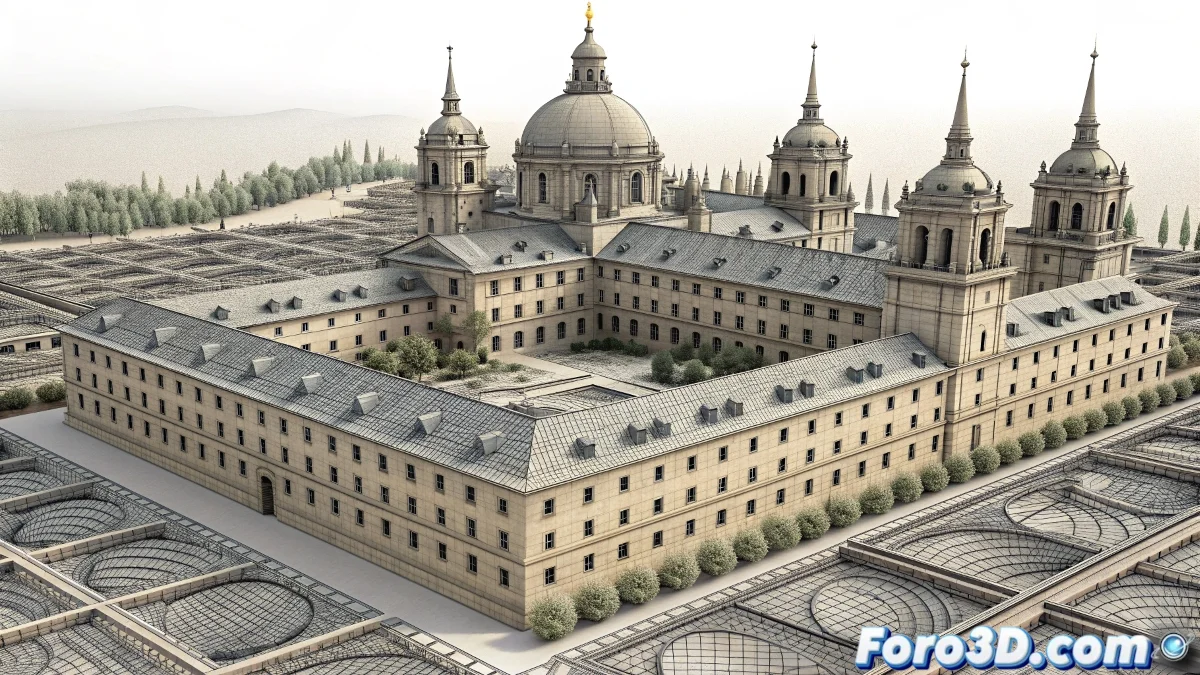
The geometry of El Escorial follows precise mathematical principles that can be efficiently replicated in Maya using symmetric duplication tools and modular arrays. Starting with basic volumes that define the general proportions, we will advance to detail using controlled extrusions for windows, cornices, and decorative elements. The Bevel tool will be crucial for softening edges and creating that characteristic temporal wear effect of granitic stone.
The perfection of El Escorial lies not in the absence of rules, but in their relentless application
To maintain historical coherence, we will model following the golden section and Renaissance proportions that define the Herrerian style. The use of distance measurers and alignment tools will ensure that every element occupies its exact place in the overall composition. The library, the basilica, and the royal pantheon will receive special attention, as they encapsulate the monument's triple cultural, religious, and dynastic function.
Creating the Secret Tunnels System
- Organic modeling with NURBS curves for irregularly traced tunnels
- Boolean operations to integrate passageways with the main structure
- Sculpt Geometry Tool to create erosion and partial collapse effects
- Instances of props like torches, chests, and scattered documents
The tunnels must feel like organic and lived-in spaces rather than perfect extensions of the upper architecture. We will use non-linear deformers to create natural curves and unevenness, while Soft Selection will allow us to shape the walls as if time and humidity had worked on them. The strategic placement of narrative elements -a fallen torch, tool marks on the stone, an abandoned chest- will suggest stories without needing to explain them explicitly.
Dual Lighting System
- Directional Light for realistic solar lighting of the exterior architecture
- Warm Area Lights to simulate torches in tunnels with volumetrics
- Skydome Light with HDRI of the Guadarrama mountain range sky
- Light Linking for precise control over which lights affect each element
Lighting is the most powerful narrative element in this scene. While the exterior must convey the rational clarity of the Renaissance, the subsurface requires a more dramatic and mysterious approach. We will use volumetric scattering on tunnel lights to create those visible light beams that so much contribute to the secretive atmosphere. The contrast between the cold and direct light of the exterior and the warm and diffuse light of the subsurface will visually reinforce the central duality of the project.
Materials and Shaders for Historical Authenticity
- Arnold Standard Surface for stone with variable roughness maps
- Aged metal shaders for decorative elements and hardware
- Procedural textures to simulate erosion and accumulated dirt
- Bump and displacement maps for fine architectural details
The final render must capture not only the physical appearance of the Monastery, but also its historical and symbolic weight. The careful composition of cameras, the balance between visible and suggested elements, and attention to detail both in the monumental and the intimate, will converge in an image that functions simultaneously as architectural reconstruction and visual narrative piece. The secret passageways, although partially a product of speculation, will find their justification in how they complement and contrast with the geometric perfection of the surface.
Those who complete this tutorial will not only have mastered advanced Maya techniques, but will have explored one of the most fascinating paradoxes of Spanish heritage: how the ultimate expression of rational order can harbor in its bowels the most persistent mysteries 🏰