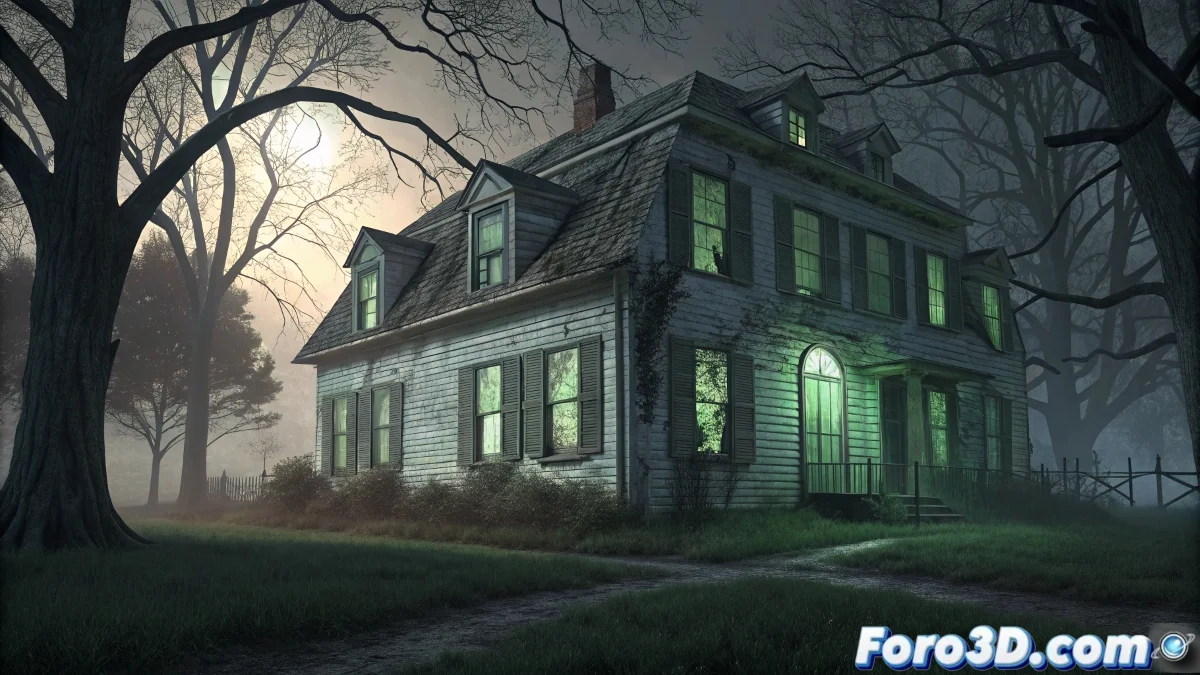
Recreation of the Amityville House in Unreal Engine for Immersive Horror Experiences
The iconic Amityville house represents one of the most famous cases of real and paranormal horror, where the DeFeo family murders in 1974 and the subsequent experience of the Lutz family created a legacy of terror that can be perfectly recreated in Unreal Engine to develop immersive psychological horror experiences. 🏚️
Historical and Paranormal Context
The Dutch colonial house in Amityville, New York, became a modern horror icon after the six murders committed by Ronald DeFeo Jr. and the subsequent paranormal events reported by the Lutz family, who abandoned the property after only 28 days claiming extreme demonic activity.
Key elements of the case:- Multiple murders in 1974 that imbued the place with trauma
- Reported paranormal phenomena: voices, knocks, apparitions
- The ongoing debate about authenticity versus fabrication
A house that became the epicenter of a demonic evil that corrupts its inhabitants - Description of the Amityville phenomenon
Pre-production and Visual Research
Before starting in Unreal Engine, it is essential to thoroughly document the real architecture of the house, its unique features like the eye-shaped windows, and study the descriptions of the paranormal events to faithfully translate them into the digital environment.
Research phases:- Collection of historical photographs and architectural plans
- Analysis of descriptions of paranormal phenomena
- Study of the color palette and materials of the era
Step by Step: Implementation in Unreal Engine
1. Initial Project Setup
Create a new project in Unreal Engine 5 using the first-person game template. Set up the lighting system with Lumen for realistic reflections and enable Nanite for detailed geometry. Set units to centimeters for architectural precision.
2. Modeling the Architectural Structure
Use Blender or 3ds Max to model the characteristic Dutch colonial structure. Pay special attention to the eye-shaped windows that give the main facade its distinctive appearance. Import the models into Unreal using Datasmith to preserve materials.
3. Atmospheric Lighting System
Implement a dynamic lighting system that alternates between different emotional states: - Normal daytime lighting - Twilight penumbra with elongated shadows - Near-total darkness with minimal light sources Use rect lights in windows and strategic spotlights to create isolated light pools.
4. Paranormal Materials and Shaders
Create custom materials in the Material Editor for: - Walls that sweat or show animated damp stains - Floors that creak with programmed displacement textures - Pareidolia effects in plaster textures Implement a dissolve shader for apparitions and fades.
5. Blueprints for Interactive Events
Develop blueprint systems for the reported phenomena: - Actor Blueprints for doors that open/close on their own - Timeline Blueprints for furniture that moves autonomously - Event Dispatchers to trigger multiple phenomena simultaneously - Interface Blueprints for interaction with demonic objects
6. Spatial Audio System
Set up a complex audio system using Sound Cues and Audio Volumes: - House ambient sounds (creaks, wind) - Whispering voices with 3D spatialization - Laughter and crying effects that seem to move through rooms - Random triggers to maintain constant tension
7. Particle Effects and Niagara
Implement particle systems for visual phenomena: - Low fog that accumulates in corners - Ectoplasm and vaporous emanations - Footprint system that appears on floors - Thermal distortion effects for apparitions
8. AI for Paranormal Entities
Create AI behaviors using Behavior Trees and Blackboards: - Entities that roam specific hallways - Appearance system based on player position - Pursuit and disappearance behaviors - Activity states that increase with playtime
9. Optimization and Performance
Ensure optimal performance through: - Level Streaming to load areas progressively - Distance Culling for distant objects - Automatic LODs for complex meshes - Lightmap baking for static lighting
Advanced Technical Considerations
For a truly immersive experience, consider implementing MetaHuman for ghostly characters, using the Niagara system for complex paranormal effects, and leveraging ray tracing for ultra-realistic reflections and shadows in low-light scenes. 🎮
Recommended technologies:- MetaHuman Creator for realistic apparitions
- Niagara VFX for supernatural phenomena
- Ray Tracing for cinematic lighting
- World Partition for open-world handling
The Legacy of Amityville in Digital Horror
Recreating the Amityville house in Unreal Engine not only honors the legacy of this horror icon but also explores new frontiers in the narration of interactive horror experiences, where the architecture becomes a character and every corner holds the potential for the perfect scare. 👻