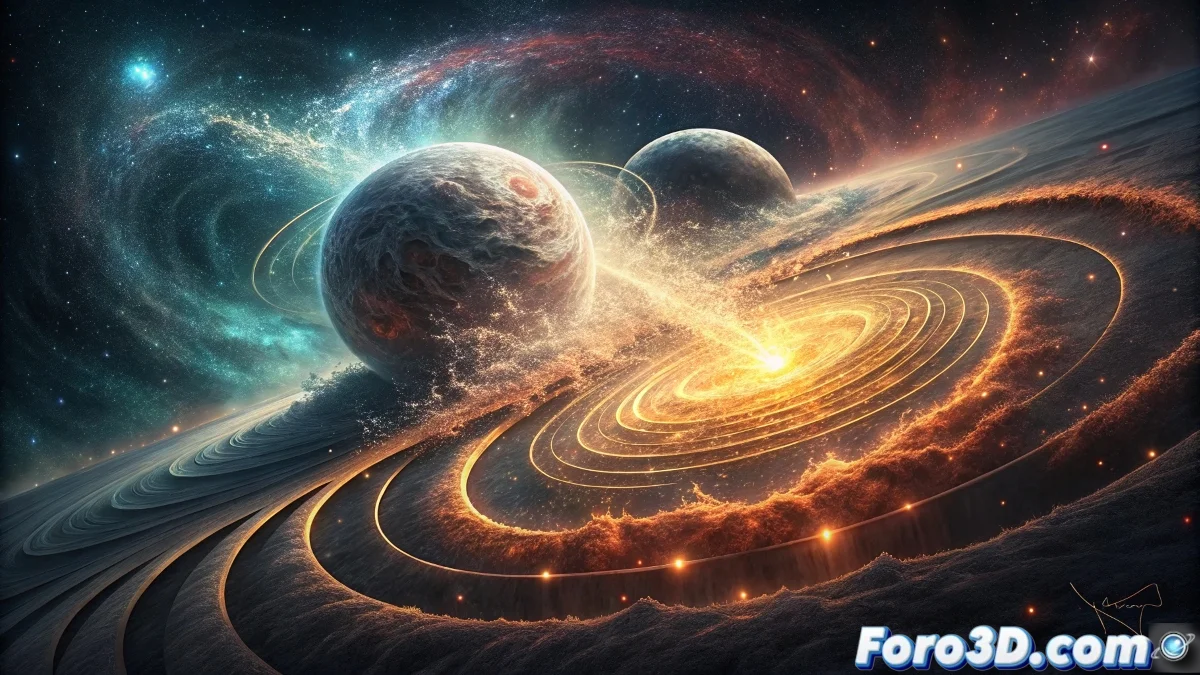
Hawking's Prediction Confirmed: Echoes in Cosmic Collisions
In the field of astronomy, a recent study has confirmed one of Stephen Hawking's great predictions: the echo of cosmic collisions 🌌. This theory, proposed decades ago, suggests that when black holes or neutron stars collide, they not only generate gravitational waves, but also a subsequent echo that reverberates in the fabric of space-time. The confirmation of this phenomenon not only validates one of Hawking's most fascinating ideas, but also opens a new window to explore the physics of the most extreme universe. Because sometimes, the universe whispers its secrets in the form of echoes 💫.
Recreating the Cosmic Phenomenon in Combustion
Combustion allows simulating this concept through visual effects that combine stellar mass collisions with waves that expand and reverberate in space 🎬. The light flashes at the moment of impact can be represented with overlaid layers and blur filters that convey the intensity of the event, while the echoes are recreated with repetitions of concentric waves that fade over time. This visual approach not only educates about the phenomenon, but also pays homage to Hawking's vision of making science accessible and inspiring.
When black holes or neutron stars collide, they generate gravitational waves and an echo that reverberates in space-time.
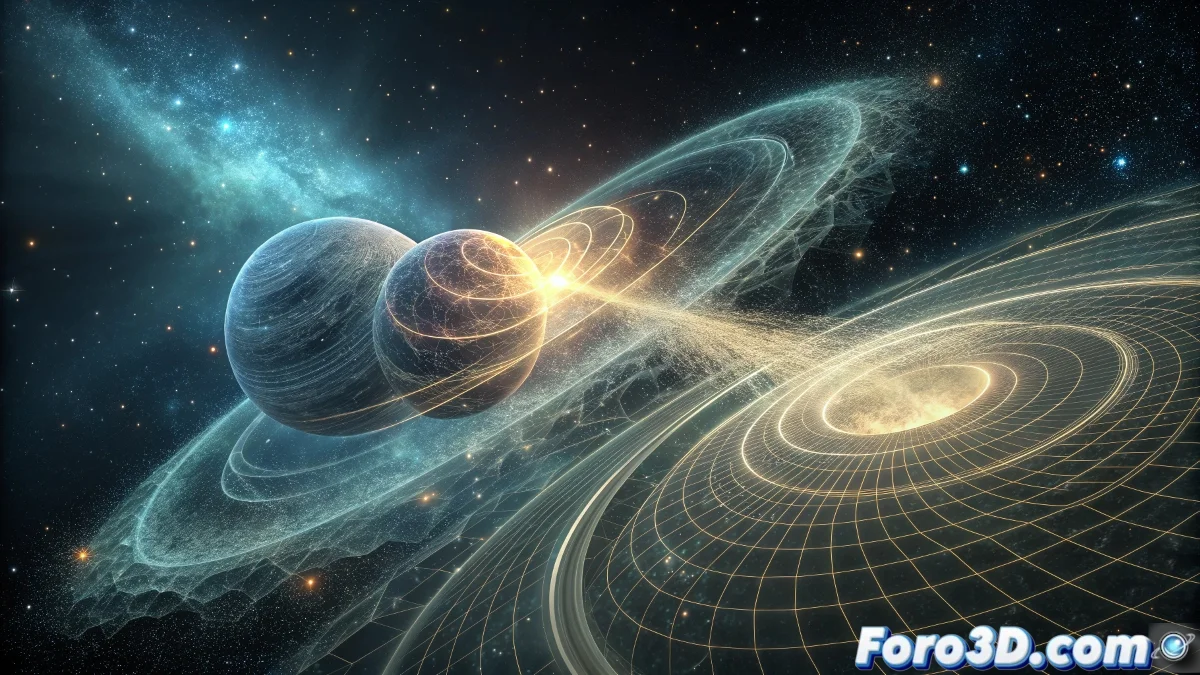
Project Setup and Creation of the Stellar Background
Starting a new project in Combustion with 16-bit color space ensures smooth light gradations, crucial for representing the cosmos 🖥️. The background is created with a dark gradient in blue and black tones, using scattered particles with different brightness levels to simulate stars. Subtle nebulae are added with soft brushes and low opacities, enriching spatial depth without distracting from the main event. Layer organization—Background, Waves, Echo—keeps the workflow orderly and editable.
Simulation of Collision and Gravitational Waves
Two luminous masses—representing black holes or neutron stars—are animated slowly approaching until they collide 💥. At the moment of impact, a central flash with Gaussian blur intensifies the energy release, while a radial distortion effect simulates the curvature of space-time. Gravitational waves are generated with animated circular masks that expand from the epicenter, applying gradual transparencies for realistic dissipation. Multiple layers with varying sizes and speeds create the illusion of complex waves.
Creation of the Echo and Reverberation Effects
The echo is simulated by duplicating the initial gravitational waves and delaying them in the timeline ⏳. Opacity is reduced and slight color changes—toward bluish or purplish tones—are applied to differentiate them from the primary waves. A soft glow is added to reinforce the reverberation sensation, and layers are further blurred with motion blur filters to convey their decay in space-time. This sequential effect communicates the persistence of the echo predicted by Hawking.
Animation, Render, and Post-Production
Cameras are animated approaching the epicenter or panning to show the wave expansion 🎥. A slight vibration at the moment of collision conveys the released energy. The render is exported in uncompressed formats at 1920x1080 px, preserving light and particle details. In post-production, colors are adjusted toward dark tones with blue nuances, contrast is enhanced in the central area, and a subtle vignette is applied to direct attention to the phenomenon. The result evokes both scientific precision and cosmic beauty.
The Irony of Cosmic Echoes
While the entire universe confirms one of Hawking's brilliant predictions, we still wait for the echo of the last mobile notification… that never arrives. Although, to be fair, the universe had 13.8 billion years of practice 😅.