Reconstructing the Prehistoric Past with Digital Tools 🦕
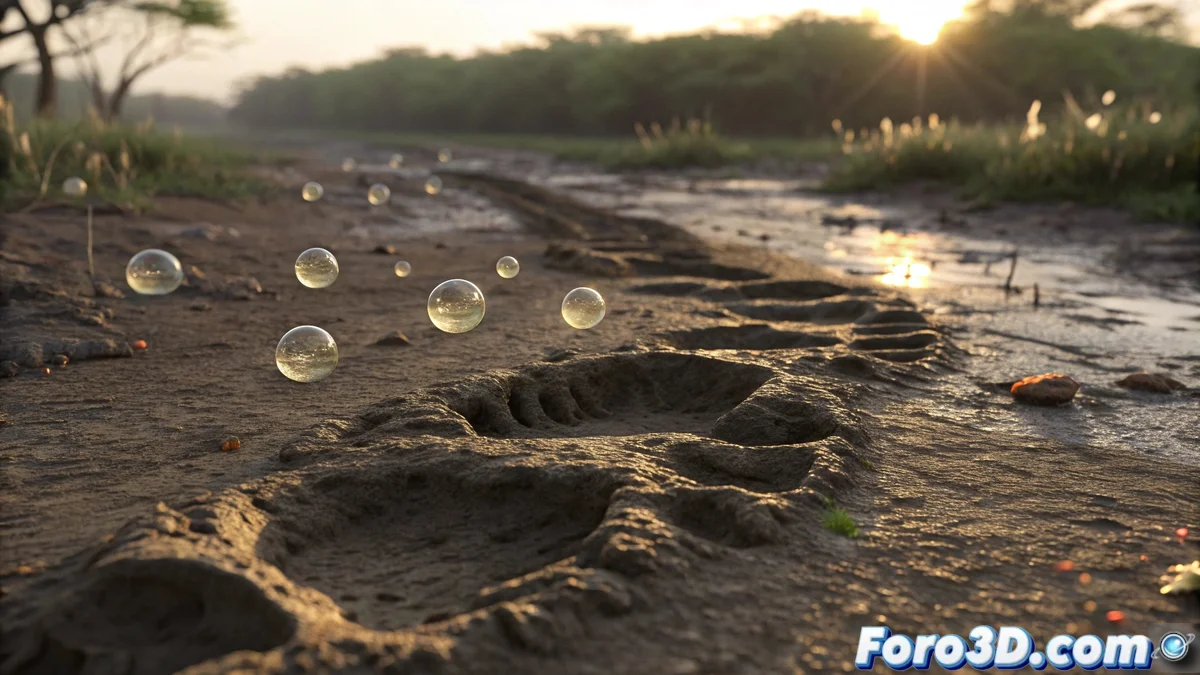
A team of researchers has found dinosaur footprints that challenge established theories about their locomotion, along with bacteria preserved in remains of a mammoth over a million years old. These parallel discoveries raise new questions about ancient life and how science can reconstruct lost episodes of the past. Maya presents itself as the ideal platform to visualize both findings in a single visual narrative, from the macro scale of the footprints to the micro world of the bacteria.
Modeling Prehistoric Footprints with Sculpt Geometry Tool
To recreate the dinosaur footprints in Maya, start with a subdivided plane that will act as prehistoric terrain. Using the Sculpt Geometry Tool, sculpt the impressions left by the feet, paying attention to the depth, shape, and distribution that would characterize a real step. The use of displacement maps or normal maps adds surface realism, simulating the texture of wet soil or compacted sediments. For greater detail, combine Sculpting Layers with high-resolution textures that mimic soil variations. 🦴
Creating Ancient Bacteria with MASH and Shaders
The bacteria recovered from the mammoth are modeled with simple geometries like spheres or cylinders, leveraging the MASH network to distribute hundreds of instances in a microscopic environment. Translucent shaders with subsurface scattering are applied to simulate cell membranes, and subtle emissive effects to highlight their presence in the scene. Activating depth of field on the camera and using directional lighting achieves the effect of observation through a microscope, with some bacteria in focus and others blurred in the background.
Digital paleontology does not just replicate forms; it revives entire ecosystems from footprints and microbes.
Integrating Macro and Micro Scales into a Single Narrative
One of Maya's advantages is the ability to unite disparate scales in a coherent sequence. Through a camera traveling shot that begins at the giant footprints and gradually transitions to the microscopic scale of the bacteria, the full story of the discoveries is told. This transition is planned with:
- Smooth animation curves for camera movements
- Keyframes that control focus and scale
- Render Layers to manage elements separately
Rendering with Arnold ensures photorealistic quality both in close-ups and microscopic views.
Workflow with Render Layers and Post-Production
To efficiently handle the scene's complexity, elements are organized into separate Render Layers: one for the terrain and footprints, and another for the bacteria and their microscopic environment. This allows adjusting materials, lighting, and effects for each scale independently. In post-production, both renders are integrated using compositing techniques to smooth the transition and add atmospheric effects that unify the visual narrative.
The Technical Challenge and Creative Irony
While science unearths impossible footprints and bacteria that survived millions of years, 3D artists face more immediate challenges: that the Maya file doesn't corrupt after an unexpected crash or that the autosave decides to work just after we lose hours of work. The paradox is evident: we can recreate extinct ecosystems with microscopic detail, but we can't prevent our software from having bad timing.
In the end, the true digital fossil is that project file you abandoned months ago and that now neither Maya nor anyone can open without catastrophic errors. 😅