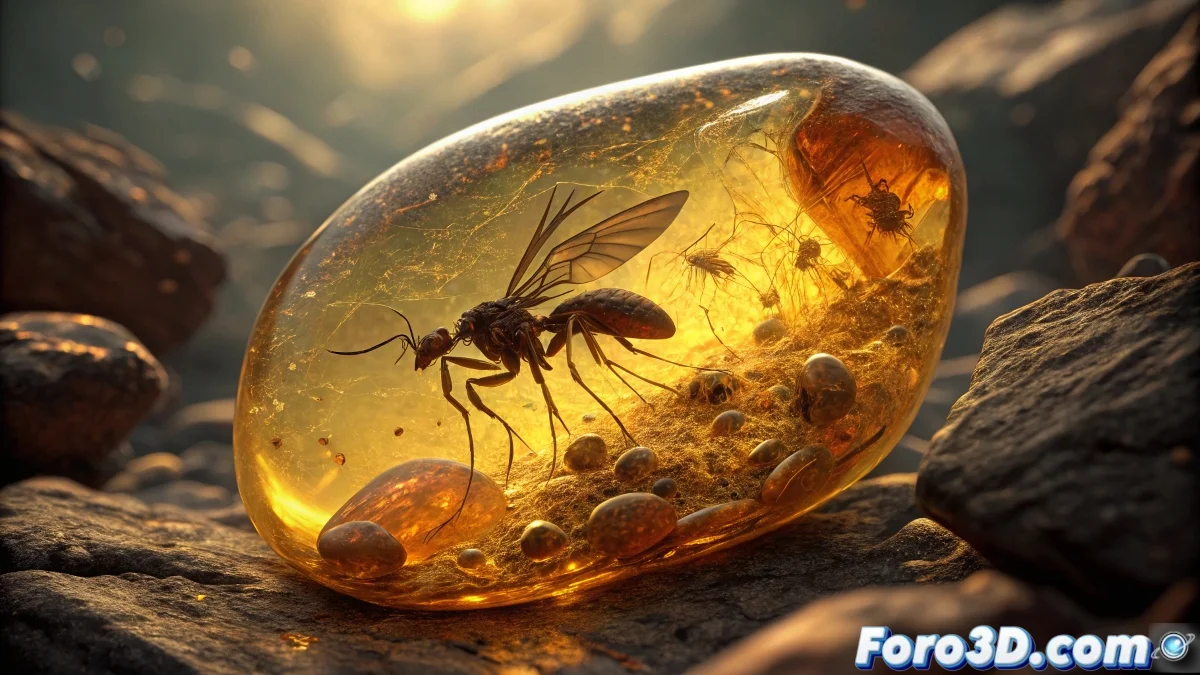
Prehistoric Amber: 100-Million-Year-Old Time Capsules
A surprising paleontological discovery reveals that amber deposits have preserved insects from over 100 million years ago, right in the age of dinosaurs 🦟. These pieces act as exceptional time capsules, trapping tiny details of prehistoric life with astonishing precision: wings, legs, and even internal structures of now-extinct species. For scientists, these fossils in fossilized resin allow a better understanding of Cretaceous biodiversity and the crucial role of insects in those ancestral ecosystems. A unique window into a lost world, preserved in golden perfection 🕰️.
Recreating the Magic of Amber in 3ds Max
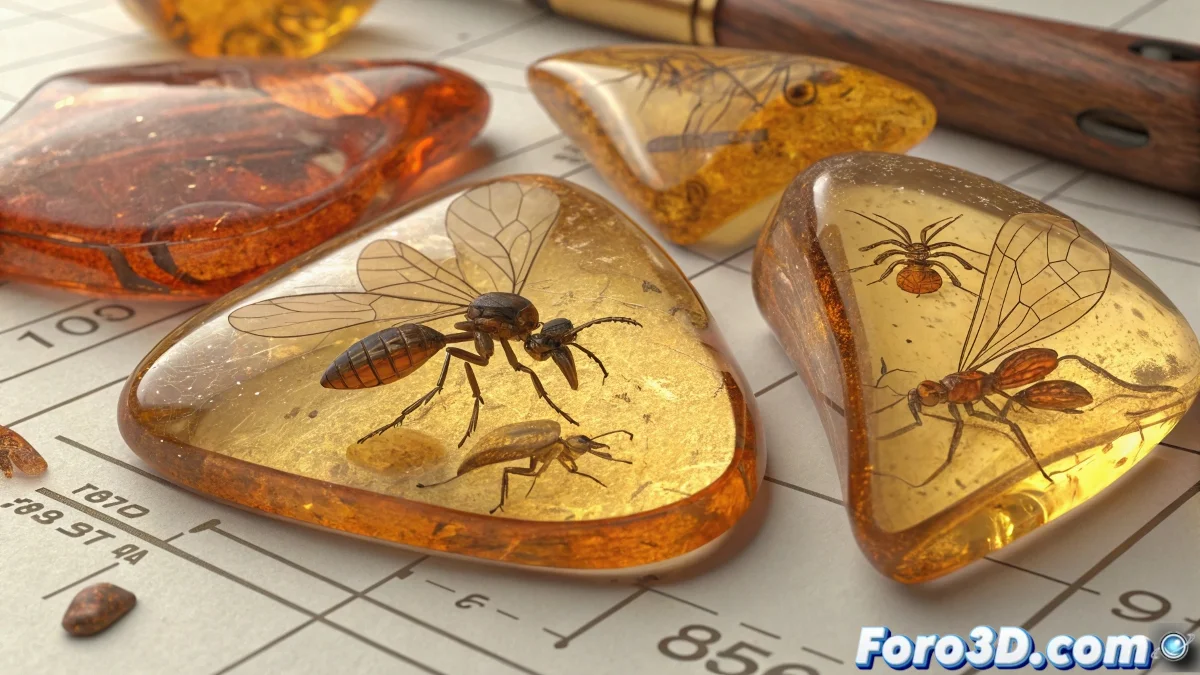
3ds Max offers the ideal tools to visually recreate these extraordinary fossils, combining organic modeling, translucent materials, and strategic lighting 🎨. The goal is to capture not only the physical appearance of the amber and its inclusions, but also the sense of discovery and antiquity that these pieces convey. Using noise modifiers, materials with subsurface scattering, and macro cameras, it's possible to simulate the golden transparency of fossilized resin and the delicate details of the insects trapped inside. Perfect for educational projects, documentaries, or simply for the love of paleoart.
These pieces act as time capsules, trapping tiny details of prehistoric life with astonishing precision.
Project Setup and Base Modeling
Starting a new project in 3ds Max with metric units ensures scalar consistency to accurately represent both the amber and the insects. Organization into layers—Amber, Insects, Lighting, Cameras—facilitates element management. The amber is modeled starting with a sphere or BlobMesh, applying FFD and Noise modifiers to create irregular and natural shapes, with cracks and internal bubbles that add realism. The insects are built starting from basic segmented shapes for head, thorax, and abdomen, adding legs, antennae, and wings with extrusions and subdivided planes 🗂️.
Materials, Lighting, and Key Technical Details
Materials are crucial to achieve the characteristic look of amber. A V-Ray or Arnold shader is used with warm amber color (#ffb347), high transparency and subtle refraction, complemented with Subsurface Scattering to simulate the depth of the resin. The insects' wings receive opacity maps to achieve their translucent delicacy. The lighting uses Area lights with warm tones that highlight transparency, complemented with a museum environment HDRI for natural reflections. A secondary cool light adds contrast and visual drama. Essential elements:
- Irregular geometry: Organic shapes with noise and deformation modifiers.
- Procedural textures: For insect cuticle and inclusions in the amber.
- Warm lighting: Soft lights that emphasize transparency and antiquity.
- Macro cameras: Selective focus with Depth of Field to highlight details.
Render and Post-Production for Scientific Realism
The render is done with engines like V-Ray or Arnold, setting high quality in refraction and translucency to faithfully capture the light interaction with the amber. A resolution of 1920x1080 pixels at 25 fps is ideal for still images or short sequences. In post-production, color levels are adjusted to accentuate golden tones, contrast is increased to highlight trapped insects, and a subtle vignette is added to simulate the observation effect through a microscope or magnifying glass. The final result should evoke both artistic beauty and scientific precision 🔬.
The Irony of Prehistoric Fame
It's curious that insects accidentally trapped in sticky resin are now the stars of paleontology... and more famous than any current mosquito that only manages to ruin a summer night for us 😅.