From Flat Paper to Sculptural Depth
Recreating the three-dimensional topography of an architectural frieze from a simple photograph is a fascinating challenge in Maya. 🏛️ Whether to digitally restore a damaged detail or to integrate historical elements into a virtual scene, there are several paths to extract that volume from a flat image. The choice of method depends on the amount of information available (a single photo or multiple shots) and the level of detail required in the final result.
Photogrammetry: Reconstruction from Multiple Angles
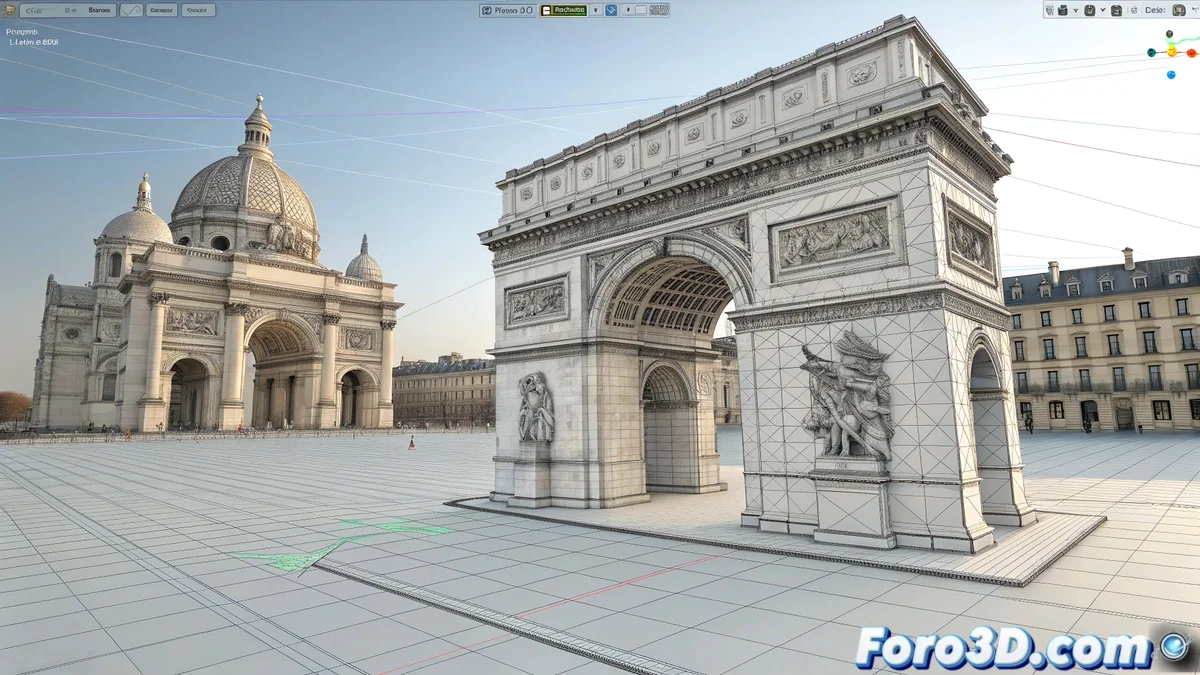
If you have access to the real frieze and can take multiple photographs from different angles, photogrammetry is the most powerful option. 📷 Programs like RealityCapture or Metashape analyze the photos to generate a point cloud and, finally, a very detailed 3D mesh. This model is then imported into Maya in OBJ or FBX format. The advantage is extreme realism; the disadvantage is that the resulting mesh is usually very heavy and requires thorough cleanup and retopology with tools like Quad Draw.
Photogrammetry turns a series of photos into a model ready to be cleaned and used.
Displacement Mapping: The Magic of a Single Photo
When you only have a frontal photograph, the most effective technique is displacement mapping. 🗺️ First, convert the photo to grayscale in Photoshop, adjusting the contrast so that light areas represent high relief and dark areas, low relief. Then, in Maya, apply this image as a displacement map to a subdivided plane. The more subdivisions the plane has, the finer the detail captured. It is an efficient method to achieve a lot with little, although the result will always be an approximation.
- Manual Modeling: For friezes with clear patterns, modeling over an Image Plane offers maximum control.
- Texturing: Project the original photo as a diffuse texture over the generated relief.
- Subdivision Control: Use a subdivision modifier to keep the mesh lightweight and subdivide only at render time.
Optimization for Production
Regardless of the method used, the final model must be optimized. If photogrammetry is used, retopology is essential to reduce the polygon count and create a clean quad mesh. 🔧 If displacement is used, you can work with a low-resolution base mesh and let the render engine (like Arnold) handle the subdivision at render time. This keeps the scene agile and allows for comfortable work.
If your frieze's relief looks smoother than a pebble instead of a carved sculpture, you have probably exaggerated the subdivision smoothness. 🍮 Sometimes, less is more when it comes to subdividing a displacement map.