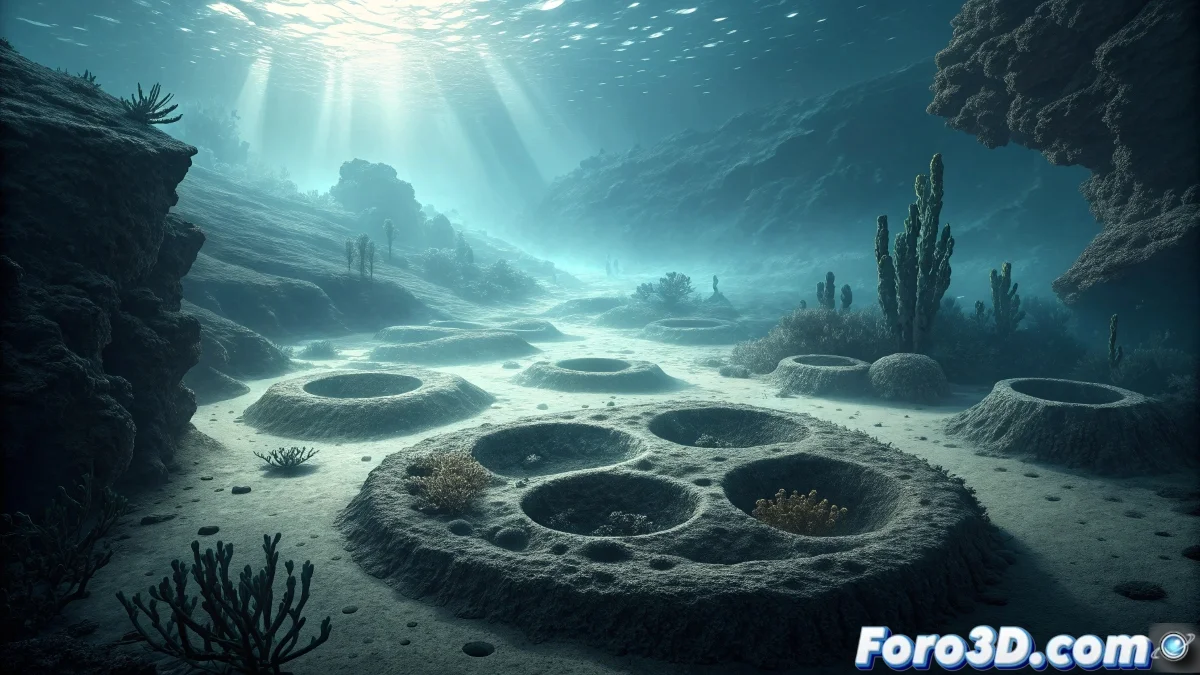
Recreating the Mysterious Michigan Lake Craters with Blender
The Lake Michigan, one of the imposing Great Lakes of North America, hides in its depths a fascinating geological enigma: the presence of vast perfectly round craters whose origin remains without a definitive explanation. These underwater formations, which could be sinkholes formed by the dissolution of underground limestone, are characterized by their large number and orderly arrangement, challenging conventional geological explanations and representing one of the most intriguing lake mysteries on the continent. We will investigate this phenomenon using the versatile tools of Blender. 🔍
Lake Environment and Bathymetry Setup
Begin by establishing the unique topography of Lake Michigan's bottom, a body of water with depths reaching 280 meters and an area of more than 58,000 km². The craters are mainly located in specific areas of the lakebed, with diameters ranging from a few meters to over 100 meters.
Scene preparation in Blender:- Create a subdivided base plane for the lakebed with Displace modifier
- Set real scale considering the massive dimensions of the lake
- Establish metric units for precision in geological formations
"The Lake Michigan craters are so geometrically perfect that they seem like the work of intelligence, not random natural processes" - Lake geologist
Modeling the Mysterious Circular Craters
The craters exhibit almost perfect circularity that suggests unique geological processes. Use procedural modeling techniques in Blender to create these formations, replicating their characteristic bowl shape with well-defined edges.
Modeling techniques for craters:- Use the Boolean modifier with spherical objects to create depressions
- Apply Smooth Shading and Subdivision Surface for organic edges
- Combine multiple craters with an arrangement suggesting inexplicable patterns
Material System for Lake Sediments
The Lake Michigan bottom is composed of layers of glacial sediments and eroded materials. Develop complex materials in Blender that capture the clayey texture and color variations of these millennial deposits.
Material setup in Blender:- Principled BSDF with high roughness for sedimentary surfaces
- Texture nodes with noise patterns for natural variation in the lakebed
- Normal maps for micro-texture details in the sediments
Water Effects and Lake Visibility
The Lake Michigan waters have specific optical characteristics different from ocean water. Set up the rendering system to simulate reduced visibility, the characteristic greenish-blue color, and light effects in continental waters.
Water system and visual effects:- Volumetric shaders to simulate suspended particles and turbidity
- Principled Volume with adjusted density for the lake's typical clarity
- Caustics with moderate intensity for light effects on the bottom
Final Composition and Mystery Narrative
Develop visual compositions that emphasize the enigma of these craters, using camera angles that highlight their orderly arrangement and lighting effects that suggest mystery. The combination of natural elements with apparently artificial formations creates a visual narrative that perfectly captures the essence of this inexplicable geological phenomenon that continues to challenge science. 🌊