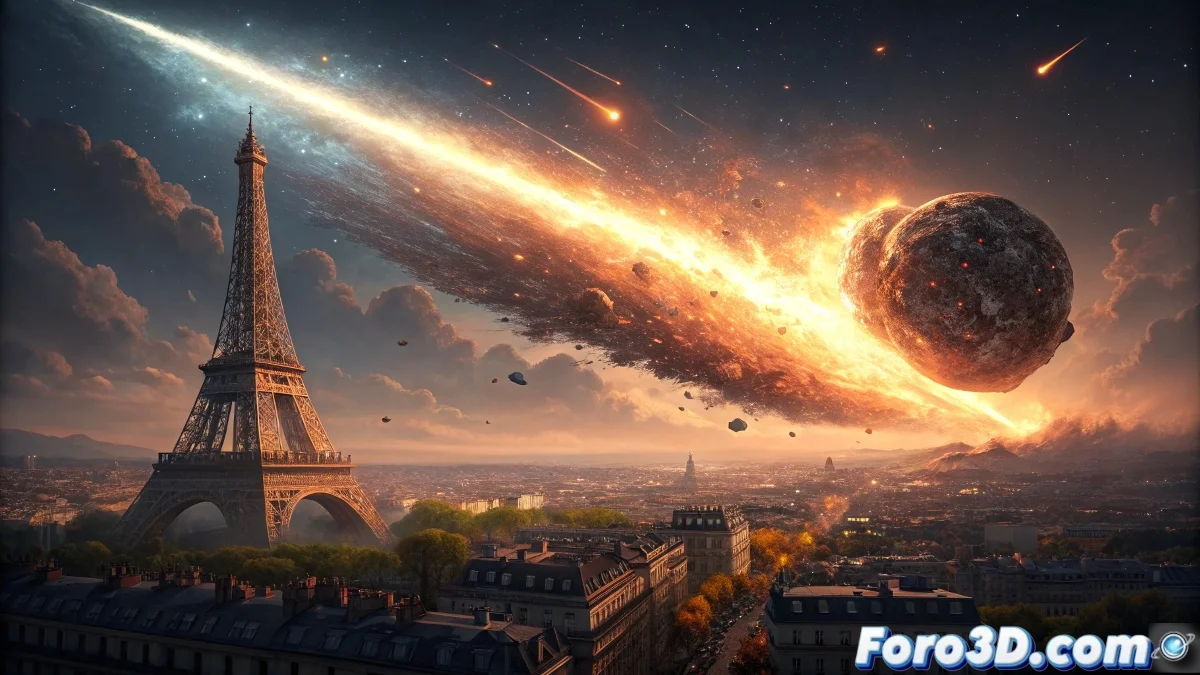
A Spectacular Celestial Event over France
An asteroid recently surprised astronomers and residents by exploding in the sky over France in an uncommon event 🌠. According to experts, the space rock released energy comparable to that of a bomb, illuminating the firmament and generating a rumble audible from kilometers away. Although fortunately it caused no material or human damage, the phenomenon served as a stark reminder of the power of cosmic objects crossing Earth's orbit and the importance of their constant monitoring. A natural spectacle that mixes beauty and danger in equal measure 💫.
Recreating the Astronomical Event in 3ds Max
3ds Max offers the perfect tools to simulate this impressive celestial event with a high level of realism. Using particle systems, physics simulations, and advanced lighting techniques, it is possible to recreate each phase of the phenomenon: atmospheric entry, main explosion, and dispersion of incandescent fragments. Adding a French urban or rural environment as context not only adds realism but also helps communicate the real scale of the event. Perfect for artists who enjoy challenging the limits of visual simulation 🎬.
In 3ds Max, the asteroid's passage through the atmosphere can be simulated with particle effects, fire, and fragmentation to represent the initial flash and shockwave.
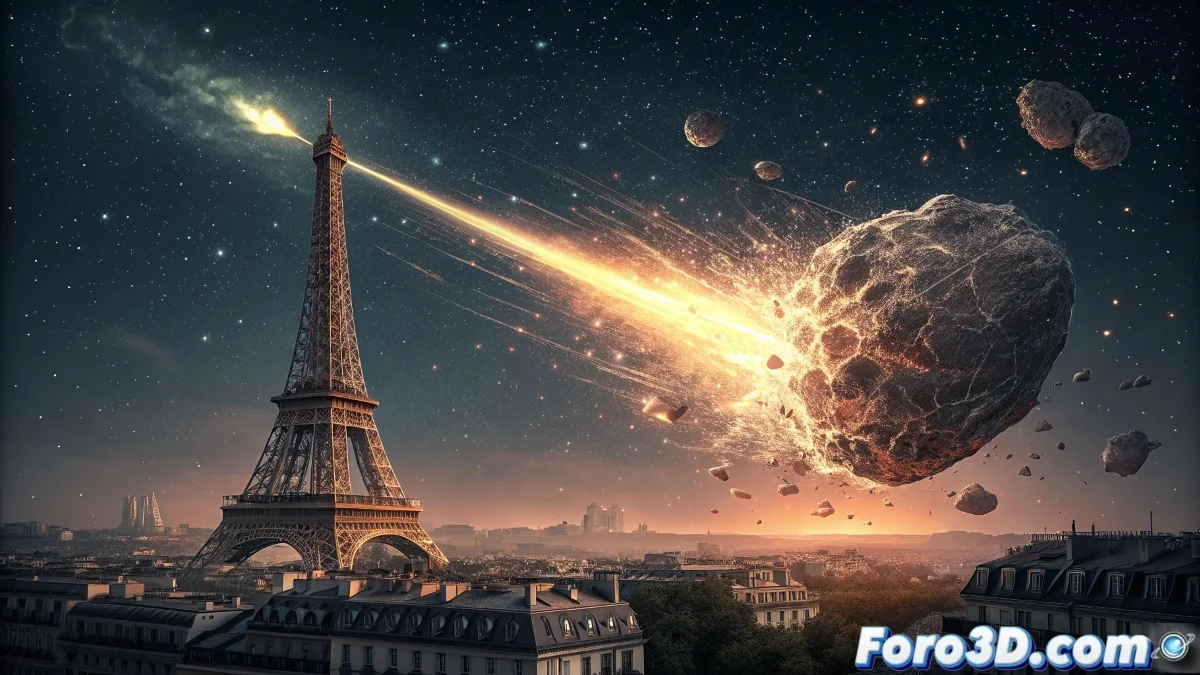
Project Setup and Basic Modeling
Starting a new project in 3ds Max with the scale set to meters is the first step to ensure consistency in simulations. Organization into layers—Sky, Asteroid, Lighting, etc.—facilitates the management of different scene elements. The asteroid is modeled starting with a sphere to which noise and displacement modifiers are applied to achieve a rocky and irregular appearance. The environment is built using planes for the terrain and a dome for the sky, to which a starry HDRI texture is applied to create the night atmosphere 🌌.
Animation and Key Visual Effects
The asteroid's animation follows a curved trajectory that simulates its atmospheric entry, using path constraints for natural movement. The explosion is created using particle systems that generate incandescent fragments and smoke, complemented with glow and lens flare effects for the main flash. Lighting is set up with an intense but short-duration omnidirectional light to simulate the explosion's flash, complemented with dim ambient lights to maintain the nighttime atmosphere. Essential technical elements:
- Particle Flow particle system for fragments and luminous trail.
- Noise and displacement modifiers to texture the asteroid.
- Lights with realistic decay and volumetric effects.
- Cameras with depth of field and motion blur for greater drama.
Materials, Rendering, and Post-Production
The assigned materials must reflect the real properties of the elements: the asteroid receives rocky textures with gray tones, while the particles carry self-illuminated materials with white-to-orange gradients. Rendering is done with engines like Arnold or V-Ray, using high sampling to capture particle details and dynamic lighting. In post-production, contrast and color levels are adjusted, subtle lens flare effects are added, and a dark vignette is applied to direct attention to the explosion point. The final result should convey both the beauty and destructive power of the event 🌅.
The Irony of Celestial Spectacles
While astronomers celebrated the rare study opportunity, ordinary French people enjoyed the best free light show since electricity was invented... though some probably thought it was the end of the world 😅.